Class 9th NCERT Math Solutions- Chapter 1 Orienting Yourself: The Use of Coordinates
Chapter Summary
Coordinate System: A structured grid framework used to define the exact physical location of points or objects using numbers.
Cartesian Plane (xy-plane): The two-dimensional surface divided by two intersecting perpendicular axes.
x-axis: The horizontal reference line on the coordinate plane.
y-axis: The vertical reference line on the coordinate plane.
Origin: The intersection point of the x-axis and y-axis, always denoted by the coordinates (0, 0).
Quadrants: The four distinct regions of the coordinate plane created by the intersection of the axes.
x-coordinate: The primary numerical value of a point, indicating its distance from the y-axis measured along the x-axis.
y-coordinate: The secondary numerical value of a point, indicating its distance from the x-axis measured along the y-axis.
Baudhāyana-Pythagoras Theorem: The fundamental geometric theorem utilized to calculate the exact distance between two points across the Cartesian plane.
Exercise 1.1 (Solutions)
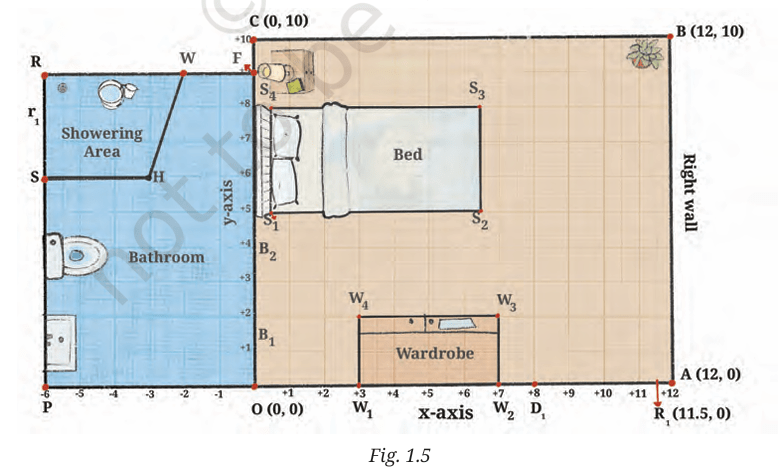
Q.1 Fig. 1.3 shows Reiaan’s room with points OABC marking its corners. The x- and y-axes are marked in the figure. Point O is the origin. Referring to Fig. 1.3, answer the following questions:
(i) If D1R1 represents the door to Reiaan’s room, how far is the door from the left wall (the y-axis) of the room? How far is the door from the x-axis?
(ii) What are the coordinates of D1?
(iii) If R1 is the point (11.5, 0), how wide is the door? Do you think this is a comfortable width for the room door? If a person in a wheelchair wants to enter the room, will he/she be able to do so easily?
(iv) If B1 (0, 1.5) and B2 (0, 4) represent the ends of the bathroom door, is the bathroom door narrower or wider than the room door?
Class 9th NCERT Math Solutions
Solution: (i) By observing the coordinate grid (Fig 1.3), the door starts at point D₁ on the x-axis. The x-coordinate of D₁ is 8. Therefore, the door is 8 units (or 8 ft) away from the left wall (y-axis). Since the door lies precisely on the x-axis, its distance from the x-axis is 0 units.
(ii) Point D₁ lies on the x-axis at a distance of 8 units from the origin. Thus, its coordinates are (8, 0).
(iii) Width Calculation: The width is the distance between R₁ and D₁.
Width = 11.5 – 8 = 3.5 ft.
Comfort & Accessibility: Yes, this is a very comfortable width. Standard room doors are usually around 3 ft wide. A standard wheelchair requires a minimum clear width of 32 inches (approx. 2.67 ft). At 3.5 ft, a person in a wheelchair will be able to enter easily.
(iv) Bathroom door width = y-coordinate of B₂ – y-coordinate of B₁ = 4 – 1.5 = 2.5 ft. Since 2.5 ft is less than 3.5 ft, the bathroom door is narrower than the room door.
Exercise 1.2 (Solutions)
On a graph sheet, mark the x-axis and y-axis and the origin O. Mark points from (– 7, 0) to (13, 0) on the x-axis and from (0, – 15) to (0, 12) on the y-axis. (Use the scale 1 cm = 1 unit.) Using Fig. 1.5, answer the given questions.
Q1. Place Reiaan’s rectangular study table with three of its feet at the points (8, 9), (11, 9) and (11, 7).
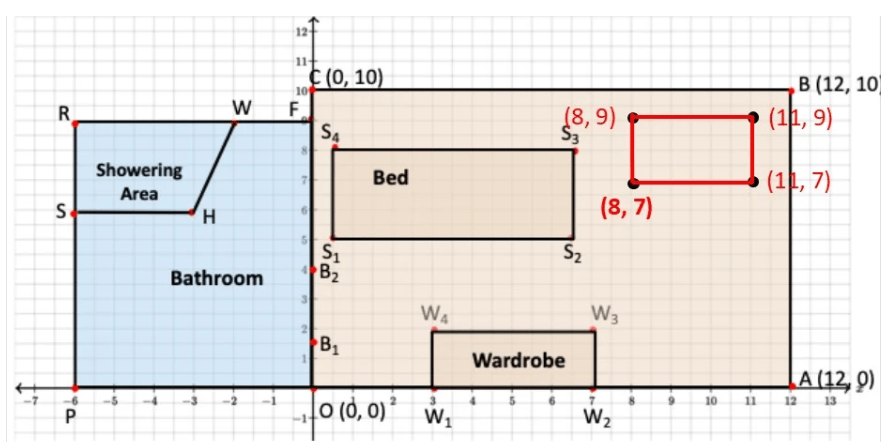
(i) Where will the fourth foot of the table be?
Solution : To form a rectangle, the opposite sides must be equal and parallel to the axes. The fourth corner aligns with the x-coordinate of the first point and the y-coordinate of the third point. Therefore, the fourth foot is at (8, 7).
(ii) Is this a good spot for the table?
Solution : Looking at the map (Fig 1.5), the bed occupies the space roughly from y = 5 to y = 8. Placing the table from y = 7 to y = 9 means it will directly overlap or block the bed.
Therefore, no, this is not a good spot.
(iii) What is the width of the table? The length? Can you make out the height of the table?
Solution : Width of the table is distance along x axis.
So it will be distance between x-coordinates of(8,9) and (11,9)
We subtract bigger coordinate from smaller
Width of table = 11 – 8 = 3 ft
Length of the table is distance along y axis.
So it will be distance between y-coordinates of(8,9) and (8,7)
Length = 9 – 7 = 2 ft.
No, the height cannot be determined because a 2D Cartesian plane only provides length and width (top-down view).
Q.2 If the bathroom door has a hinge at B₁ and opens into the bedroom, will it hit the wardrobe? Are there any changes you would suggest if the door is made wider?
Solution: The hinge is at B₁(0, 1.5). The door is 2.5 ft wide (from 1.5 to 4). When it swings open, it requires a clearance radius of 2.5 ft. The wardrobe starts at x = 3 (Point W₁). Since 2.5 ft < 3 ft, the door will not hit the wardrobe. However, if the door is made wider (e.g., 3.5 ft), it would exceed the 3 ft clearance and hit the wardrobe. The hinge would need to be moved, or the wardrobe repositioned.
Q.3 Look at Reiaan’s bathroom.
(i) What are the coordinates of the four corners O, F, R, and P of the bathroom?
Solution : Origin O is (0, 0).
F is on the y-axis at (0, 9).
R aligns with F and the left wall, giving (-6, 9).
P is on the x-axis at (-6, 0).
(ii) What is the shape of the showering area SHWR in Reiaan’s bathroom? Write the coordinates of the four corners.
Solution : The shape is a Quadrilateral with RW parallel to SH, and we know that quadrilateral with one pair of opposite sides parallel is a trapezium. Thus SHWR trapezium.The coordinates are: S(-6, 6), H(-3 9), W(-2, 9), and R(-6, 9).
(iii) Mark off a 3 ft × 2 ft space for the washbasin and a 2 ft × 3 ft space for the toilet. Write the coordinates of the corners of these spaces.
Solution : Washbasin (3 × 2):
Placing it in the bottom left corner:
Corners at (-6, 0), (-4, 0), (-4, 3), and (-6, 3).
Toilet (2 × 3):
Placing it against the right wall below the door:
Corners at (-6, 3), (-3, 3), (-3, 5), and (-6, 5).
Q.4 Other rooms in the house:
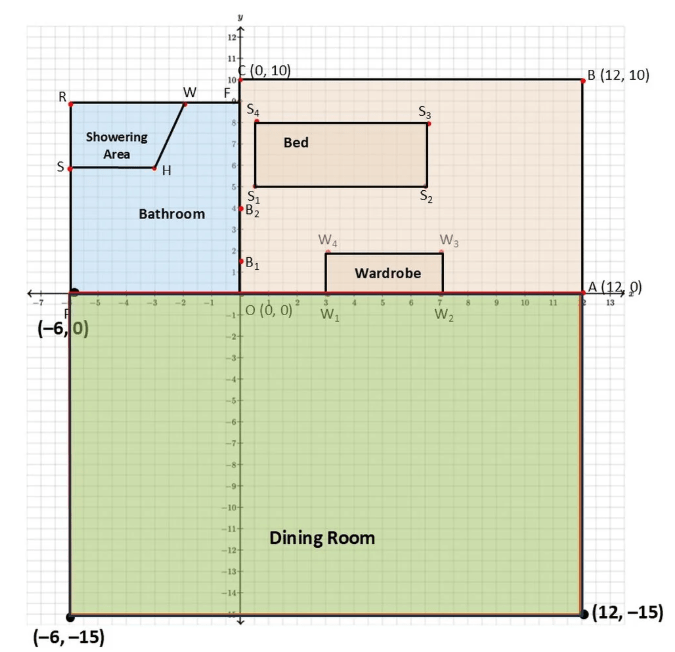
(i) Reiaan’s room door leads from the dining room which has the length 18 ft and width 15 ft. The length of the dining room extends from point P to point A. Sketch the dining room and mark the coordinates of its corners.
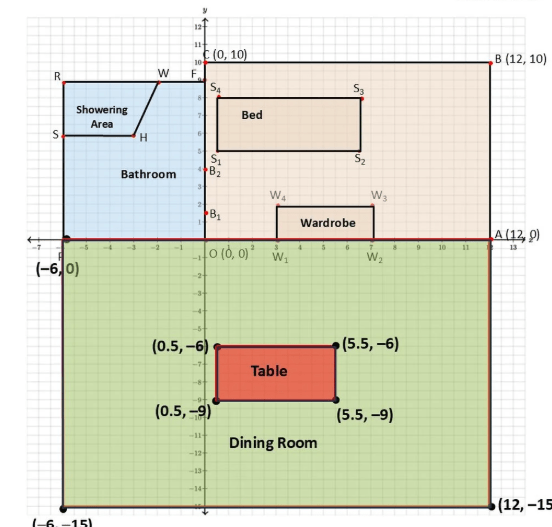
Solution : The distance from P(-6, 0) to A(12, 0) is precisely 12 – (-6) = 18 ft, matching the length. Since it extends outward from the existing room door, the y-coordinates will go into the negative region (Quadrant III and IV). The corners are: P(-6, 0), A(12, 0), (12, -15), and (-6, -15).
(ii) Place a rectangular 5 ft × 3 ft dining table precisely in the centre of the dining room. Write down the coordinates of the feet of the table.
Solution: Let’s find the center of the dining room by using midpoint formula
center is at x = (-6 + 12) / 2 = 3
y = (0 – 15) / 2 = -7.5
thus Center of the room is (3, -7.5)
Now center the 5 x 3 table over this point.
The length (5ft) spans along with x-axis:
so ends would be 3 + 2.5 = 5.5 3 – 2.5 = 0.5
The width (3ft) spans along with y-axis:
-7.5 + 1.5 = -6 -7.5 – 1.5 = -9
So the coordinates of the table’s feet are : (5.5, -6) (5.5, -9) (0.5, -9) and (0.5, -6)