Here are the detailed Words Class 9 English NCERT Solution
Reflect and Respond
I. Why are words important? Can we communicate without words? How? Share your answers with your classmates and teacher.
Answer: Words are important because they are the primary medium we use to express our thoughts, emotions, ideas, and needs to others. They form the foundation of human language and connection. However, we can also communicate without words through non-verbal communication. This includes body language, facial expressions, hand gestures, eye contact, and even silence. For example, a smile can express happiness or approval without a single word being spoken.
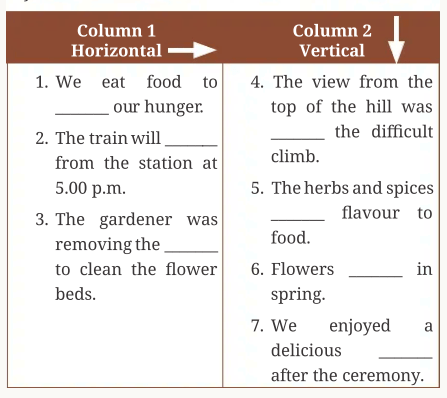
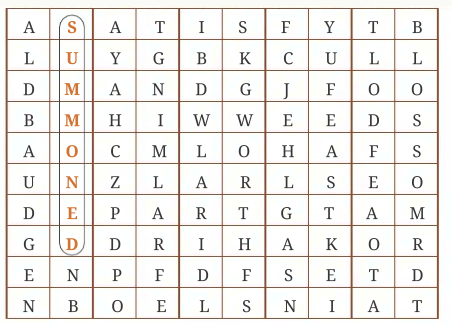
II. Use the given sentences as clues to find words from the grid and fill the blanks.
Answer:
We eat food to satisfy our hunger.
The train will depart from the station at 5.00 p.m.
The gardener was removing the weeds to clean the flower beds.
The view from the top of the hill was worth the difficult climb.
The herbs and spices impart flavour to food.
Flowers blossom in spring.
We enjoyed a delicious feast after the ceremony.
(Note: These words—satisfy, depart, weeds, worth, impart, blossom, and feast—can all be found in the provided word grid.)
Check Your Understanding
I. Fill in the blanks with one word from the poem. Answer: In this poem, the poet reflects that words fail to truly satisfy what the heart wants to convey. Words are compared to summer birds who 1. depart leaving nothing behind. The heart, is equated to a 2. pilgrim who finds that words are as worthless as 3. weeds when needed. He feels that a few sincere words can bring more 4. joy than many meaningless ones. He adds that a voice that brings happiness to a 5. lonely place does not say much, but the few words it does, are very precious. Moreover, if words could satisfy us, the 6. world would celebrate but words often fail to do that. The poem ends on the note that empty words may look impressive with lots of flowers, but they cannot produce anything valuable, like a 7. fruit.
II. Let us appreciate the poem.
1. Read the poem again. Find any four sets of rhyming words and also write the rhyme scheme of the poem. Answer: * Rhyme Scheme: The rhyme scheme of the poem is a b a b for each stanza.
Four sets of rhyming words: * heart / depart
care / air
earth / worth
needs / weeds
2. Identify the poetic device in each of them and explain what the poet wants to communicate through their usage. Answer:
(i) But words, like summer birds, depart… -> Simile. The poet compares words to summer birds that fly away, communicating that mere words are temporary and offer no lasting support.
(ii) heart, a pilgrim upon earth… -> Metaphor. The heart is compared to a wanderer or seeker, showing that human emotions are on a journey looking for genuine connection and meaning.
(iii) words are of as little worth / As just so many weeds -> Simile. Empty words are compared to useless weeds, meaning that when we truly need comfort, superficial words hold no value.
(iv) If words could satisfy the chest… Oft satisfy the least! -> Synecdoche / Metaphor. “Chest” is used to represent the heart or deep human emotions. It communicates the inability of words to fulfill our deepest emotional needs.
(v) The world might hold a feast… -> Hyperbole. It exaggerates the idea that if words were truly fulfilling, the entire world would be in a constant state of celebration.
(vi) Like plants that make a gaudy show / All blossom to the root -> Simile. Superficial words are compared to flashy but useless plants, showing that people often use impressive vocabulary that lacks true substance.
(vii) But whose poor nature cannot grow / One particle of fruit! -> Metaphor. “Fruit” represents the meaningful outcome or real action. The poet communicates that beautiful but empty words do not produce any real, helpful results.
3. Which words are repeated in the poem? Why does the poet use repetition?
Answer: The words “words” and “heart” are frequently repeated throughout the poem. The poet uses this repetition to continuously contrast the two central themes: the superficial, often empty nature of verbal communication (“words”) versus the deep, genuine, and profound nature of human emotions and needs (“the heart”).
4. The stanzas 4, 5, and 6 end with exclamation marks. Choose the option that displays the emotions being expressed through them.
Answer: (iii) 4. admiration, 5. frustration and 6. disillusionment (Explanation: Stanza 4 ends with admiration for few but sincere words; Stanza 5 ends with frustration that words satisfy the least; Stanza 6 ends with disillusionment that showy words bear no fruit).
III. Identify examples of hyperbole from the given lines.
- If words could satisfy the chest,
- The world might hold a feast.
Work in pairs. Complete the sentences given below with hyperboles. Use the hints given in the brackets.
Answer:
I have tonnes of things to do on this weekend.
The player missed the basket by a mile.
My mother is so tired that she can sleep for a decade.
I will be back in two seconds.
Critical Reflection
I. Read the following lines and answer the questions.
1. The heart, a pilgrim upon earth… As just so many weeds.
(i) Why has the poet referred to the heart as ‘a pilgrim’?
Answer: The heart is referred to as a pilgrim because, like a traveler seeking a sacred destination, the human heart journeys through life seeking truth, genuine love, comfort, and meaningful connections.
(ii) When would a heart ‘need’ words?
Answer: A heart would ‘need’ words during times of sorrow, distress, grief, or loneliness, when it seeks comfort, reassurance, and empathy from others.
(iii) The words are like weeds because…
Answer: …they can be abundant and take up space, but they lack true substance, value, and the ability to nourish or heal the emotional pain of the listener.
(iv) Mention two emotions the heart might be experiencing when it finds words to be of ‘little worth’.
Answer: Disappointment and profound loneliness.
(v) What do these lines suggest about the nature of communication?
Answer: These lines suggest that verbal communication is often superficial. Without genuine intent and empathy, mere words fail to provide real emotional support.
2. If words could satisfy the chest… Oft satisfy the least!
(i) How can words ‘satisfy the chest’?
Answer: Words can ‘satisfy the chest’ if they bring true comfort, emotional fulfillment, and alleviate the heavy burdens or sorrows that a person carries in their heart.
(ii) How can words be ‘summoned to the test’?
Answer: Words are ‘summoned to the test’ when real-life situations demand actual proof of support, loyalty, or action, rather than just empty promises.
(iii) What does ‘the world’ holding ‘a feast’ imply?
Answer: It implies that if words were truly capable of fulfilling all our emotional needs, everyone on earth would be completely satisfied, happy, and in a constant state of celebration.
(iv) The poet mentions that words satisfy the least because…
Answer: …they are often spoken without genuine feeling, are rarely backed up by meaningful actions, and fail to provide real comfort in times of true hardship.
(v) Select the word that does not mean the same as ‘oft’.
Answer: A. always
II. Answer the following questions.
1. What is the comparison that the poet draws between words and ’empty air’?
Answer: The poet compares words to ’empty air’ to highlight that both are invisible, lack real substance, and have no permanence. Just as empty air cannot be grasped or relied upon to hold weight, superficial words disappear quickly without leaving any meaningful or lasting impact on the listener’s heart.
2. According to the poet meaningful words are more precious than a lot of them. Explain.
Answer: The poet states, “A little said, and truly said, Can deeper joy impart.” This means that a few words spoken with absolute sincerity, empathy, and truth carry far more emotional weight than a constant stream of empty chatter. Sincere words resonate with the soul and provide genuine comfort, whereas “hosts of words” only reach the mind and fail to touch the heart.
3. Do you agree that the poet presents contrasting ideas related to ‘words’ in the poem? If yes, why? If no, why not?
Answer: Yes, I agree. The poet contrasts the sheer volume of words against their actual value. He contrasts “hosts of words” that only reach the head with a “little said” that imparts deep joy to the heart. He also creates a visual contrast by comparing empty words to plants that put on a beautiful, “gaudy show” of blossoms but contrastingly fail to yield even “one particle of fruit.”
4. The theme of loneliness hovers over the poem. Support this statement with examples from the text.
Answer: The theme of loneliness is evident when the poet describes the heart as a “pilgrim upon earth” —a solitary traveler wandering and seeking connection. The theme is further reinforced in the lines referencing “The voice that wins its sunny way / A lonely home to cheer,” indicating that human beings often endure isolation and deeply crave a sincere voice to break their loneliness.
5. How does the poet convey the superficial nature of words? What ought to be done to address this?
Answer: The poet conveys the superficial nature of words by comparing them to fleeting “summer birds,” worthless “weeds,” and “plants that make a gaudy show” but bear no fruit. To address this, the poet suggests that we should speak less but with absolute sincerity. We must ensure that our words carry genuine emotion (“truly said”) so that they can effectively “touch the heart” and provide real comfort to those in need.
Vocabulary in Context
I. Match the phrases in Column 1 with their correct meanings in Column 2. Use each phrase in a sentence of your own.
Answer for Matching:
satisfy the heart -> (iv) makes one happy
depart and leave but empty air -> (vi) makes no impact
hosts of words -> (i) many words
never touch the heart -> (v) does not appeal to our emotions
wins its sunny way -> (ii) cheers up a person
plants that cannot grow fruit -> (iii) there is no outcome
Sentences:
A single act of kindness is enough to satisfy the heart.
His grand promises during the election were bound to depart and leave but empty air.
She used hosts of words to explain the situation, but no one understood her point.
The actor’s performance was technically perfect but it never touched the heart.
The child’s innocent laughter always wins its sunny way into everyone’s soul.
Endless planning without execution is like plants that cannot grow fruit.
II. Create a ‘Word Map’ for each of the words from the poem given in the box.
Word: Depart
Meaning: To leave or go away.
Synonym: Leave, exit, vanish.
Antonym: Arrive, stay, remain.
Sentence: The flight will depart from terminal two in an hour.
Word: Pilgrim
Meaning: A person who journeys to a sacred place for religious reasons, or a wanderer seeking meaning.
Synonym: Traveler, seeker, wanderer.
Antonym: Resident, settler.
Sentence: The weary pilgrim walked for days to reach the sacred mountain.
Word: Satisfy
Meaning: To fulfill a need, desire, or expectation.
Synonym: Fulfill, please, appease.
Antonym: Disappoint, frustrate, dissatisfy.
Sentence: A cold glass of water will satisfy your thirst after the long run.
Writing Task
I. Write an essay on any one quotation from speaking activity.
(Sample Essay based on Gautama Buddha’s quotation)
The Weight of Our Words
“Whatever words we utter should be chosen with care for people will hear them and be influenced by them for good or ill.” These profound words spoken by Gautama Buddha resonate deeply in today’s fast-paced world. I selected this quotation because it highlights the immense, invisible power that our everyday language holds over others. The purpose of this essay is to explore how mindful communication can shape our relationships and society, and why we must take responsibility for what we say.
Words are not just empty sounds; they are tools that can either build bridges or burn them down. For instance, a few words of encouragement spoken to a friend who is failing can ignite hope and give them the strength to try again. Conversely, harsh or careless criticism can deeply damage someone’s self-esteem, leaving emotional scars that take years to heal. Because human beings are inherently social, we are heavily influenced by the feedback and language of those around us.
In addition to personal relationships, the collective words we use shape our societal environment. When leaders or individuals use inclusive, positive language, it fosters unity and peace. However, when words are used carelessly to spread anger or misinformation, it can lead to widespread negativity. Some might argue that people should not be overly sensitive and should just ignore harsh words. While building resilience is important, this counterargument is flawed because it removes the responsibility from the speaker. It is entirely unfair to ask the listener to absorb cruelty when the speaker can simply choose to be kind and thoughtful in the first place.
Finally, Gautama Buddha’s wisdom serves as a timeless reminder that speaking is a powerful action. Words carry energy that influences the listener “for good or ill.” Therefore, we must cultivate the habit of pausing and weighing our words before we let them out into the world. By choosing our words with care, we contribute to a more compassionate, understanding, and supportive world.
Read More: Carrier of Words (NCERT SOLUTION)