Here is the complete NCERT Class 9 Kaveri English Chapter 1 Solution
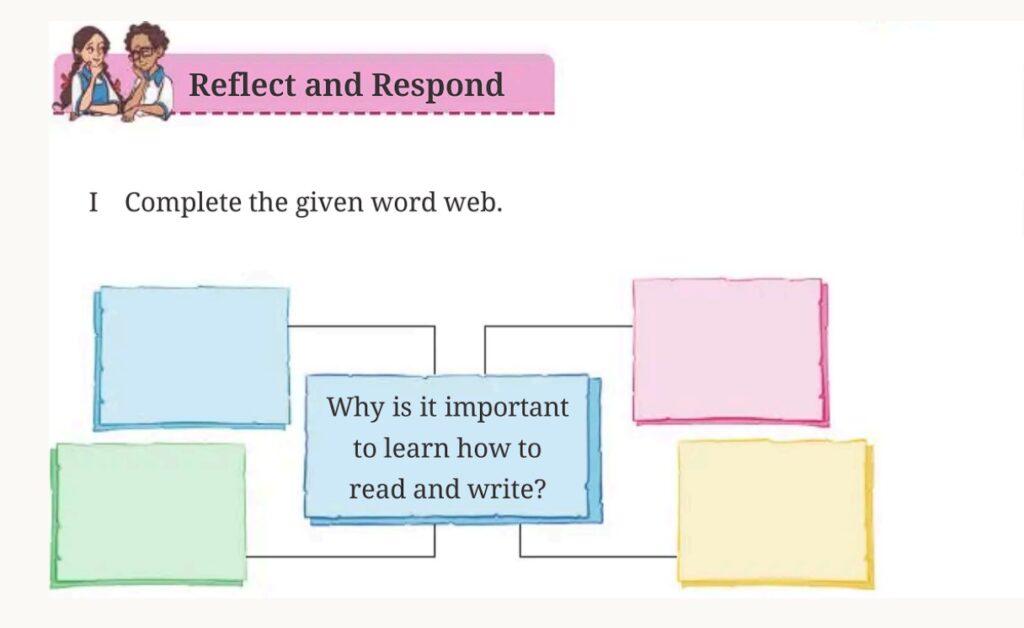
Reflect and Respond (Page 1)
I. Complete the given word web. (Why is it important to learn how to read and write?)
Answer (Suggested points for students):
- To become independent and self-reliant.
- To gain knowledge and stay informed about the world.
- To communicate effectively.
- To perform daily tasks easily, such as reading signs, newspapers, or banking documents.
II. Read the questions given below and share your answers with your classmates and teacher. (Note to educators: These are subjective, personal response questions for classroom discussion. Below are sample structures students might use).
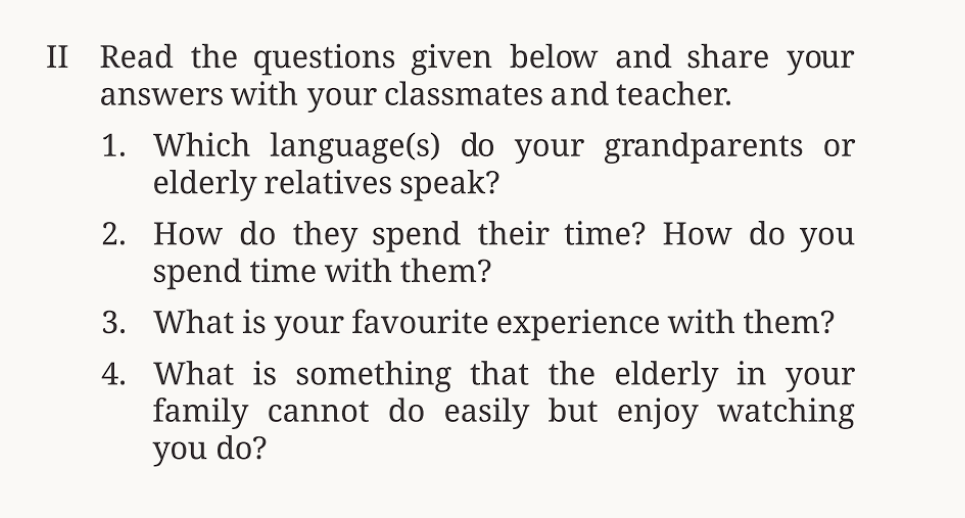
Which language(s) do your grandparents or elderly relatives speak?
Sample Answer: My grandparents speak Hindi and our regional language, Marathi.
How do they spend their time? How do you spend time with them?
Sample Answer: They spend their time reading the newspaper, doing gardening, and visiting the temple. I spend time with them by listening to their stories and helping them use the smartphone.
What is your favourite experience with them?
Sample Answer: My favourite experience is listening to the stories of their childhood and celebrating festivals together.
What is something that the elderly in your family cannot do easily but enjoy watching you do?
Sample Answer: They cannot easily navigate complex apps on the phone or play fast-paced video games, but they enjoy watching me play them and explain the graphics.
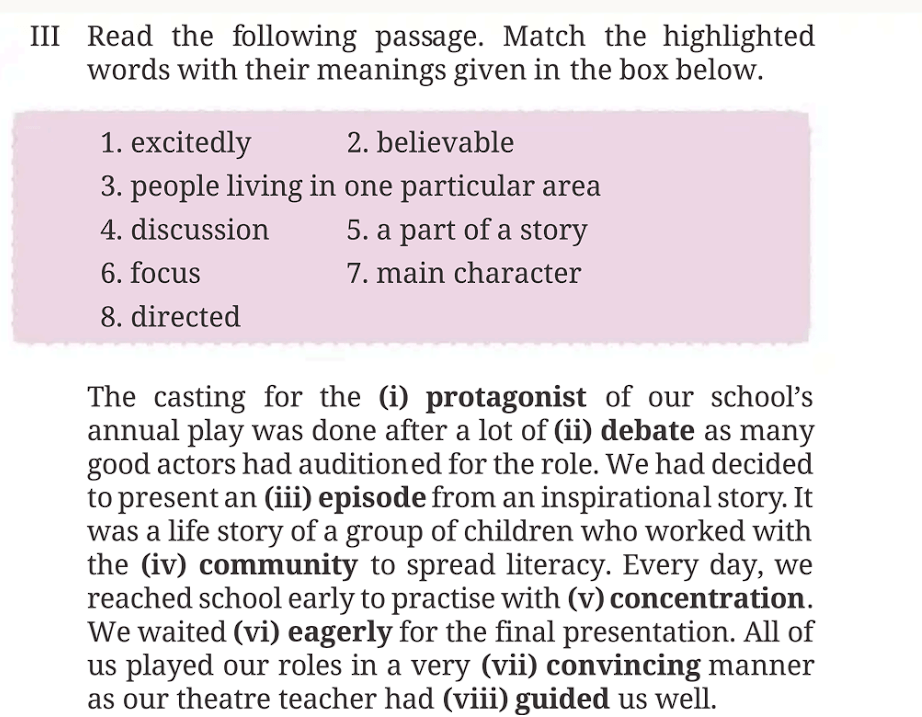
(i) protagonist: 7. main character
(ii) debate: 4. discussion
(iii) episode: 5. a part of a story
(iv) community: 3. people living in one particular area
(v) concentration: 6. focus
(vi) eagerly: 1. excitedly
(vii) convincing: 2. believable
(viii) guided: 8. directed
Check Your Understanding – Part I
I. Complete the cause and effect table given below based on Part I of the story.
| Cause | Effect |
| 1. The morning papers arrived late in the day and weekly magazines would come one day late. | (i) All of them would wait eagerly for the bus to arrive with the papers and magazines. |
| 2. The grandmother, Krishtakka, never went to school. | (ii) She could not read the weekly magazine independently. |
| 3. She identified herself with the novel’s protagonist. | (iii) She was deeply interested in the story and discussed it with her friends. |
| 4. The narrator went to a wedding for a week. | (iv) The grandmother was left helpless, unable to read the next episode, and ended up in tears. |
| 5. In those days, people never considered education essential for girls. | (v) The grandmother never went to school. |
| 6. The grandmother regretted not going to school. | (vi) She made sure that her children and grandchildren studied well. |
II. Do you think the narrator expected to see her grandmother in tears when she returned to the village? If yes, why? If no, why not?
Answer: No, the narrator did not expect to see her grandmother in tears. The narrator notes that she was surprised because she had never seen her grandmother cry, even in the most difficult situations.
III. How might the narrator help her grandmother to fulfil her desire to learn to read and write?
Answer: The narrator can help by becoming her grandmother’s teacher, dedicating time each day to teach her the Kannada alphabet, giving her homework, and supporting her until she is able to read a novel independently.
Check Your Understanding – Part II
I. State whether the following sentences are true or false.
- The grandmother wanted to learn the Kannada alphabet to gain independence. (True)
- The grandmother asked someone in the village to read Kashi Yatre to her while the narrator was away. (False – she was too embarrassed to ask)
- The narrator was the grandmother’s first teacher and taught her how to read Kannada. (True)
- The grandmother believed that there was no age limit for learning. (True)
- The grandmother touched the narrator’s feet as a mark of respect for her as a teacher. (True)
- The narrator was disappointed with the progress her grandmother made in learning to read. (False – she found her to be a wonderful, hardworking student)
Critical Reflection
I. Read the extracts given below and answer the questions that follow.
Extract 1 (i) The phrase ‘never seen her cry in the most difficult situations’ tells us that the grandmother was Answer: A. strong-willed
(ii) Grandmother did not reply when the narrator asked if she was alright because she might have been too _______ to respond. Answer: emotional
(iii) Identify the clue from the extract that indicates a rural setting with traditional customs. Answer: Sleeping in the “open terrace of our house” and the use of the regional term “Avva”.
(iv) Which lines of the extract establish a tender atmosphere? Answer: “Her affectionate hands touched my forehead.”
(v) Which of the following aspect is NOT emphasised in the given extract? Answer: C. the grandmother’s regret over her lack of education (This is revealed later in the story; this specific extract focuses on her emotional state and the narrator’s concern).
Extract 2 (i) What does the grandmother’s statement, “I want to be independent,” reveal about her character? Answer: B. She desires self-sufficiency.
(ii) The grandmother’s determination shows that learning has no _______. Answer: age limit
(iii) The narrator laughs at her grandmother’s decision to learn the alphabet at the age of sixty-two because… Answer: …she childishly assumed that physical traits of old age (grey hair, wrinkled hands, wearing spectacles) and busy kitchen routines made learning impossible.
(iv) List any two qualities displayed by the grandmother. Answer: Determined and hardworking.
(v) How can we say that the narrator is making assumptions about her grandmother? Answer: The narrator assumes that old age and domestic responsibilities act as strict barriers to learning, completely underestimating her grandmother’s willpower and cognitive abilities.
II. Answer the following questions.
1. Why do you think the grandmother felt embarrassed to ask someone else to read to her while the narrator was away? Answer: She felt embarrassed because she was an older, well-off woman in the village, and revealing that she was illiterate made her feel dependent, vulnerable, and helpless in front of others.
2. Why does the narrator initially laugh at her grandmother’s determination to learn at the age of sixty-two? Answer: Being a twelve-year-old, the narrator viewed age rigidly. She associated learning exclusively with childhood and saw her grandmother’s grey hair, wrinkles, and busy kitchen life as reasons why returning to “schooling” was absurd.
3. What significance does the story of Kashi Yatre have in both the grandmother’s life and the story? Answer: The grandmother strongly identifies with the novel’s protagonist, an old woman yearning to visit Kashi. Her inability to read this specific story during the narrator’s absence acts as the immediate catalyst for her deciding to learn how to read, driving the plot forward.
4. What does the grandmother’s desire to learn the Kannada alphabet reflect about her? Answer: It reflects her deep inner strength, self-respect, and resilience. It shows that she values intellectual independence over mere financial security and firmly believes that one is never too old to pursue a good cause.
5. What lessons can we infer from the grandmother’s action of touching the narrator’s feet? Answer: This action breaks traditional age hierarchies to highlight that respect should be based on knowledge and merit. It teaches us that a teacher deserves absolute respect and gratitude, irrespective of their age or gender.
6. What does the following line tell us about the broader theme of the story? ‘For a good cause if you are determined, you can overcome any obstacle.’ Answer: It establishes the central theme that age is just a number. Willpower, dedication, and clear intention are the only true prerequisites for learning and achieving independence.
7. How effectively does the story highlight the value of education in supporting personal independence? Answer: The story highlights it beautifully by showing the stark contrast in the grandmother’s emotional state. When illiterate, she feels helpless and cries despite having wealth. Once she learns to read, she proudly declares herself “independent,” proving that true self-reliance comes from education, not money.
Vocabulary and Structures in Context
I. Match the binomials in Column 1 with their meanings in Column 2.
- sink or swim -> (vii) succeed or fail without help
- on and off -> (v) sometimes, occasionally
- mix and match -> (i) put different things together to get a range of possibilities
- all or nothing -> (viii) completely or not at all
- part and parcel -> (ii) complete part of or belong to
- pick and choose -> (iii) choose only the best (things, people, etc.)
- sooner or later -> (iv) at sometime in the future
- leaps and bounds -> (vi) increase or develop very quickly
II. Make words by adding the suitable prefixes (un, in, im, mis, dis, extra).
- popular -> unpopular
- belief -> disbelief
- important -> unimportant
- respect -> disrespect
- correct -> incorrect
- continue -> discontinue
- understand -> misunderstand
- ordinary -> extraordinary
- interesting -> uninteresting
- possible -> impossible
IV. Match the idioms related to ‘learning’ given in Column 1 with their meanings in Column 2.
- to hit the books -> (iii) to study seriously
- to draw a blank -> (v) to be unable to remember
- to learn the ropes -> (vi) to understand how to do an activity
- to rack one’s brain -> (ii) to think very hard
- to learn by heart -> (i) to memorise something
- burn the midnight oil -> (iv) to study or work late into the night
V. Verbs and Tenses (i) Fill in the blanks with simple past and past perfect tense form of the verbs given in brackets. A. When the delegates arrived (arrive) at the conference, the keynote speaker had already begun (already begin) the session. B. After the students had learned (learn) how to identify fake news online, they started (start) verifying information before sharing it. C. Before Kiran started (start) using digital payment platforms, she had ensured (ensure) her understanding of online fraud prevention. D. By the time Varun recognized (recognise) the importance of budgeting, he had exhausted (exhaust) most of his savings. E. When Raghu logged in (log in) to the cybersecurity webinar, the instructor had already discussed (already discuss) the importance of strong passwords.
(ii) Fill in the blanks with the correct form of verbs given in brackets. Last year, my parents and I A. took (take) a financial planning course. When we B. reviewed (review) our expenses, we realised we C. had spent (spend) too much on unnecessary purchases. After my parents D. discussed (discuss) ways to save, I E. opened (open) a savings account. By the time we F. set (set) our budget, the course G. had already introduced (already introduce) investment strategies. We H. hurried (hurry) to take notes, but many participants I. had completed (complete) their financial plans. Despite that, we J. enjoyed (enjoy) learning how to manage money wisely.
Writing Task: Letter to the Editor
Task: Write a letter to the Editor of a local newspaper emphasising the importance of student participation in adult literacy camps conducted by various organisations.
Sample Letter:
12, Residency Area Indore, M.P. 15 April 2026
The Editor The Daily Chronicle Indore, M.P.
Subject: Emphasising Student Participation in Adult Literacy Camps
Sir/Madam,
Through the columns of your esteemed newspaper, I would like to draw the attention of the public and educational institutions towards the pressing need for student participation in adult literacy camps.
While our country is making great strides in technology and development, a significant portion of our adult population still struggles with basic reading, writing, and digital literacy. Illiteracy severely restricts their independence, making them vulnerable to misinformation and fraud. It is imperative that we bridge this gap. Students, with their fresh knowledge, energy, and access to modern education, are in the perfect position to act as catalysts for this change.
By engaging in these adult literacy programmes, students not only impart crucial skills to the elderly but also develop a deep sense of empathy, patience, and civic responsibility. It would be highly beneficial if schools and colleges made volunteering at such camps a part of their core curriculum or community service hours. Furthermore, local authorities could organise awareness drives to encourage the youth to dedicate just a few hours a week to this noble cause.
I am hopeful that educational institutions will take necessary steps to motivate students to volunteer, ensuring a fully literate and self-reliant society. I trust this matter will be considered seriously for the benefit of all.
Yours truly,
[Your Name]
Concerned Citizen