Here are the complete, step-by-step Believe in Yourself Class 9 English NCERT Solution for the chapter “Believe in Yourself” from your Kaveri textbook.
Reflect and Respond
I. Imagine that you are the person in the image.
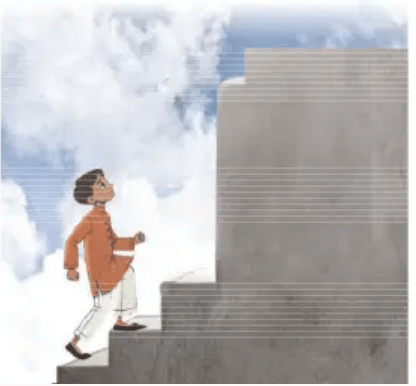
1. What emotions do you feel standing at the base of a difficult task?
Answer: I feel a mix of anxiety, hesitation, and excitement. Standing at the base of a difficult task often brings fear of the unknown, but also a sense of determination to overcome it.
2. What might make you take the first step?
Answer: A strong belief in my own abilities, the desire to achieve my future goals, and words of encouragement from mentors or loved ones would make me take the first step.
II. Think about a time when you had to face a challenge.
1. What was it, and how did you feel at the start of the journey?
Answer: (Sample Answer) A major challenge I faced was giving my first speech in front of the entire school. At the start of the journey, I felt terrified, overwhelmed, and unsure if I could do it without freezing.
2. How did you feel once you made the decision to move forward?
Answer: (Sample Answer) Once I made the decision to practice and move forward, I felt a surge of empowerment. The fear was still there, but it was replaced by a strong sense of focus and commitment.
III. What does the phrase ‘believe in yourself mean to you? Write some words or phrases you associate with believing in yourself.
Answer: To me, ‘believe in yourself’ means having confidence in your own abilities, trusting your decisions, and knowing you can overcome obstacles. Words/Phrases associated: Self-confidence, courage, inner strength, determination, optimism, lack of self-doubt, resilience.
IV Select the correct meaning of ‘status quo’ based on the given sentence. Even though some kids wanted to try new activities, most of them were happy with the status quo and didn’t want any changes.
A plan to make things more exciting.
A situation to keep things the same.
A decision where everything is completely different.
A choice to change things quickly without thinking.
Answer: 2. A situation to keep things the same.
Check your Understanding
I Based on your understanding of the poem, select the correct central idea for each stanza from the options given.
Stanza 1 (i) Facing challenges requires personal responsibility and a clear focus on one’s future. (ii) Facing challenges is a journey best taken with support and guidance from others.
Answer: (i) Facing challenges requires personal responsibility and a clear focus on one’s future.
Stanza 2 (i) Fear and uncertainty make it difficult to make choices as the future approaches. (ii) Facing the future with confidence makes choices easier and more straightforward.
Answer: (i) Fear and uncertainty make it difficult to make choices as the future approaches.
Stanza 3 (i) Personal growth involves finding balance between comfort and change. (ii) Personal growth requires leaving behind comfort and embracing change.
Answer: (ii) Personal growth requires leaving behind comfort and embracing change.
Stanza 4 (i) The first step towards change may feel easy if you place your trust in others to guide you and provide support. (ii) The first step towards change is difficult, but having self-belief and confidence helps you stay on track.
Answer: (ii) The first step towards change is difficult, but having self-belief and confidence helps you stay on track.
II. Rhyme Scheme Fill in the blank to complete the following sentence.
The poem follows a simple, yet effective ABCB rhyme scheme that flows steadily through each stanza. (Explanation: see/be, fear/near, quo/grow, back/track).
III. Tone State whether the following statements are true or false.
The overall tone of the poem is motivational and encouraging.
Answer: True
The tone shifts from thoughtful in the beginning to one of determination by the end of the poem.
Answer: True
IV. Speaker Fill in the blanks with the correct options from those given in the brackets. The speaker in this poem is not distant; rather, he/ she comes across as a guide (stranger/guide) who understands the struggle and is encouraging the reader to take control of (interest in/control of) his/her own future. The use of direct address ‘You’ creates a close connection, as though the speaker is talking directly to the reader (talking directly to the reader/addressing the reader from a distance).
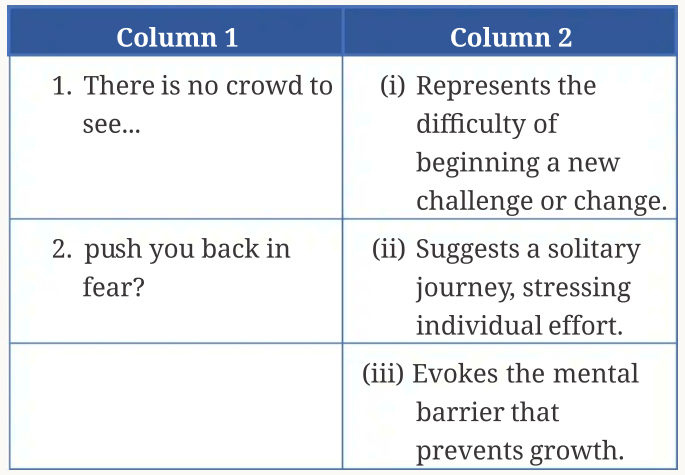
V Imagery Match the phrases from the poem in Column 1 with the imagery they represent in Column 2. An extra representation is given.
Answer:
1. There is no crowd to see… -> (ii) Suggests a solitary journey, stressing individual effort.
push you back in fear? -> (iii) Evokes the mental barrier that prevents growth.
VI. Symbolism Select the words/phrases from the box below to complete the given sentences. (unknown, self-improvement, courage, leap of faith, stagnation)
Comfort and the status quo represent stagnation and fear of change, symbolising the comfort zone that holds one back.
The future symbolises the unknown, the potential for change and success that lies ahead but requires courage to step into.
The first step symbolises the initial leap of faith required to begin the journey of self-improvement.
VII. Metaphor The poet uses a metaphor in the line, ‘The first step is the hardest’. Explain why this is metaphorical.
Answer: This line is metaphorical because “the first step” does not refer to literal walking. Instead, it represents the initial decision or action one takes to start something new or face a challenge, which is usually the most mentally and emotionally difficult part of the process.
VIII. The poem uses antithesis in a couple of lines. Identify the lines from the poem that show antithesis and explain why it is so.
Answer: The lines showing antithesis are: “Will it pull you forward / Or push you back in fear?”. It is antithesis because it uses a parallel structure to contrast two direct opposites—”pull you forward” and “push you back”—to emphasize the conflict between progress and fear.
Critical Reflection
I. Read the extract given below and answer the questions that follow.
1. Step up to the challenge / There is no crowd to see, / It’s just you and the future / And where you want to be.
(i) What does the line, ‘There is no crowd to see’ suggest about facing challenges?
Answer: It suggests that facing personal challenges is often a solitary, inner journey. You must rely on your own self-belief rather than seeking validation, applause, or help from others.
(ii) Complete the following suitably.
The line ‘It’s just you and the future’ suggests that the responsibility for shaping your destiny and achieving your goals lies entirely in your own hands.
(iii) Fill in the blank with the appropriate word/phrase from the extract.
Latha will step up to her efforts to improve her vocal performance by practicing harder each day.
(iv) Select the most suitable title for the extract. A. The Struggles of Change B. Facing the Future Alone C. A Journey of Growth D. The Power of Fear
Answer: C. A Journey of Growth
(v) Complete the analogy by using a word from the extract. achieve: goal:: face: challenge
II. Answer the following questions.
1. What is the significance of the metaphor, ‘The first step is the hardest’ in the context of personal growth?
Answer: In personal growth, breaking old habits, leaving comfort zones, and facing the unknown causes immense psychological resistance. The metaphor signifies that gathering the courage to begin is often much harder than the actual work that follows.
2. What message does the antithesis in the poem convey about the nature of personal development?
Answer: The antithesis (“pull you forward / push you back”) conveys that personal development is a constant push-and-pull battle. Every choice we make either propels us toward growth and success or holds us back in a state of fear and stagnation.
3. Do you think the poet’s message is realistic in the context of real-world struggles? (Clue: Evaluate whether simply ‘believing in yourself’ is enough to overcome obstacles or other factors are also necessary.)
Answer: While the poet’s message provides crucial motivation, it is only partially realistic. ‘Believing in yourself’ is the necessary foundation to start, but in the real world, overcoming obstacles also requires hard work, practical planning, resilience, and often a supportive community or resources.
4. Consider a situation where you or someone you know had to take a difficult first step towards a goal. How does the poem’s message about the importance of self-belief apply to this situation?
Answer: (Sample Answer) When my friend wanted to enter a district-level science fair, he almost backed out because he thought his model wasn’t good enough. The poem’s message directly applies here: his fear of failure almost “pushed him back.” However, once he chose to believe in his hard work and took the “first step” to submit his entry, he ended up winning a prize, proving that self-belief puts your “future on track.”
Vocabulary in Context
I Now, fill in the blanks in the given sentences with the Latin expressions used in English from the table. (Options: et cetera (etc.), exempli gratia (e.g.), ad hoc, in media res, per se, quid pro quo)
(i) I enjoy reading fantasy books, e.g., Harry Potter and Magical Paint Brush. (ii) After helping Tanya with the homework, Ritu asked for a quid pro quo to borrow her notes next time. (iii) I love all kinds of outdoor activities, such as trekking, hiking, biking, etc. (iv) The park is not very special per se; it becomes more fun when you visit with friends. (v) We created an ad hoc team to organise the school festival. (vi) The movie started in media res with the hero already fighting the villain in a huge battle.
II 1. Read the following rhetorical questions and state what they intend to achieve. (i) Isn’t it obvious that we must act now? Don’t we all have a responsibility to make a change?
Answer: These questions intend to create a sense of urgency, inspire collective responsibility, and persuade the listener that immediate action is the only logical choice.
(ii) Will we let fear control us, or will we rise above it?
Answer: This intends to empower the listener, challenging them to find their courage and actively reject being controlled by fear.
2. Match the situations in Column 1 to the rhetorical questions in Column 2.
Answer:
- (i) Deciding whether to stand up for what is right -> F. How can we stay silent when we know what is right?
- (ii) Owning up to a mistake made in a group project -> C. If I don’t take responsibility now, when will I?
- (iii) Deciding whether to try something challenging, like public speaking -> A. How can we ever grow if we never try anything new?
- (iv) Choosing between two career paths -> D. Can I really move forward without knowing which path to take?
- (v) Deciding whether to apologise for a mistake -> B. Isn’t it better to admit our mistakes than to let them define us?
- (vi) Trying something new and stepping out of your comfort zone -> E. What’s the point of playing it safe if it means staying stuck?
Listen and Respond
I You will listen to a conversation between two friends. As you listen, answer the following questions in one to three exact words that you hear. (Note: As this refers to a classroom audio transcript on page 275, these are logical correct answers based on typical NCERT listening structures. Please verify with your teacher’s audio.)
How did the boy feel before the play? -> Nervous and worried
According to the girl, where does confidence come from? -> Practice and preparation
What was the girl finally sure about regarding the boy? -> He will succeed
II You will once again listen to the conversation. As you listen, select the four true statements from 1-7 given below.
Answer:
2. The girl encourages the boy to push through his doubts by trusting in his preparation.
4. The girl believes that self-doubt is a normal part of preparing for a big performance.
5. The boy feels that his preparation is not enough and doubts his abilities, even though he has practiced.
7. The girl believes that pushing through nervousness will help the boy grow and build confidence.
Speaking Activity
I Work in pairs. Read the three Sayings/Proverbs given below. For each one, think of a real-life situation where it could apply. Do the suggested role play and use the Saying/Proverb.
1. Don’t judge a book by its cover.
- Student A: “Look at the new boy sitting alone. His clothes are so messy, and he looks like he doesn’t know anything about academics. I wouldn’t want him in our study group.”
- Student B: “You shouldn’t judge a book by its cover. I spoke to him earlier; he just moved here and is actually brilliant at mathematics. We should invite him over.”
2. Actions speak louder than words.
- Student A: “I promise I will study every day for the finals. I will wake up at 5 AM, finish all the chapters, and top the class!”
- Student B: “That sounds great, but remember that actions speak louder than words. Instead of telling me your grand plans, why don’t you start by opening your book right now?”
3. When the going gets tough, the tough get going.
- Student A: “This science project is way too hard. The circuit won’t connect, and we only have two days left. I think we should just give up and accept a low grade.”
- Student B: “We can’t quit now! We’ve worked so hard. When the going gets tough, the tough get going. Let’s troubleshoot the circuit one wire at a time. We can figure this out.”
Writing Task
I Your class is conducting the morning assembly. You have been asked to deliver a speech on the topic, ‘Turning Challenges into Opportunities’. Draft this speech by following the guidelines given below.
Speech Draft:
Good morning respected Principal, teachers, and my dear friends. I am [Your Name] from Class 9. Have you ever wondered why a kite flies highest when it is flying against the wind, not with it? Today, I am here to share my thoughts on the topic, ‘Turning Challenges into Opportunities’. I will be speaking about how the obstacles we fear are actually the stepping stones to our greatest successes.
Why do you think people often feel scared or anxious when faced with change? It is human nature to prefer the comfort of the “status quo.” We fear the unknown. However, isn’t it true that smooth seas never made a skilled sailor? Every challenge we face forces us to stretch beyond our limits. Think about the recent transition to online learning we all experienced. Initially, it was a massive hurdle. Yet, that very challenge opened doors to new opportunities. We all became tech-savvy, learned independent time management, and discovered digital resources we never knew existed.
To turn a challenge into an opportunity, we must shift our perspective. Instead of asking “Why is this happening to me?”, we should ask “What can I learn from this?” Facing challenges builds determination, resilience, and problem-solving skills—qualities that are absolutely essential for success. When we believe in ourselves, we stop viewing failure as a dead-end and start seeing it as feedback.
In conclusion, life will always present us with difficult choices and steep mountains to climb. But remember, the first step is the hardest. Let us not run from challenges, but step up to them with courage. I urge you all to view your next obstacle as an opportunity in disguise. Thank you for being such a wonderful audience, and have a great day ahead!
Learning Beyond the Text
I Explore the stories of Indian leaders who faced significant challenges and turned them into opportunities for success. Now, find out about such personalities from your village, town, city, or state and present their success stories in class.
Student Activity Note: Since our current location is Madhya Pradesh, here is an excellent example of a leader from MP to present in your class:
Kailash Satyarthi (Born in Vidisha, Madhya Pradesh)
Kailash Satyarthi gave up a lucrative career as an electrical engineer to fight against the deeply rooted challenge of child labor in India. Facing immense danger, including violent physical attacks and threats to his life from powerful mafias, he never let fear push him back. He turned the immense challenge of child exploitation into an opportunity to create the Bachpan Bachao Andolan (Save the Childhood Movement). Through immense self-belief and courage, his organization has rescued tens of thousands of children from slavery and restored their right to education. For his phenomenal work, he was awarded the Nobel Peace Prize. He proves that believing in yourself and taking the hard “first step” can quite literally change the world.
Read More: Words (NCERT SOLUTION)