Check out Class 9 Kaveri Chapter 1 poem Bharat Our Land Class 9 NCERT Solution here:
Reflect and Respond
I. Recall the lines of the National Anthem and complete the table given below with the names of the states, mountain ranges, and rivers mentioned in it.
States/Provinces: Punjab, Sindhu, Gujarat, Maratha, Dravida, Utkala, Banga
Mountain Ranges: Vindhya, Himachala
Rivers: Yamuna, Ganga
II. Work in pairs. Discuss what the words ‘जय हे’ (Jaya he) in the last two lines of the National Anthem convey.
Answer: The words ‘जय हे’ (Jaya he) translate to “Victory to thee” or “Hail to thee.” They convey a deep sense of respect, celebration, and a prayer for the ultimate triumph and glory of the motherland.
III. Read the underlined words in the given lines of the poem. Choose the odd one out that does not correspond with the meaning of the underlined word.
She’s peerless, let’s praise her! (valuable, incomparable, unmatched)
Odd one out: valuable (Peerless means incomparable or unmatched).
Many a sage has sanctified this land. (blessed, purified, applauded)
Odd one out: applauded (Sanctified means blessed or purified).
And here all auspicious things are found. (fortunate, fantastic, favourable)
Odd one out: fantastic (Auspicious means fortunate or favourable).
Of hoary antiquity is Bharat, (ancient times, recent past, time immemorial)
Odd one out: recent past (Antiquity refers to ancient times or time immemorial).
Check Your Understanding
I. Fill in the blanks by choosing appropriate words from the box given below to complete the summary of the poem. (Words: warriors, peerless, Upanishads, Ganga, Buddha, Himavant, sages, praise, historical greatness, Brahma-knowledge)
The poem is a tribute to India, celebrating its natural beauty, spiritual heritage, and 1. historical greatness. The poet praises the 2. Himavant describing it as mighty and unparalleled. The 3. Ganga is depicted as generous and graceful, while the 4. Upanishads are honoured as sacred and unmatched. The poem highlights the contributions of 5. warriors and 6. sages who have enriched the land with their bravery and wisdom. It also acknowledges the presence of 7. Brahma-knowledge and the teachings of 8. Buddha highlighting India’s deep-rooted spiritual and philosophical traditions. The poet repeatedly asserts that India is 9. peerless , urging everyone to 10. praise her.
I. Complete the following features about the poem.
1. The impact on the readers (mood): Inspiring, patriotic, and prideful.
2. The poet’s attitude (tone): Revering, admiring, and passionate.
3. The rhyme scheme: The poem is written in free verse. It does not follow a strict rhyme scheme but uses the repetition of the word “ours” to create a rhythmic effect.
4. Examples of personification : “The generous Ganga” (“match her grace”) and the motherland (“she’s peerless, let’s praise her“).
III. What is the impact of the refrain, ‘she’s peerless, let’s praise her!’?
Answer: The refrain reinforces the central theme of India’s unparalleled greatness. It acts as a powerful call to action, inspiring a shared sense of duty among citizens to respect and celebrate their motherland.
IV. Complete the following sentence appropriately. India is metaphorically described as ‘this sunny golden land,’ suggesting that it is radiant, prosperous, wealthy, and full of life and positive energy.
V. The poet uses symbolism. Match the symbols in Column 1 to what they suggest in Column 2.
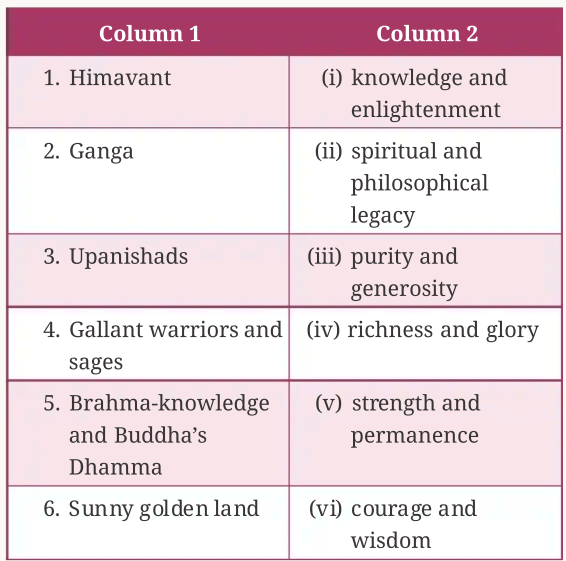
| Himavant | (v) strength and permanence |
| Ganga | (iii) purity and generosity |
| Upanishads | (ii) spiritual and philosophical legacy |
| Gallant warriors and sages | (vi) courage and wisdom |
| Brahma-knowledge and Buddha’s Dhamma | (i) knowledge and enlightenment |
| Sunny golden land | (iv) richness and glory |
VI. The poet uses imagery. Give any two examples from the poem.
Answer: 1. “The mighty Himavant” (visual imagery of a towering, grand mountain). 2. “This sunny golden land” (visual imagery of a bright, wealthy, and radiant landscape).
VII. What is the impact of the use of hyphens in the first stanza? Select the options that are true.
Answer: Options 1, 3, and 5 are true.
(1) Creates deliberate pauses to reinforce the sense of admiration and pride.
(3) Lends to the lyrical quality giving it a measured, chant-like rhythm.
(5) Presents a key element of India’s greatness before the hyphen and makes a strong assertion about its uniqueness after the hyphen.
IX. The poem is an ode. Now, identify examples from the poem that correspond to it being an ode.
Answer: An ode is a formal lyric poem that expresses deep admiration. The poem is an ode because it directly praises the motherland using elevated, expressive language (e.g., “mighty Himavant,” “generous Ganga,” “divinest music”). The passionate refrain, “she’s peerless, let’s praise her!” perfectly captures the reverence characteristic of an ode.
X. The poet uses allusion in the poem. Read the explanations and identify the matching allusions from the poem for the following.
1. An allusion to the ancient Indian scriptures that form the philosophical core and symbolize deep wisdom and enlightenment. ———–“The sacred Upanishads”
2. An allusion to the concept of spiritual knowledge associated with self-realisation and ultimate truth. ————— “Brahma-knowledge”
3. An allusion to Gautama Buddha’s teachings, which include compassion, non-violence, and enlightenment. ——————–“Buddha preached his dhamma here”
Critical Reflection
I. Read the extract given below and answer the questions that follow.
1. The word ‘mighty’ refers to the _______ of the Himavant. Answer: strength / grandeur / massive scale
Answer: strength / grandeur / massive scale
2. The question mark at the end of the fourth and sixth line of the extract is used to
Answer: (ii) emphasise a point (They are rhetorical questions).
3. The poet uses the word ‘generous’ to describe the Ganga. Why?
Answer: The river Ganga is called ‘generous’ because it selflessly provides abundant water, sustaining agriculture, life, and civilization across the vast Indian plains.
4. Why has the movement of the river been described as graceful?
Answer: The movement is graceful because the river flows smoothly, beautifully, and life-givingly across the land, symbolizing elegance and divine blessing.
5. The poet is implying that the Upanishads are _ (unmatched/abundant) in their wisdom and spiritual depth.
Answer: unmatched
Answer the following Questions:
1. How does the poem reflect a strong connection to cultural identity and heritage?
Answer: The poem roots its identity in specific, iconic physical landmarks (Himavant, Ganga) and foundational spiritual texts and teachings (Upanishads, Brahma-knowledge, Buddha’s dhamma). By claiming these as “ours,” the poet grounds the reader in a rich, shared cultural history.
2. What can you infer about the poet’s attitude towards India from the repeated phrase ‘she’s peerless, let’s praise her!’?
Answer: The poet has an attitude of supreme devotion, absolute pride, and deep reverence. He firmly believes that India is unique and unrivaled in the world.
3. What does the line ‘many a sage has sanctified this land’ suggest about India’s spiritual heritage?
Answer: It suggests that India’s holiness does not just come from its geography, but from the generations of wise saints, seers, and ascetics who have lived, meditated, and spread pure spiritual wisdom on this soil.
4. How does the poet connect warriors and music to India’s greatness?
Answer: The poet balances physical courage with cultural refinement. “Gallant warriors” highlight the nation’s bravery and strength in protecting the land, while “divinest music” highlights its artistic, aesthetic, and cultural zenith.
5. How does this poem foster a sense of national pride?
Answer: It fosters pride by vividly listing the country’s greatest natural, philosophical, and historical assets, declaring them unequaled on Earth, and directly commanding the reader to recognize and celebrate this unmatched legacy.
Vocabulary in Context
I. Complete the table by choosing words from the poem.
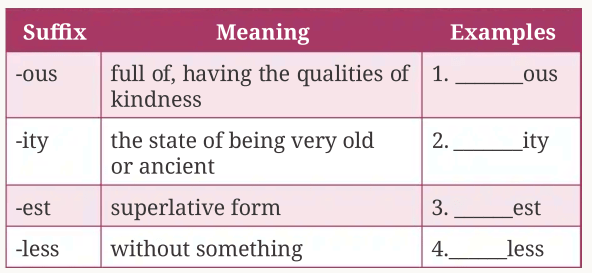
-ous (full of, having the qualities of): generous, auspicious
-ity (the state of being very old or ancient): antiquity
-est (superlative form): divinest
-less (without something): peerless
II. Complete the following table by adding a different suffix to form new words. Also, create a sentence using the created word. (Note: These are sample answers using standard vocabulary).
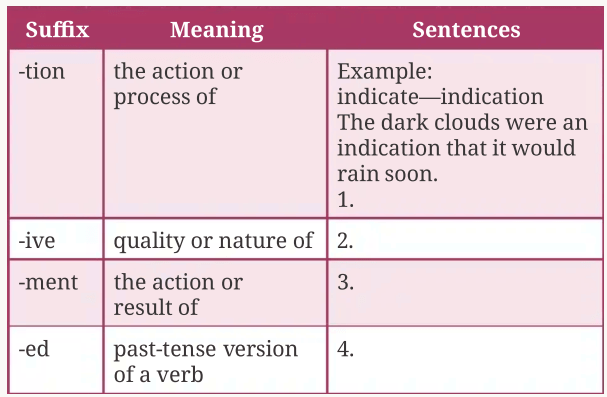
-ive (quality or nature of): * Word: Creative
Sentence: She found a highly creative solution to the complex math problem.
-ment (the action or result of): * Word: Development
Sentence: The rapid development of infrastructure has transformed the city.
-ed (past-tense version of a verb) : * Word: Preached
Sentence: The Buddha preached a message of peace and non-violence to his followers.
______________________________________________________________________________________________________________________________________________