Reflect and Respond
I. Look at the pictures given below and identify the vocations. Now, list at least five more vocations.
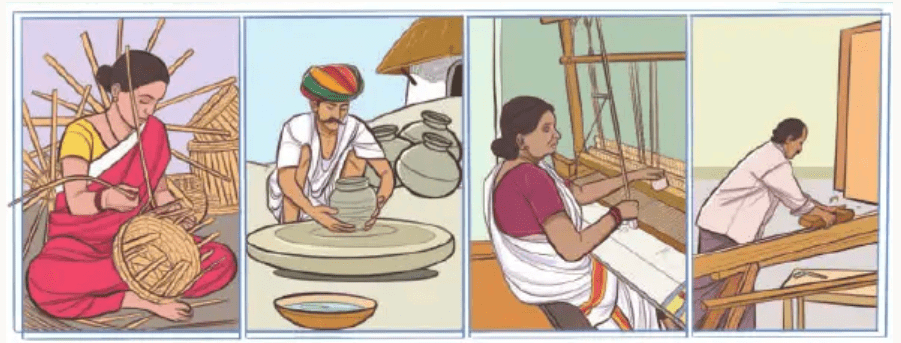
Identified Vocations in Pictures: Basket weaving, pot making (pottery), cloth weaving on a handloom, and carpentry (woodworking).
Five More Vocations: 1. Blacksmithing 2. Tailoring 3. Goldsmithing/Jewellery making 4. Cobbling (Shoemaking) 5. Sculpting
II. Work in pairs. Discuss the following questions and share your answers with your classmates and teacher.
1. What is common among these pictures?
Answer: All the pictures depict people engaged in traditional, manual, and skill-based handicrafts or trades.
2. We refer to such skill-based work as:
Answer: VOCATIONS
3. Mention a few differences between handmade and machine-made products.
Answer: * Handmade Products: These are crafted by artisans using traditional skills, meaning each piece is unique and often carries minor, charming imperfections. They take a long time to make and reflect deep cultural heritage.
Machine-made Products: These are mass-produced in factories, ensuring uniformity and perfection in every piece. They are produced much faster and are generally cheaper, but they often lack the personal touch and artistic individuality of handmade goods.
Check Your Understanding – Part I
I. Do you think pot making is easy? If yes, why? If no, why not?
Answer: No, pot making is highly demanding and physically exhausting. As described by Arenla, it requires travelling long distances to riverbanks to collect specific clay, carrying heavy loads uphill, and enduring backaches. The process includes the tedious pounding of stubborn clay, carefully shaping it, and expertly tending the fire in the kiln, where a single mistake like over-firing can ruin months of labor.
II. Would Sentila be able to fulfil her dream of becoming a pot maker? Explain. Answer: Yes, it is highly likely that Sentila will fulfill her dream. She is deeply passionate about the craft, highly persistent, and keenly observant. Even when her parents go to the fields, she actively seeks out expert potters to watch and learn from them, showing true dedication despite her mother’s initial resistance.
III. Do you think Mesoba and Arenla would support Sentila? Give a reason.
Answer: Mesoba is supportive, as he defends Sentila to the village council and proudly promises that she will soon make the “best pots in the village.” Arenla is initially unsupportive because she wants Sentila to learn weaving, which is more profitable and less physically taxing. However, as parents ultimately want the best for their children, Arenla might support her if she recognizes Sentila’s genuine talent and passion for the craft.
Check Your Understanding – Part II
I. Do you think Onula’s support helped Sentila? If yes, why? If no, why not?
Answer: Yes, Onula’s support was a major turning point for Sentila. Sentila was incredibly tense and anxious while working with her mother, causing her to fail. Onula offered a kind, encouraging, and pressure-free environment, guided her technique patiently, and restored her confidence, allowing Sentila to finally shape a perfect pot.
II. Sentila observes her mother making pots. What does this tell us about her?
Answer: It tells us that Sentila is a keen, focused observer and a fast learner. She pays great attention to the smallest details—like the rhythm of her mother’s hands, how she holds the spatula, and how she slows down to fashion the rim of the pot—showing her deep determination to master the art.
III. Arrange the following events of the story in the correct sequence. Share your answer with your classmates and teacher.
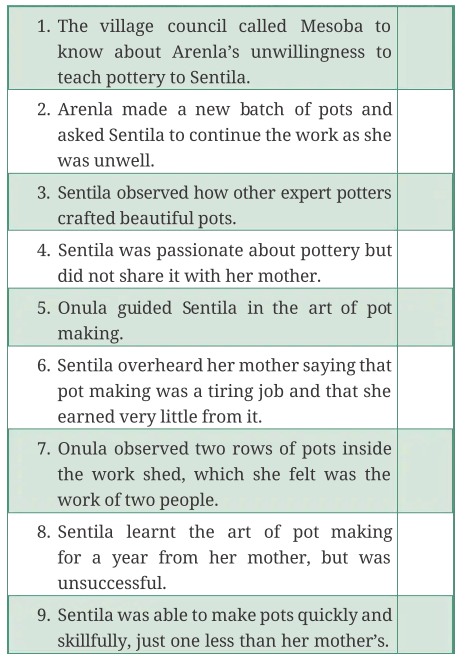
Answer: The correct chronological sequence of the story is:
- (4) Sentila was passionate about pottery but did not share it with her mother.
- (6) Sentila overheard her mother saying that pot making was a tiring job and that she earned very little from it.
- (3) Sentila observed how other expert potters crafted beautiful pots.
- (1) The village council called Mesoba to know about Arenla’s unwillingness to teach pottery to Sentila.
- (8) Sentila learnt the art of pot making for a year from her mother, but was unsuccessful.
- (5) Onula guided Sentila in the art of pot making.
- (2) Arenla made a new batch of pots and asked Sentila to continue the work as she was unwell.
- (9) Sentila was able to make pots quickly and skillfully, just one less than her mother’s.
- (7) Onula observed two rows of pots inside the work shed, which she felt was the work of two people.
(Sequence mapping: 4, 6, 3, 1, 8, 5, 2, 9, 7)
Critical Reflection
I. Read the extracts given below and answer the questions that follow.
1. Pounding the stubborn clay inside bamboo cylinders to soften it, is also tedious. So many times I’ve dropped the mould out of sheer exhaustion and have had to start all over again. It takes months to bring out a batch of pots after so much labour. And the reward? A few rupees. But if Sentila learns weaving, she can make much more money besides providing enough cloth for the family. Weaving is not messy like pot making and can be done indoors in all seasons. Also, the time spent on weaving one shawl is much less and the return is handsome.
(i) Choose the correct reason for the given assertion. (A): The effort in making pots is far greater than the returns.
Answer: A. The process of pot making is quite tiresome and long, and one hardly earns much.
(ii) Why does Arenla want Sentila to learn weaving?
Answer: Arenla wants her to learn weaving because it yields a handsome return (more money), provides clothing for the family, isn’t messy like working with clay, takes less time, and can be done comfortably indoors in all seasons.
(iii) State one advantage that weaving has over pot making, as per the extract.
Answer: Weaving is not messy and can be done indoors during all seasons.
(iv) Choose the sentence that uses the word ‘handsome’ in the same way as in the extract.
Answer: B. They will make a handsome profit selling this property. (Here, ‘handsome’ means a large or generous amount of money, just as it does in the text).
(v) ‘And the reward?’ What is the author’s purpose of using a question mark here?
Answer: The question mark emphasizes the bitter irony and disproportion between the immense, months-long physical labor required for pot making and the extremely poor financial compensation (“A few rupees”) received in return.
2. Onula saw her taking out some clay and the implements from her basket quietly. She watched Sentila’s clumsy efforts to make a pot and noticed that Sentila was too tense. As a result, the clay seemed unable or unwilling to yield the right shape. When Sentila wearily let the misshapen lump fall flat on the ground, Onula went to her and said, “Don’t worry, little one, I shall teach you how to make a perfect pot.” Sentila watched in amazement as Onula fashioned a beautiful pot and asked her to try again.
(i) Onula feels Sentila’s effort at making a pot is clumsy because…
Answer: …Sentila was too tense and anxious, preventing her from handling the clay naturally.
(ii) ‘Don’t worry, little one, I shall teach you how to make a perfect pot.’ This shows that Onula was…
Answer: C. thoughtful and generous.
(iii) Which among the following is the effect of a cause?
Answer: A. As a result, the clay seemed unable or unwilling to yield the right shape.
(iv) ‘Onula fashioned a beautiful pot.’ Here, the word ‘fashioned’ means:
Answer: created
(v) How might Sentila have felt when she saw ‘the misshapen lump fall flat on the ground’?
Answer: She must have felt incredibly frustrated, defeated, and exhausted after repeated failures.
II. Answer the following questions.
1. Describe the process of pot making followed by expert pot makers, as observed by Sentila.
Answer: The process begins by mixing clay with water and pounding it soft. The potter pushes their left hand into a lump of clay and deftly rotates it, while the right hand uses a spatula to tap and shape the exterior. After initial shaping, the pots are given a final touch up for consistency, dried in the sun, and then loaded onto a kiln upon a bed of hay and dried bamboo. Finally, they are carefully fired to perfection.
2. What warning was given to Mesoba by the village council?
Answer: The village council warned Mesoba to remind his wife, Arenla, of her duty to pass down her pottery skills. They emphasized that ancestral skills do not belong to an individual but symbolize the history and tradition of the community, and therefore experts are obliged to pass them on to the next generation.
3. How did Sentila feel when she failed at pot making even after a year of training with her mother?
Answer: Sentila felt a deep sense of shame and frustration because she could not even hold the dough properly, constantly struggling while her mother easily transformed the clay into beautiful pots right in front of her.
4. ‘Onula stood there for a long time as if trying to absorb a new phenomenon’. Explain.
Answer: Following Arenla’s tragic death, Onula looked into the work shed and found two separate, perfectly symmetrical rows of newly made pots. She stood stunned because she realized that Sentila had finally unlocked her true potential, flawlessly replicating her mother’s expert work. It was the awe-inspiring phenomenon of a “new pot maker” being born out of grief.
5. ‘The tradition and history of the people did not belong to any individual,’ what does this symbolise?
Answer: This symbolises that indigenous arts, crafts, and skills are collective cultural treasures. They hold the identity of the entire community and must be preserved and shared selflessly to keep the culture alive, rather than being treated as private property.
6. What is the significance of the concluding line of the story, ‘A new pot maker was born’?
Answer: It signifies the successful transfer of heritage and the triumph of passion. Even though Arenla tragically passed away, the tradition did not die with her because Sentila had finally mastered the craft, ensuring the ancestral legacy would continue.
7. What is the role of perseverance in pursuing one’s dreams? Elaborate with reference to Sentila. Answer: Perseverance is the key to overcoming failure and opposition. Sentila faced a lack of support from her mother, intense physical labor, and over a year of embarrassing failures at the wheel. However, she persisted by quietly observing experts, accepting guidance from Onula, and practicing relentlessly. Her determination eventually allowed her to master the craft and achieve her ultimate dream.
Vocabulary and Structures in Context
I Read the highlighted words in the following sentencesfrom the text.
1. She taught Sentila how to dig the clay with dao,load it on to her carrying basket…
2. Sentila was a quick learner and turned the clay into malleable dough. Pounding the stubborn clay inside bamboo cylinders to soften it …The highlighted words describe the tools and materials required in the process of pot making. Now, classify the words/phrases given in the box as shown in the table below. One example for each category has been done for you.
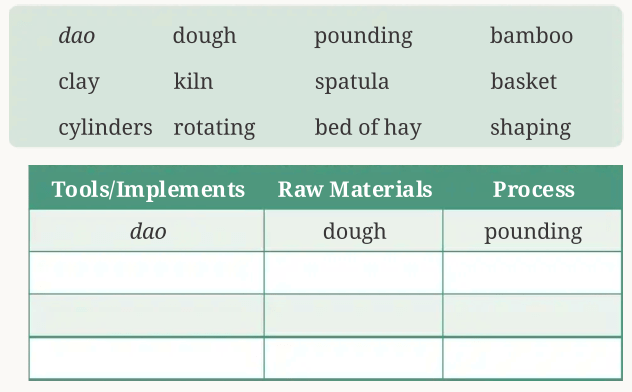
Answers:
| Tools/Implements | Raw Materials | Process |
| dao (example) | dough (example) | pounding (example) |
| spatula | clay | rotating |
| basket | bamboo | shaping |
| cylinders | bed of hay | klin |
II. Frame sentences using each word.
Bankrupt: Declared by law as unable to pay one’s debts.
- Sentence: The continuous losses forced the small business to go bankrupt.
Credit: The ability of a customer to obtain goods or services before payment, based on the trust that payment will be made in the future.
- Sentence: The potter bought her raw materials on credit from the supplier.
Currency: A system of money in general use in a particular country.
- Sentence: When travelling abroad, it is important to exchange your currency at the airport.
Debt: A sum of money that is owed or due.
- Sentence: He worked extra shifts to clear his heavy debt.
Fiscal: Relating to government revenue, especially taxes.
- Sentence: The government announced its new fiscal policies for the upcoming financial year.
Inflation: A general increase in prices and fall in the purchasing value of money.
- Sentence: High inflation has made everyday groceries much more expensive.
Investment: The action or process of investing money for profit or material result.
- Sentence: Purchasing the new automated kiln was a great investment for the pottery shop.
Interest: Money paid regularly at a particular rate for the use of money lent.
Sentence: The bank charged a high rate of interest on the business loan.
III. Subordinate clauses that act like nouns and perform the same functions as subject or object are called noun clauses.
- Complete the following sentences with suitable noun clauses.
(i) The elders emphasised that skills did not belong to any individual.
(ii) Mesoba explained why Arenla had delayed teaching Sentila.
(iii) Onula’s promise was that she would teach her how to make a perfect pot.
(iv) Sentila observed her mother carefully when she was shaping the mouth of the pot, which helped her understand the correct rhythm.
(v) The kiln, where the pots were fired, required careful attention to prevent over-or-under firing.
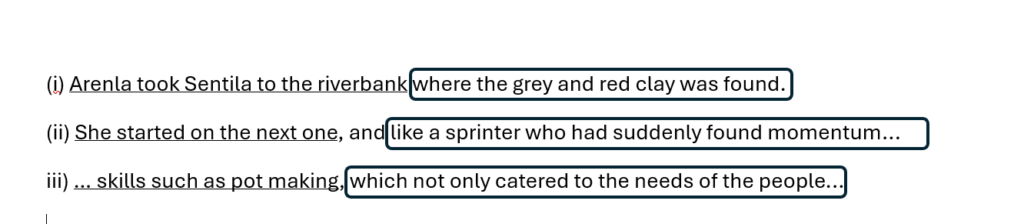
2. Read the following sentences from the text. Underline the main clause and circle the subordinate clause.
(i) Arenla took Sentila to the riverbank where the grey and red clay was found.
(ii) She started on the next one, and like a sprinterwho had suddenly found momentum…
(iii) … skills such as pot making, which not only catered to the needs of the people…
3. Complete the following sentences with suitable relative clauses.
(i) Sentila, whose passion for pottery was very strong, practised the craft diligently.
(ii) The village council, where Mesoba was summoned, sought an explanation for Arenla’s reluctance.
(iii) The potter’s hands, which moved deftly and quickly, shaped the clay into beautiful creations.
(iv) Arenla, her mother, wanted her to learn weaving, which was less messy and brought a handsome return.
(v) Mesoba went home and discussed the matter with Arenla, who listened to the council’s advice.
4. Determiners
(i) Find out some more determiners from the text.
Answer: Examples from the text include: “a” (a lump), “the” (the riverbank), “her” (her mother), “two” (two neat rows), “another” (another layer).
(ii) Fill in the blanks with suitable determiners.
A. The florist arranged five bouquets for her clients, that were displayed in an elegant floral shop.
B. The carpenter crafted several tables, and this unique centrepiece became the collection.
C. Many of the apprentices in the culinary class demonstrated their knife skills during the intense cooking session.
D. A few of these sculptures were displayed at an art exhibition, showcasing many diverse artistic skills.
Listen and Respond
(Note: As the audio transcript on Page 261 is required for exact phrasing, these are the most highly probable answers based on standard context).
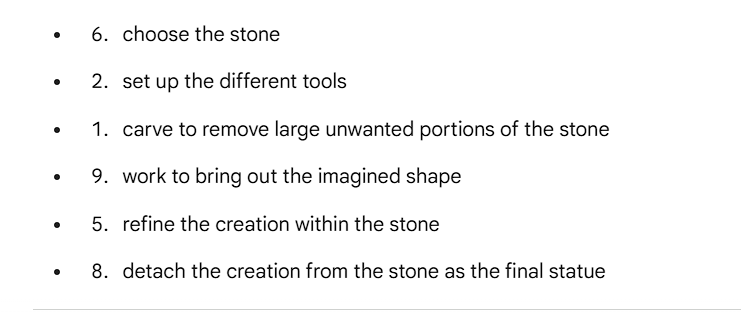
I. Complete the given paragraph: A statue is carved to create a shape that is
1. imagined/desired. Among the many things stone is used for, making stone
2. sculptures/statues is one of them. India has some of the most
3. ancient/beautiful stone sculptures, as is obvious from its many stone monuments across the country.
II. Select the six correct steps out of the nine given: Based on the general process of sculpting, the logical steps are:
Learning Beyond the Text
I. Match the pictures with the pottery it represents. (For website compilation, provide this reference list of regional Indian pottery styles mentioned in the text for students to research):
Khurja Pottery: Uttar Pradesh (Known for colorful, glazed ceramics).
Blue Pottery: Jaipur, Rajasthan (Distinctive blue dye, doesn’t use clay).
Terracotta: West Bengal (Redish-brown clay, famous for Bankura horses).
Andretta Pottery: Himachal Pradesh (Slip-painted pottery).
Karigari Pottery: Tamil Nadu (Intricate designs and specific colors).
Longpi Black Pottery: Manipur (Black color, mixed with crushed serpentinite rock).
____________________________________________________________________
Get solutions for other class 9 English Kaveri chapters solution here…