Here is the complete and comprehensive Twin Melodies Class 9 NCERT Solution.
Reflect and Respond
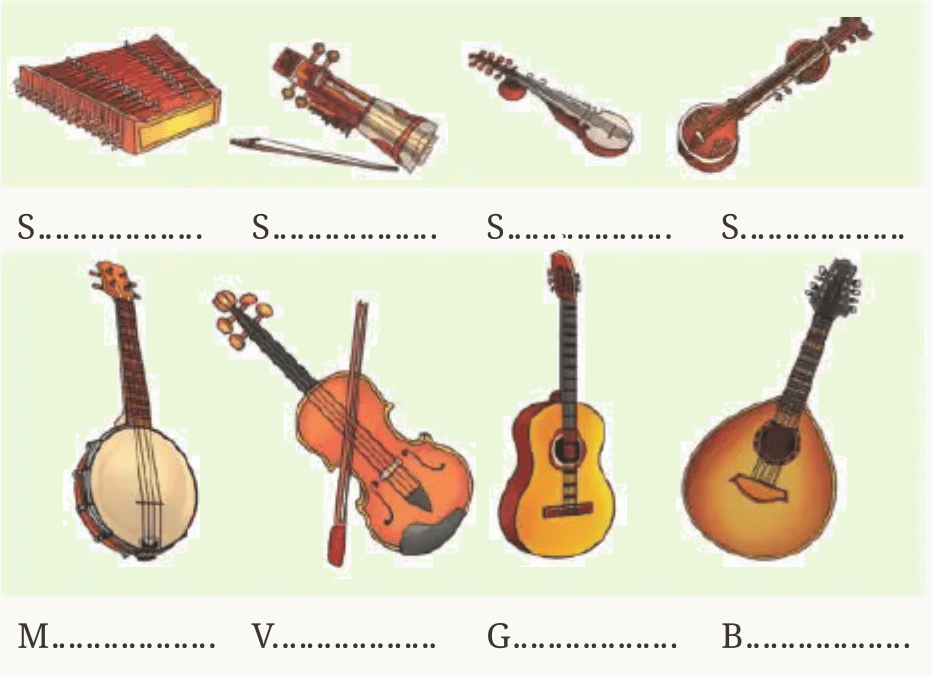
Q. I. Given below are some stringed musical instruments. Work in pairs and identify them by first letter of the spellings of their names.
Answer:
Sitar
Sarod
Santoor
Sarangi
Mandolin
Violin
Guitar
Banjo
Q. II. Do you play a musical instrument? If given a choice, which one would you choose and why?
Answer: (This is a subjective question; here is a sample answer)
Yes, I play the keyboard. If given a choice to pick another, I would choose the flute because it is highly portable, and its melodious, airy sound is very soothing to the mind.
Q. III. Is there any difference in the choice of music between children and elders? If yes, why? If no, why not?
Answer: Yes, there is often a difference in the choice of music between children and elders. Elders usually prefer traditional, classical, or older melodies that they grew up listening to, as it connects them to their cultural roots and past. Children and teenagers, on the other hand, often prefer modern, upbeat genres like pop, rock, or fusion, as they are heavily influenced by current trends, media, and peer groups.
Q. IV. Work in pairs to complete the paragraph given on the next page by choosing the correct phrases given in the box. Discuss with your teacher whether the following phrases have a literal meaning or a figurative one.
(Phrases: wearing a look of distress, bite the bullet, found words, lost in his thoughts, bring it up, throw a party, winding up, sweating on, come around)
Answer:
The theatre club was 1. winding up their practice. Anil saw Sunny was 2. lost in his thoughts and not speaking to anyone. They had a disagreement in the morning and since then, Sunny was 3. wearing a look of distress. Anil did not want to 4. bring it up and disturb Sunny further but he finally decided to 5. bite the bullet and speak to Sunny. He was sure if he apologised first, his friend would 6. come around. With a lot of anxiety, he 7. found words to apologise. And finally, Sunny smiled! Everyone clapped and asked them to 8. throw a party to celebrate.
- Literal Phrases: Winding up, wearing a look of distress, throw a party, bring it up, found words.
- Figurative Phrases: Bite the bullet (meaning to face a difficult situation courageously), lost in his thoughts, come around (meaning to change one’s mood or opinion), sweating on (meaning to worry about).
Check Your Understanding – Act I (Page 6)
Q. I. Complete the table given below based on Act I of the play.
Answer:
| Setting | Details |
| Where | Iqbal’s room |
| Description of the room | A small rack and a wooden table stacked with books. |
| On the wall | Posters of famous Indian flute players Pandit Hariprasad Chaurasia and Shashank Subramanyam. |
| Children and the instruments they play | Children and the instruments they play |
| 1. Iqbal: flute | 3. Peter: keyboard |
| 2. Avinash: tabla | 4. Shruti: violin |
| Speaker | Words of the Speaker | Reason |
| Avinash | “Oh ho! Wow Shruti! You are a sensation now! The least you can do is throw a party!” | A newspaper had highly praised Shruti’s violin performance with her father. |
| Shruti | “There is need to worry Iqbal! You don’t know papa.” | She is afraid her strict father will see her playing fusion music on the violin as a disrespect to classical music. |
| Peter | “That’s the spirit!” | Shruti finally decided to be courageous (“bite the bullet”) and speak to her parents about the fusion concert. |
Q. II. Do you think Shruti will gather the courage to speak to her father? Give a reason.
Answer: Yes, Shruti will gather the courage to speak to her father because her friends encouraged her, and she promised them that she would “bring this up” at dinner that night.
Q. III. What might be Shruti’s father’s reaction? Why?
Answer: Shruti’s father might react with anger or severe disapproval. He is a strict traditionalist who firmly believes that Classical Hindustani music is the only kind of music an artist should play, and he might consider playing Western tunes on a violin as disrespectful.
Check Your Understanding – Act II
Q. I. Complete the summary of Act II by choosing the correct words from the box given below. There are two extra words that you do not need. (Words: disapproval, plea, absent-minded, setback, surprised, scolded, courage, firm, clash, relief)
Answer:
Shruti seemed 1. absent-minded during dinner. She finally gathered the 2. courage to inform her father, Nabin, about her wish to participate in an upcoming Indo-Western fusion concert. Nabin reacted negatively, expressing 3. disapproval of fusion music and dismissed the idea. Despite Shruti’s 4. plea to him to attend a practice before deciding, Nabin was 5. firm in his decision. Shruti’s mother, Leela, 6. scolded her for not seeking permission earlier. The tension highlights the 7. clash between traditional and contemporary musical preferences within the family. Despite the 8. setback, Shruti promises not to hide again and is urged to go to bed by her mother.
Q. II. Will Shruti’s father go for the rehearsal? Support your answer with a reason.
Answer: Yes, Shruti’s father is likely to go to the rehearsal. Although he walked away angrily, fathers usually care deeply for their children, and Leela (the mother) might talk sense into him behind the scenes to at least observe what their daughter is so passionate about.
Q. III. Do you think Shruti and her parents would understand one another? If yes, why? If no, why not?
Answer: Yes, they will eventually understand one another. Underneath the strict discipline, there is a foundation of love and respect. Shruti respects her father’s opinions greatly, and her parents deeply care for her musical growth. Communication and witnessing her talent firsthand will bridge the gap.
Check Your Understanding – Act III
Q. I. Work in pairs. Identify the true statements.
Answer:
During the rehearsal, Shruti’s parents enter the room and are overjoyed at her performance. (True)
Shruti initially considers telling her friends that she can’t join them for the performance, after practising one last time. (True)
Shruti’s father expressed that she had sung a few notes incorrectly during her performance. (False – He said she didn’t lose sight of the notes even once).
Shruti’s father had followed the family’s tradition of being a violinist and worked very hard to achieve all that he did. (False – His family was of vocalists; taking up the violin went against tradition).
Shruti’s mother helped her husband realise why he should support their daughter. (True)
Shruti’s father accepts that he underrated the potential of classical music. (True)
Critical Reflection
Q. I. 1. Read Extract 1 (Shruti and Iqbal’s dialogue)
(i) Select the option that correctly identifies Shruti’s situation. A. confident | B. indifferent | C. content | D. in a dilemma
Answer: D. in a dilemma
(ii) What does Shruti mean by ‘the right way’, in the sentence, “I just don’t know how to tell him in the right way!”?
Answer: By ‘the right way’, Shruti means finding the most respectful and gentle method to break the news to her traditional father without hurting his feelings or making him feel that she disrespects classical music.
(iii) Complete the following with a suitable reason. We can say that the extract reflects the generational gap in understanding art and tradition because…
Answer: …the older generation (Shruti’s father) rigidly believes that only traditional classical music has worth, whereas the younger generation (Shruti) is eager to experiment with new styles like Indo-Western fusion.
(iv) Explain how Iqbal’s words were meant as an assurance to Shruti.
Answer: Iqbal assures Shruti by saying, “All ways are right ways,” meaning that because Nabin is her father, his love for her will eventually override his anger. He is trying to calm her anxiety about making a mistake in how she delivers the news.
(v) Fill in the blank with a phrase from the extract. The critics argued that only films which provoke thoughtful discussion are ________.
Answer: of any worth
Q. I. 2. Read Extract 2 (Nabin’s dialogue) (i) Select the suitable option to complete the sentence. Nabin’s breakthrough in his understanding of artistic freedom, highlights a bridge between…
Answer: B. traditional values and modern expressions
(ii) Fill in the blank with a suitable phrase. The extract uses the word ‘lost’ both in the sense of losing ________ and physical separation.
Answer: cultural roots / family traditions
(iii) In the line, ‘Shruti hugs her parents’, which word from those given below, does not show what it conveys? (reconciliation, harmony, duty, acceptance, understanding)
Answer: duty
(iv) What can be inferred about Shruti’s future in music following her father’s expression of trust and support?
Answer: It can be inferred that Shruti has a bright and unrestricted future. She will be able to pursue both classical music and fusion music confidently, knowing she has the emotional and practical backing of her family.
(v) Identify the phrase that refers to the uniqueness of each artist’s journey and style. Answer: “each bay, its own wind”
Q. II. Answer the following questions.
1. Justify the title ‘Twin Melodies’. How does the play explore the theme of tradition and modernity?
Answer: The title ‘Twin Melodies’ represents two parallel tracks: the blend of Indian Classical and Western styles in fusion music, and the parallel life journeys of Shruti and her father. Both had to break traditional barriers to pursue their preferred musical instruments or styles. The play explores tradition and modernity by showing that modern expressions (fusion) do not destroy tradition; rather, they can coexist beautifully if grounded in strong foundational skills.
2. What are the different perspectives of Peter, Iqbal, and Avinash regarding confronting figures of authority? How do their attitudes towards Shruti’s dilemma provide insight into their own characters?
Answer: Peter, Iqbal, and Avinash take a much lighter, almost casual approach to authority. They suggest hiding the truth or downplaying the reaction (“scolding for breakfast every day”). This shows they are easy-going, pragmatic, and perhaps used to minor rebellions, contrasting sharply with Shruti’s deep-seated reverence and fear of disappointing her father.
3. Analyse the character of Nabin Sharma. How does his attitude towards music evolve?
Answer: Nabin Sharma starts as a strict, unyielding traditionalist who views fusion as “making noise.” However, he is a man capable of self-reflection. When confronted with his daughter’s actual talent and reminded of his own rebellious past by his wife, he realizes his hypocrisy. His attitude evolves from rigid purism to open-minded support and acceptance.
4. How does the play use Shruti’s internal conflict to explore the theme of duty towards family versus personal passion?
Answer: Shruti is torn between her immense respect for her father’s traditional views (duty) and her desire to play fusion music with her friends (passion). The play shows that this conflict doesn’t require choosing one over the other; by proving her dedication and communicating honestly, she honors her family while fulfilling her personal passion.
5. Evaluate the effectiveness of the play’s conclusion. Does it realistically address the conflicts?
Answer: The conclusion is highly effective and heartwarming. It resolves the conflict realistically because Nabin doesn’t just change his mind randomly; he changes it because he hears his daughter play flawlessly and is reminded that he, too, was once a rebel who chose the violin over vocal music. This shared experience creates a believable bridge of understanding.
6. Assess how well the role of cultural diversity contributes to the storyline of the play.
Answer: Cultural diversity is central to the plot. The “Indo-Western fusion” band represents a harmonious blending of diverse cultures. The friends in the band (Iqbal, Peter, Avinash, Shruti) themselves represent a diverse cross-section of society working together to create beautiful, unified art.
Vocabulary and Structures in Context
Q. I. What is ‘aside’ used for? (i) enables characters to talk about the story (ii) shows what a character thinks or feels (iii) makes a direct link between the audience and the character (iv) (i), (ii), and (iii)
Answer: (iv) (i), (ii), and (iii)
Q. II. Non-lexical fillers: Why are they used?
to fill gaps while speaking | 2. to increase clarity | 3. to provide confidence
Answer: 1. to fill gaps while speaking
Now, choose suitable non-lexical fillers (whew, hmmm, err, arrgh, ahem-ahem) to describe the emoticons 1 to 4. Answer:
whew (Relief)
hmmm (Thinking)
err (Confusion / Awkwardness)
arrgh (Frustration / Anger)
Q. III. Match the meanings of other music-related words in Column 1 with their meanings in Column 2.
Answer:
rhythm – (iii) the pattern of beats or time intervals in music
tempo – (iv) the speed or pace at which a piece of music is played
bass – (i) the lowest tone or part in music
baritone – (v) a male voice that falls between the higher and lower ranges
cacophony – (ii) a mixture of loud unpleasant sounds
pitch – (vii) the perceived frequency of a sound, how high or low a sound is
scale – (vi) a series of musical notes moving upwards or downwards
Q. IV. Write the meanings of the underlined phrases based on your understanding of the usage in sentences.
Answer:
drown your individual style: To lose one’s unique identity or personal touch by blending in too much with a crowd or an orchestra.
sense of musicality: An innate understanding, feeling, and natural sensitivity toward music and its notes.
go down the drain: To be completely wasted, ruined, or lost without achieving any result.
Q. V. Convert the exclamatory sentences given above to declarative sentences.
Answer:
Shruti exclaimed with joy that she enjoyed performing that piece very much.
Nabin exclaimed with admiration that the music was very soulful and they all had done a wonderful job.
Q. VI. Write the sentences given below in reported speech.
Answer:
(Done in text): Avinash exclaimed with wonder that Shruti was a great sensation.
Iqbal exclaimed with joy that it was an incredible achievement and he couldn’t believe they had pulled it off.
Shruti’s mother applauded that each note had been executed perfectly and the performance had been flawless.
Iqbal joked that he basically had a little bit of scolding for breakfast every day.
Shruti apologised to her mother and promised that she wouldn’t hide anything from her again.
Avinash exclaimed to Shruti that she was a sensation then and the least she could do was throw a party.
Q. VII. Report the following dialogue in the indirect form of speech.
Answer: Asma exclaimed excitedly that she 1. had a unique experience at the art studio that day. Deepa urged her to tell her as she was eager to hear. Asma said that 2. she had accidentally spilled paint all over her canvas. Deepa pitied Asma. However, Asma replied to her not to worry as 3. the painting then looked better than her original plan. Deepa exclaimed that 4. it was incredible.
Listen and Respond
Q. I. Look at the given stringed musical instruments and decide which one could be the yazh [yal].
Answer: Image 3 is the Yazh. (The Yazh is an ancient string instrument from Tamil Nadu, frequently carved in the shape of a boat or a mythological fish/animal).
Q. III. Complete the notes below with not more than three words.
Answer: (Based on standard historical data regarding the Yazh)
Type of instrument – The Indian harp(i) Was used in: ancient Tamil music(ii) Earlier version of: the Veena
Design(i) stem tip-shaped like a mythological animal(ii) resonator A. shape of a boat / fish B. material – jackfruit wood
Design variety(i) peacock, fish (Makara)
Writing Task
Q. In groups of four, create a play script based only on the beginning of the story given above (Anuradha learning tabla).
Answer: (Sample Play Script Draft)
Title: The Rhythm Within
Setting: The living room of Anuradha’s house. A tabla set sits in the corner.
Characters: * ANURADHA: A talented teenage tabla player
FATHER: A strict vocalist and music teacher
MOTHER: Supportive parent
RAHUL: Anuradha’s younger brother
ACT I
(The scene opens with Anuradha sitting silently near her tabla, looking troubled. Rahul enters, bouncing a ball).
RAHUL: (cheerfully) Hey Anu! Why the long face? You got the invitation for the State Music Festival, didn’t you?
ANURADHA: (sighing heavily) Yes, Rahul. But you know Papa. He will never allow it. He thinks the tabla is just an accompaniment. He wants me to focus solely on vocals.
RAHUL: Arrghh! He needs to see you perform solo once. You are magic on those drums!
(Mother enters from the kitchen wiping her hands on a towel).
MOTHER: (gently) Rahul is right, Anuradha. You have an extraordinary gift.
ANURADHA: (Aside) I know I am meant to play the tabla. When my fingers hit the skin, it feels like my own heartbeat. (Turning to her mother) I don’t want to disrespect him, Ma. But I have decided… I am going to participate.
MOTHER: (smiling) We are rooting for you, dear. Just… ahem-ahem… find the right time to tell him.
(Father walks into the room holding a stack of sheet music. He looks stern).
FATHER: (firmly) I heard the word ‘participate’. I hope we are talking about the vocal recital next month, Anuradha?
ANURADHA: (timidly) Actually, Papa, I… er…
FATHER: (frowning) Speak up, child.
ANURADHA: (taking a deep breath) Papa, I have been invited to perform a solo tabla piece at the prestigious City Event. And… I have accepted the invitation.
(Father stops moving. Dead silence in the room…)
Learning Beyond the Text
Q. I. Study the words given in brackets in the following dialogues… 1. Why do we not use inverted commas to convey the dialogues?
Answer: In a play script, the character’s name followed by a colon already clearly indicates that the following text is spoken dialogue, making inverted commas redundant.
2. Where do we use colons?
Answer: We use colons immediately after the character’s name to introduce the words they are going to speak.
3. What is written within the brackets? What do these convey?
Answer: Stage directions and emotions are written within the brackets (e.g., a little loudly, getting up). They convey the tone of voice, physical movements, or feelings the actor needs to express while delivering the line.
4. How does it help the actors?
Answer: It helps the actors understand how to say their lines and what actions to perform on stage, acting as a direct instruction from the playwright to bring the scene to life accurately.
Read More: Nine Gold Medals Class 9 NCERT Solutions