This is indeed a beautiful and deeply moving poem by Rabindranath Tagore. Here are the complete, detailed solutions for Chapter: I Cannot Remember My Mother Class 9 NCERT Solution, formatted exactly in the “Question followed by Answer” notebook style.
Reflect and Respond
Q I. Work in pairs. Discuss the memories from your childhood that you remember. List them and share with your classmates and teacher.
Answer: (Sample response) 1. Playing hide-and-seek with my friends in the evening.
2. The comforting smell of my grandmother’s cooking during festivals.
3. The day my father taught me how to ride a bicycle without training wheels.
Q II. Discuss how children’s relationship with their mother can influence their emotions and memories.
Answer: A mother is usually a child’s first emotional bond. A loving and nurturing relationship creates happy, secure memories and helps the child develop positive emotions like empathy and confidence. Conversely, the absence of a mother brings deep emotional longing, but the sensory memories of her care continue to provide comfort, as seen in the poem.
Q III. Match the words given in Column 1 with their meanings in Column 2.
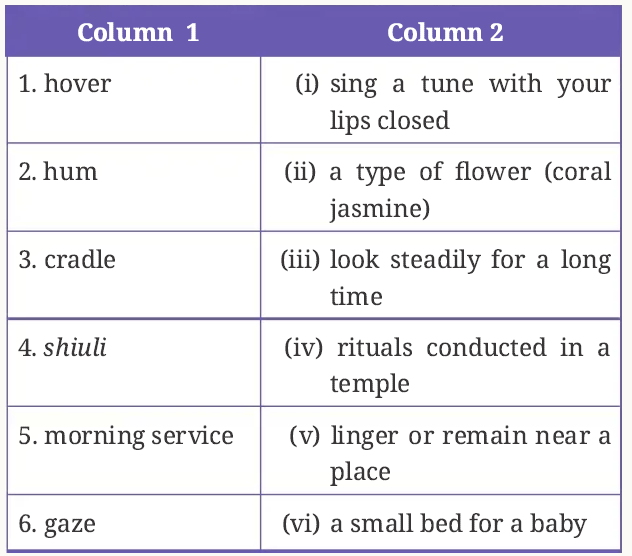
Answer: 1. hover -> (v) linger or remain near a place
2. hum -> (i) sing a tune with your lips closed
3. cradle -> (vi) a small bed for a baby
4. shiuli -> (ii) a type of flower (coral jasmine)
5. morning service -> (iv) rituals conducted in a temple
6. gaze -> (iii) look steadily for a long time
Check Your Understanding
Q I. Fill in the blanks with appropriate words.
Answer:
Stanza 1
- The poet remembers his mother while he plays.
- The poet remembers the tune of the song she hummed but not the mother’s face.Setting: (indoor)
Stanza 2
The poet remembers his mother in the autumn season.
The poet remembers his mother by the smell of shiuli flowers.Setting: (outdoor)
Stanza 3
- The poet feels that his mother is gazing at him from the blue sky.Setting: (indoor) (looking out of his bedroom window)
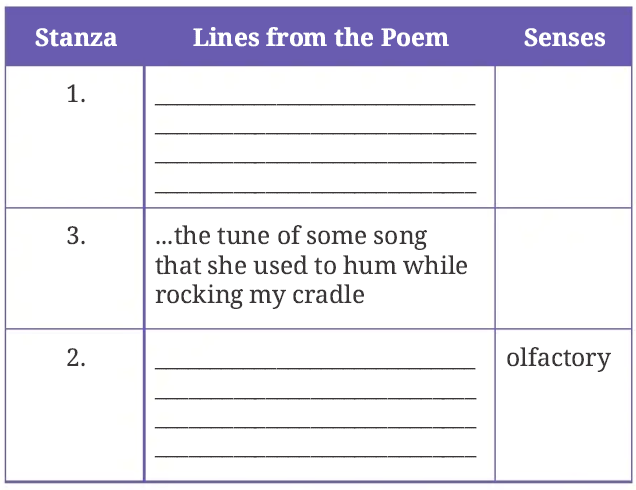
Q II. The senses of olfactory (smell), auditory (hearing), and visual (sight), are three of the five basic senses in humans. Give examples of references to senses from the poem. Complete the table given below.
Answer:
Stanza 1: “…the tune of some song that she used to hum while rocking my cradle” | auditory
Stanza 2: “…the smell of the shiuli flowers floats in the air” | olfactory
Stanza 3: “…my eyes into the blue of the distant sky” / “…stillness of my mother’s gaze” | visual
Q III. Read the poem silently once again and complete the following.
Answer:
Two examples of alliteration from the poem are (i) smell of the shiuli / song that she and (ii) scent of the morning service / my mother.
An example of onomatopoeia is “hum”.
The poem uses imagery extensively. Explain.
Answer: The poet uses sensory imagery to evoke his mother’s memory without seeing her face. He uses auditory imagery (“tune,” “hum”), olfactory imagery (“smell of the shiuli flowers,” “scent of the morning service”), and visual imagery (“blue of the distant sky”).
Although the poem does not have a rhyme scheme, it is enjoyable because…
Answer: …of its deep emotional resonance, gentle rhythm, repeating refrain, and vivid sensory images that beautifully capture the universal feeling of nostalgia and a child’s pure love.
What is the tone of the poet? Why do you say so?
Answer: The tone is nostalgic, melancholic, yet deeply tender and reverent. We can say this because while he feels a gentle sadness at not remembering her physical form, he finds immense warmth and peace in feeling her spiritual presence around him.
What impact does the title of the poem have on the overall mood of the poem?
Answer: The title instantly establishes a mood of tragic loss and melancholy. It prepares the reader for a poem about absence and the deep longing for a lost parent.
The poet uses ‘I cannot remember my mother’ as a refrain because…
Answer: …he wants to emphasize his profound sense of loss. It highlights the contrast between his inability to recall her physical face and the powerful, inescapable ways he still feels her spiritual presence in everyday life.
The poet uses symbolism to indicate the memory of his mother’s presence. Identify the symbols used in the poem.
Answer: The symbols are the “tune” (representing her soothing care), the “shiuli flowers/morning service” (representing her purity and devotion), and the “blue sky/gaze” (representing her vast, overarching protection and watchful love).
Critical Reflection
Q I. Read the extracts given below and answer the questions that follow.
Extract 1: I cannot remember… hover over my playthings,
(i) Complete the following sentence appropriately. The poet is reminded of his mother during his…
Answer: …playtime.
(ii) What is the primary emotion conveyed by the line ‘a tune seems to hover over my playthings’?
Answer: C. It activates memories of the mother.
(iii) In the context of the poem, what role does the hovering tune play during the speaker’s playtime?
Answer: It acts as an invisible, comforting presence that connects his current innocent playtime to the loving, nurturing care his mother provided when he was an infant in a cradle.
(iv) State whether the following sentence is true or false. The poet experiences the tune lingering over playthings only occasionally during playtime.
Answer: True (the poem says “only sometimes”).
(v) How could the poet feel his mother’s presence, even though she isn’t there?
Answer: He feels her presence through deep subconscious sensory memories—like a lingering lullaby tune, familiar scents, and a spiritual feeling of being watched over.
Extract 2: I feel that the stillness… spread all over the sky.
2. (i) What does the poet suggest about the stillness of his mother’s gaze spreading over the sky?
Answer: B. The sky is a symbolic extension of the mother’s presence.
2. (ii) What emotion does the poet associate with the ‘stillness’ of his mother’s gaze?
Answer: D. a sense of serenity
2. (iii) State whether the following sentence is true or false. The poet suggests that the mother’s gaze has a tangible and visual effect on the sky.
Answer: False (It is a spiritual and emotional feeling, not a literal visual effect).
2. (iv) What is the purpose of likening the mother’s gaze to the sky?
Answer: The sky is vast, infinite, and covers everything. By likening her gaze to the sky, he shows that his mother’s protective love is boundless and omnipresent, constantly watching over him from heaven.
2. (v) Complete the sentence appropriately. The tone of the poet in the given extract is… because…
Answer: …reverent and peaceful… because he finds immense comfort in believing that his mother’s eternal, watchful presence covers him completely like the sky.
Q II. Answer the following questions.
1. What is the emotional impact of the refrain, ‘I cannot remember my mother’?
Answer: It creates a recurring wave of pathos and highlights the tragedy of a child losing a mother so early. It anchors the poem in grief, making the sensory memories that follow feel much more powerful and precious.
2. Interpret the connection between the poet’s mother and the following: (i) shiuli flowers (ii) humming tune
Answer: (i) Shiuli flowers are used for morning prayers; their scent reminds him of his mother’s daily morning rituals, her purity, and her devotion.
(ii) The humming tune connects him to her gentle, nurturing affection when she used to rock him in his cradle as a baby.
3. What role does nature play in the poet’s description of the memory of his mother?
Answer: Nature acts as a medium that bridges the gap between life and death. Because he cannot remember her face, he finds her spirit living on in nature—the seasonal shiuli flowers carry her scent, and the vast blue sky carries her protective gaze.
4. What can be inferred about the poet’s perception of the mother-child relationship?
Answer: The poet perceives the mother-child bond as eternal and unbreakable. He proves that even if physical memories fade, a mother’s love leaves an indelible mark on a child’s soul, living on through the subconscious and the senses.
Vocabulary in Context
Q I. Work in pairs to classify the sensory words given in the box below.
Answer: * Visual: glowing, gigantic, minuscule, gloomy, vibrant, crimson.
Auditory: hiss, sizzle, deafening, squeaky, ear-splitting, rustle.
Olfactory: aroma, stale, scent, pungent, stinky, fragrant.
Tactile: sticky, rough, chilled, fluffy, hairy, smooth, slimy.
Q II. Fill in the blanks with sensory words in the box for the following passage written by Sarojini Naidu. There are two extra words. (scarlet, flaming, smooth, shrill, sizzle, perfumes, scents, sweetness, essence)
Answer: Come and share my exquisite March morning with me: this sumptuous blaze of gold and sapphire sky; these (1) flaming lilies that adorn the sunshine; the voluptuous (2) scents of neem and champak and serisha that beat upon the languid air with their implacable (3) sweetness; the thousand little gold and blue and silver breasted birds bursting with the (4) shrill ecstasy of life in nesting time. And, do you know that the (5) scarlet lilies are woven petal by petal from my heart’s blood, these little quivering birds are my soul made incarnate music, these heavy (6) perfumes are my emotions dissolved into aerial (7) essence… this blue and gold sky is the ‘very me’… (Extra words: smooth, sizzle)
Q III. Write numbers against each picture with the phrases that describe them with their sensorial associations.

Answer: * Picture 1 (Hands gathering flowers): 3. fragrant breeze of blooming buds
Picture 2 (Mother rocking cradle): 4. gentle lullaby, a soft melody
Picture 3 (Kites flying in the sky): 5. colourful sky, painting a lively sight
Picture 4 (Sunset over water): 6. attractive canvas painting the horizon
Picture 5 (Tabla drums): 1. beats of music echo in air
Picture 6 (Incense sticks in pot): 2. melody of soothing scent, dancing in the air
Speaking Activity
Q I. Work in pairs. Think of an object, song, or a place that is memorable for you. Take turns to speak about it using the prompts given below.
Answer: (Sample Speech Draft)
“During my childhood, a place that is truly memorable for me is my grandmother’s village home. I have a clear memory of the massive mango tree in her backyard. Recalling those early years, I can’t forget the sweet, sticky scent of ripe mangoes in the summer, and the rough texture of the tree bark as I tried to climb it. A cherished part of my childhood includes sitting under its cool, vibrant green shade while my grandmother told us ancient stories. This place has deeply impacted my life by teaching me to appreciate the simple, quiet joys of nature. To summarise, this memory is meaningful to me even now because it represents pure innocence, warmth, and the unconditional love of my family.”
Writing Task (Page 10)
Q I. Imagine you had been on a school trip to a scenic place which appealed to all your senses. Write a diary entry describing the place and why it was a memorable experience.
Answer:
Friday, May 8, 2026
9:00 PM
Dear Diary,
Today was an absolutely unforgettable day! Our school trip to the hill station of Munnar felt like stepping into a paradise that awakened all my senses at once.
As soon as we stepped out of the bus, the chilled, crisp mountain breeze brushed against my face. My eyes were greeted by vibrant, rolling hills covered in bright green tea plantations that looked like a giant, soft velvet carpet stretching into the horizon. The air was incredibly fragrant, filled with the refreshing, earthy aroma of tea leaves and damp soil. While walking the trails, I could hear the gentle rustling of the leaves and the distant, soothing roar of a hidden waterfall. Later, we tasted the freshly brewed local tea, and its warm sweetness was the perfect comfort against the cold weather.
I feel so serene and joyful right now. Standing there amidst such vast nature made me realise how beautiful and peaceful the world can be away from the noisy city. This trip will always remain a deeply cherished memory because it brought me so much peace and bonded me closer to my friends.
Until tomorrow,
[Your Name]
Learning Beyond the Text
Q I. You read about the shiuli flowers from the poem. Gather more information on unique flowers of India… Add more flowers to this list.
Answer: 1. Brahma Kamal: * Where found: High altitudes of the Himalayas (Uttarakhand).
Appearance: A striking, star-shaped pure white flower.
Scent: Emits a very strong, sweet fragrance.
Significance: It is considered the spiritual flower of Lord Brahma. Uniquely, it blooms only for one night a year, usually during the monsoon season.
2. Champa (Plumeria):
Where found: Widely grown across central and southern India.
Appearance: Beautiful five-petaled flowers, usually white with a yellow center, with a soft, velvety touch.
Scent: Releases a rich, sweet, and exotic perfume, especially at night.
Significance: Often planted near temples and ashrams. It is used in garlands and symbolizes immortality and dedication in Indian culture because the tree will bloom even if uprooted.
Read more: Vitamin-M (NCERT SOLUTION)