Here are the complete exercises and solutions for Vitamin M Class 9 NCERT Solution
Reflect and Respond
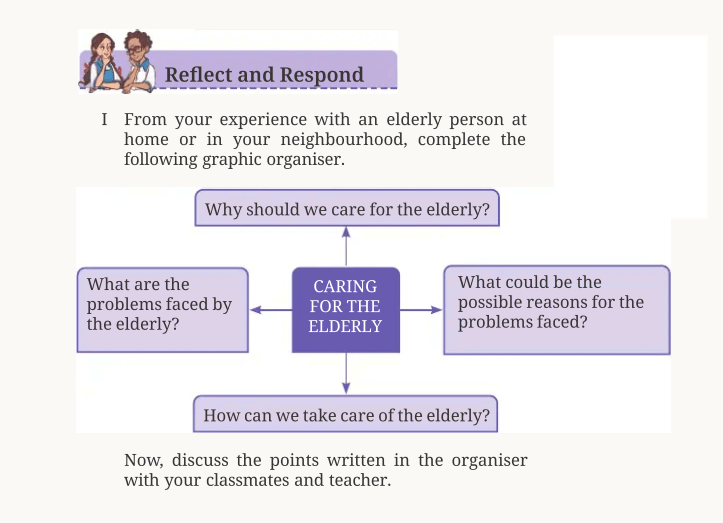
I. From your experience with an elderly person at home or in your neighbourhood, complete the following graphic organiser.
(Note for educators: These are suggested responses for the graphic organiser).
• Why should we care for the elderly?
Answer: They spent their youth taking care of us, they possess immense wisdom, and it is our moral duty to provide them with physical and emotional support in their vulnerable years.
• What are the problems faced by the elderly?
Answer: Health and mobility issues, loneliness, memory loss, and a feeling of being a burden.
• What could be the possible reasons for the problems faced?
Answer: Natural physical ageing, the generation gap, the rise of nuclear families, and the busy lifestyles of the younger generation.
• How can we take care of the elderly?
Answer: By spending quality time with them, actively listening to their stories, assisting them with their medications and daily chores, and showing endless patience.
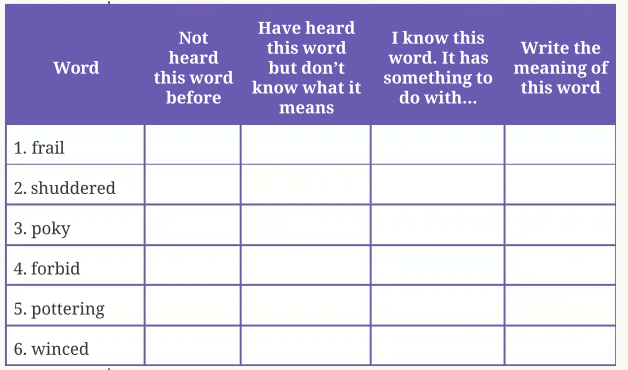
II. Fill in the table given below. You may check youranswers with the help of a dictionary.
Vitamin M Class 9 NCERT Solution
| Word | Write the meaning of this word |
|---|---|
| 1. frail | Physically weak and delicate; easily broken or damaged. |
| 2. shuddered | Shook or trembled suddenly and violently, usually from fear, cold, or disgust. |
| 3. poky | Small, cramped, and uncomfortable (often referring to a room or building). |
| 4. forbid | To refuse to allow something; to order someone not to do something. |
| 5. pottering | Occupying oneself in a relaxed, casual way with small tasks or hobbies. |
| 6. winced | Gave a slight involuntary grimace or shrinking movement out of pain or distress. |
III. Think of a tradition, story, or recipe passed down by grandparents or an elderly relative in your family. What does it mean to you? How does it connect you to your growing-up years? Share with your classmates and teacher.
Answer: Every Sunday morning, I carry forward a cherished tradition gifted to me by my grandmother: the art of making hand-rolled parathas. To me, this ritual is a labor of love, patience, and warmth. It serves as a sensory bridge to my childhood, instantly conjuring the rich aroma of ghee and the sound of my grandmother’s voice as she shared family stories in her kitchen.
This tradition is deeply meaningful for several reasons:
Connection to Roots: It bridges the gap between generations, allowing me to better understand my family’s history and core values.
Cultural Identity: These recipes are more than just meals; they are cultural treasures that preserve our unique heritage.
Gratitude and Love: The process reflects my grandmother’s wisdom and care, reminding me to find joy in life’s simplest moments.
The practice remains my strongest link to my formative years. Those Sunday mornings were defined by specific tastes and a quiet, domestic joy. As we cooked, my grandmother’s stories about her own youth taught me about resilience and the importance of a family legacy. Ultimately, those hours weren’t just about learning a recipe—they taught me the vital importance of bringing people together. I am profoundly grateful for these shared moments, as they continue to shape who I am today.
Check Your Understanding – Part I (Vitamin M Class 9 NCERT Solution)
I. Why did Grandpa dislike living in the city with his daughter?
Answer: Grandpa hated the loud noise, hustle, and bustle of city life. He felt trapped in his daughter’s “poky little flat” and deeply missed his quiet, small brick house in the town, where it was so peaceful that one could even hear a leaf fall.
II. Why did Vidya not want her father to go out alone?
Answer: Vidya was overly worried because Grandpa was getting old and forgetful. The previous month, he had absent-mindedly taken a double dose of his medicines, wandered off on a walk and got lost, and had slipped in the garden where he lay all night without help. She believed it was too dangerous for him.
III. Was Ravi in favour of his mother treating Grandpa like a child? How can you say so?
Answer: No, Ravi was not in favour of it. We know this because Ravi “winced” at the loud, patronising tone his mother used with Grandpa, feeling she was treating him like a baby who couldn’t hear or understand properly.
IV. Would Ravi be able to keep up his promise to his mother? Answer: No. Although he promised to keep Grandpa at home, Grandpa cleverly manipulated the situation and went out. Ravi ended up secretly trailing him across the city instead of keeping him indoors.
Check Your Understanding – Part II (Vitamin M Class 9 NCERT Solution)
I. Complete the flow chart by describing Grandpa’s day out.
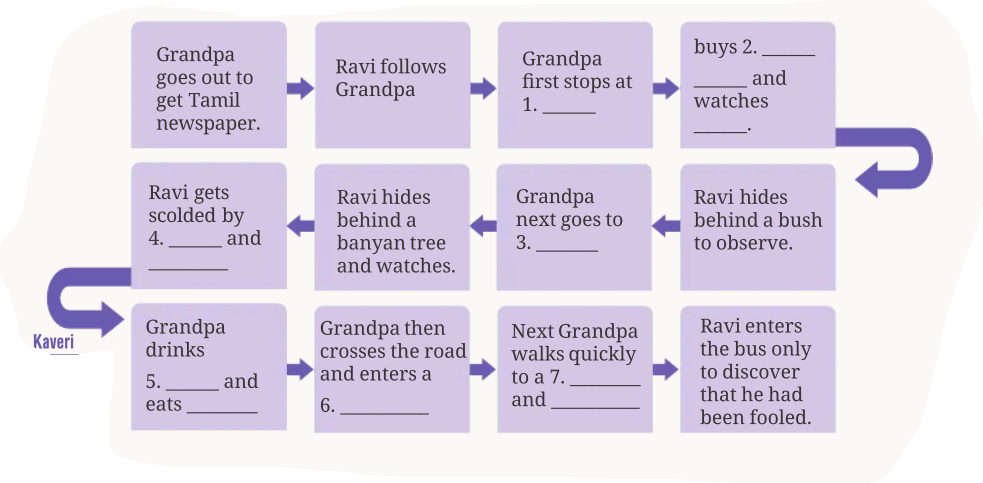
Grandpa first stops at the children’s park and buys peanuts and watches the children play.
Ravi hides behind a bush to observe. Ravi gets scolded by a small child’s mother.
Grandpa next goes to a tea stall. Ravi hides behind a banyan tree and watches. Ravi gets scolded by the vendors.
Grandpa drinks a sugary cup of tea, eats two bananas and an ice cream.
Grandpa then crosses the road and enters a barber shop.
Next, Grandpa walks quickly to a bus stop and boards a bus.
Ravi enters the bus only to discover that he had been fooled (it was a stranger wearing Grandpa’s cap).
II. Was Grandpa lost as feared by Ravi’s mother?
Answer: No, Grandpa was never lost. He confidently navigated his way through the city traffic, visited his favourite spots, enjoyed his snacks, and made it back home completely safe.
III. How would Ravi feel after seeing Grandpa?
Answer: Ravi would feel an overwhelming sense of relief and delight. After being frantic and sick with worry that he had lost his grandfather, finding him safely asleep at home filled Ravi with deep affection.
IV. Do you think Ravi’s mother will get to know about what had happened?
Answer: It is highly unlikely. Ravi will not tell her because he would get severely scolded for failing his duty, and Grandpa covered for him by casually mentioning that Ravi “just disappeared,” keeping the actual adventure a secret between them.
━━━━━━━━━━━━━━━━━━━━━━━━━━━━━━━━━━━━━━━━━━━━━━━━━━━━
Check Your Understanding – Part III
I. Describe how Ravi’s emotional reaction upon finding Grandpa safe at home reveals his feelings towards his grandfather.
Answer: Ravi was frantic and sick with worry when he couldn’t find Grandpa. Upon returning home and hearing his snores, he was overcome with immense relief and affection, kneeling down to hug him. This reveals that Ravi deeply loves, respects, and fiercely cares for his grandfather, going beyond just obeying his mother’s orders.
II. What might be the significance of Grandpa’s habit of giving gifts to everyone on his birthday rather than receiving them?
Answer: This habit highlights Grandpa’s selfless, generous, and loving nature. It shows that he finds more joy in giving than receiving, and it signifies that he still looks at his grown daughter and son-in-law as his cherished “babies.”
III. Why do you think Grandpa gave Ravi a detective storybook as a gift? What might this suggest about Grandpa’s awareness of Ravi’s actions earlier in the day?
Answer: Grandpa gave Ravi a detective book, explicitly mentioning it had tips on “how to avoid getting fooled when one is trailing a suspect.” This strongly suggests that the sharp-witted Grandpa was completely aware that Ravi was clumsily following him around the city all morning!
Critical Reflection
I. Read the extracts given below and answer the questions that follow.
Extract 1: (i) Choose the emotion displayed by the Grandfather.
Answer: C. nostalgic
(ii) Complete the following sentence with a reason. Grandpa hated the busy and noisy city life because…
Answer: …he was used to the profound peace and quietness of his small brick house in the town.
(iii) Why did Grandpa come to the city despite his dislike for city life?
Answer: He came because he had slipped in his garden and lay there helpless all night. Consequently, his daughter locked up his house and forced him to move in with them for his safety.
(iv) Choose an expression similar in meaning to, ‘you can even hear a leaf fall’.
Answer: D. pin drop silence
(v) State one advantage and one disadvantage of the Grandfather living in the house in town.
Answer: Advantage: It was incredibly peaceful and connected to nature (the big mango tree). Disadvantage: He lived entirely alone, meaning there was no one to help him during physical emergencies.
Extract 2: (i) Choose the option that displays the tone of the Grandfather’s response.
Answer: C. calm
(ii) Why was Ravi confused and embarrassed? Answer: Ravi was embarrassed because he was supposed to stay home and look after Grandpa, but he had spent the whole morning secretly trailing him. Grandpa’s cool remark cleverly exposed Ravi’s absence.
(iii) Complete the sentence with a suitable reason. Ravi’s mother was impatient because…
Answer: …she assumed her father’s memory was failing and that he had foolishly forgotten that Ravi’s birthday had passed three months ago.
(iv) State whether the following sentence is true or false. Grandfather forgot that Ravi’s birthday was three months ago.
Answer: False.
(v) Why did Grandpa say he didn’t know what kind of morning Ravi might have had?
Answer: Grandpa said this sarcastically because he secretly knew exactly what kind of exhausting, panic-filled morning Ravi had while trying to act as a detective following him.
II. Answer the following questions.
1. Grandpa is portrayed as a person with failing memory in the beginning of the story. Give two evidences to disprove the statement.
Answer: Firstly, Grandpa vividly remembers complex, historical chess moves made by grandmasters like Karpov and Bobby Fischer. Secondly, he remembered his own tradition of buying and wrapping gifts for his entire family on his birthday.
2. Give two characteristic traits of each of the following characters.
Answer: • Grandfather: Independent and sharp-witted (crafty). • Ravi: Caring and determined (loyal). • Ravi’s mother: Anxious and patronising (over-protective).
3. Why was Ravi worried about what Grandfather had at the tea stall?
Answer: Ravi was worried because Grandpa happily consumed sugary tea, bananas, and ice cream—all of which were strict, medically “forbidden” or “banned” items for him at home.
4. Do you think it was easy for Ravi to follow his Grandfather? If yes, why? If no, why not? Answer: No, it was incredibly difficult. Ravi had to crouch behind bushes, crawl on all fours to hide from an angry mother, duck behind cars, get scolded by street vendors, and ultimately sprint to catch a moving bus in the scorching heat.
5. ‘Ravi is a good detective’. Give one argument in favour of and against the given statement.
Answer: In favour: Ravi showed great dedication and physical stamina, successfully tracking Grandpa across multiple locations without giving up. Against: He was clumsy, easily spotted by the public (getting into arguments with strangers), and was completely fooled by a decoy wearing Grandpa’s cap.
6. Was Grandfather aware that Ravi was following him? How do you know?
Answer: Yes, he was completely aware. We know this because he deliberately gave his distinctive yellow cap to a stranger on the bus to act as a decoy, and later gifted Ravi a detective book, playfully advising him on how to better “trail a suspect.”
7. In your opinion, who needs Vitamin-M? And why?
Answer: In an ironic twist, it is Vidya (Ravi’s mother) who truly needs “Vitamin-M” (Memory). Despite constantly complaining about Grandpa’s memory, she is the one who completely forgot her own father’s birthday, even after marking it in red on the calendar!
━━━━━━━━━━━━━━━━━━━━━━━━━━━━━━━━━━━━━━━━━━━━━━━━━━━━
Vocabulary and Structures in Context (Pages 15-20)
I. Classify the words given in the box into movement words in Column 1 and sound words in Column 2. Then fill in the blanks.
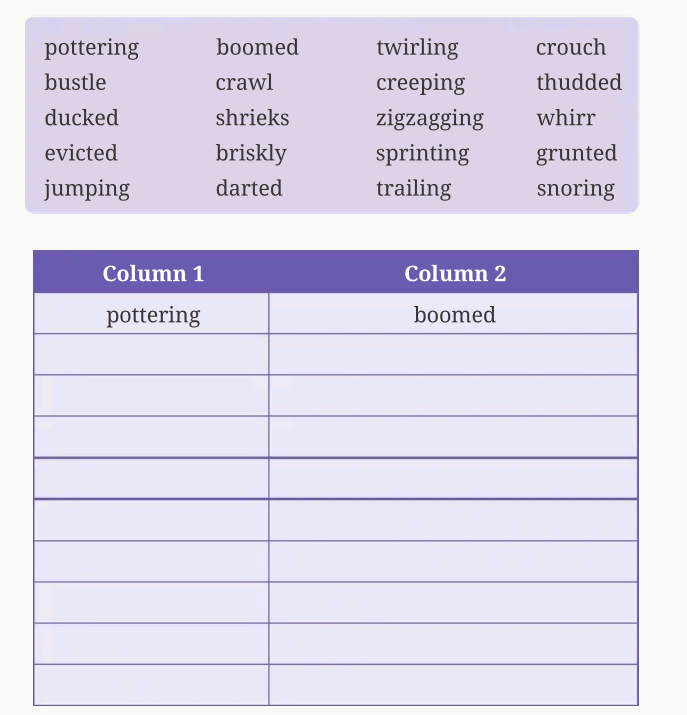
| Column 1: Movement words | Column 2: Sound words |
|---|---|
| pottering | boomed |
| twirling | shrieks |
| crouch | thudded |
| bustle | whirr |
| crawl | grunted |
| creeping | snoring |
| ducked | |
| zigzagging | |
| briskly | |
| sprinting | |
| jumping | |
| darted | |
| trailing |
Fill in the blanks:
Detective Shankar, 1. trailing the mysterious suspect through the dimly lit side lanes, away from the 2. bustle of the city, quickened his pace 3. briskly. The suspect’s heavy footsteps 4. thudded across the street, unaware of the pursuit. Shankar, 5. twirling his magnifying glass had to 6. duck behind the market stalls, 7. zigzagging through the lanes to avoid being seen. Shankar 8. grunted when he hit himself against a pole. This alarmed the suspect and he 9. sprinted into the night leaving only the distant 10. whirr of the sleeping city behind.
II. Study the highlighted word in the given sentence from the text and fill in the boxes with synonymous words.
- QUANDARY
- PREDICAMENT
III. Fill in the table given below.
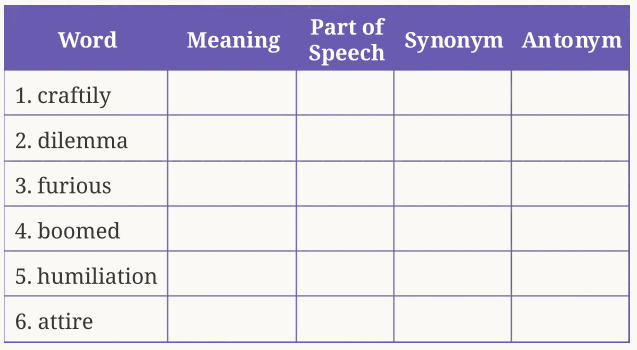
Answer:
| Word | Meaning | Part of Speech | Synonym | Antonym |
|---|---|---|---|---|
| craftily | in a clever but slightly tricky way | adverb | cleverly | honestly |
| dilemma | a situation with difficult choices | noun | problem | solution |
| furious | extremely angry | adjective | enraged | calm |
| boomed | made a deep loud sound | verb | thundered | whispered |
| humiliation | feeling of shame or embarrassment | noun | disgrace | honour |
| attire | clothes or outfit | noun | clothing | undress |
IV. Match the emotions/expressions in Column 1 with their meanings in Column 2.
embarrassed ➞ (v) felt uncomfortable
countered ➞ (iv) reply to an argument
flushed ➞ (vi) became red in the face
stricken ➞ (i) affected severely by an unpleasant feeling
gleam ➞ (iii) expression of emotion
V. Prepositions
I walked (i) through the village, crossed a bridge (ii) over a brook, and found a quiet garden (iii) near a cottage. Sitting on a bench (iv) in the garden, I enjoyed the peaceful surroundings. Later, I strolled (v) along a riverbank, exploring the forest and heading (vi) towards the unknown.
VI. Direct to Indirect Speech
A. The words in the quotes are (i) interrogative sentences.
B. Sentences 1, 4, and 5 are (ii) Yes/No type interrogative sentences.
C. Sentences 2 and 3 are (iii) Wh- type interrogative sentences.
So, there are (iv) two types of interrogative sentences.
VII. Read the following conversation. Complete the following sentences in reported speech.
Arvind asked Priya if she 1. helped in taking care of her grandparents at home, for which Priya replied in the affirmative and said that they 2. took turns making sure they were alright. Priya further asked Arvind 3. if he had grandparents living with him. Arvind replied in the negative and said that 4. his parents and he visited his grandpa every weekend. He further enquired 5. how she managed her grandparents’ medical needs. Priya responded by saying that they 6. had a schedule for giving medications and visits to the doctor.
━━━━━━━━━━━━━━━━━━━━━━━━━━━━━━━━━━━━━━━━━━━━━━━━━━━━
Learning Beyond the Text
I. Revisit the story and choose the image that correctly displays Grandpa’s walking stick.
Answer: The correct image is the walking stick with the brass handle carved in the shape of an eagle’s head, matching the specific description given in the text: “He picked up his beautiful mahogany shiny-black walking stick with a brass handle carved in the shape of an eagle’s head…”
___________________________________________________________________________________________________________________________
See More: Gifts of Grace Class 9 NCERT Solution