
Find the complete and detailed NCERT Solutions for Class 9 Science Chapter 3 Tissues in Action. These solutions cover all exercise and in-text questions to help you prepare effectively for exams.
Part 1: Chapter Introduction & “Think It Over”
Question: How is the study of cells and tissues significant for understanding the life processes and human welfare?
Answer: Understanding cells and tissues allows scientists to comprehend the natural biological processes that govern growth and development. By studying how cells group together and differentiate, researchers can replicate or modify these processes for human welfare, such as in tissue culture, growing disease-free crops, and regenerative medicine.
Question: How are tissues in plants and animals different, and why?
Answer: Plants are mostly fixed in one place and need support to stay upright, so their cells have rigid cell walls and they possess many dead supportive tissues. Animals move around; their cells lack rigid cell walls, providing the cellular flexibility necessary for locomotion. Furthermore, their modes of nutrition and growth patterns differ, leading to entirely distinct tissues for digestion, transport, and growth.
Question: How is the division of labour at various levels of organisation in multicellular organisms correlated with their structure and function?
Answer: In multicellular organisms, cells of a similar type form tissues, tissues form organs, and organs form organ systems. This structural hierarchy leads to a division of labour, where specific cell groups become highly specialised to perform specific functions (like muscle for movement or xylem for water transport). This increases the overall efficiency of the body in carrying out complex life processes.
Question: What makes cells group together to form tissues? Why do some tissues grow throughout life while others do not?
Answer: Cells group together to form tissues to perform specific functions more efficiently (division of labour). Some tissues grow throughout life (like meristematic tissues in plants) because their cells retain the ability to divide continuously. Other tissues lose this ability and differentiate into permanent tissues with fixed, specialised functions.
Part 2: In-Text Activities & “What Ifs” (Plant Tissues)
Question: Which tissues are responsible for these changes? (Referring to a seedling growing, roots growing deep, stems thickening, and grass regrowing) Answer: These changes are driven by actively dividing cells that together form a tissue called meristematic tissue.
Activity 3.1: Let us design experiments
Question: What trend do you observe in the data you recorded in Table 3.1?
Answer: The roots of the onion bulb in Jar A continue to grow in length day by day. However, the roots in Jar B stop growing completely after their tips are cut on day 3.
Question: Are your observations similar to those presented in the graphical representation (Fig. 3.2)? What do you infer?

Answer: Yes, the observations match the graph. We infer that roots grow only from their tips, which contain specialised cells that divide continuously (the apical meristem).
Question: What causes this increase in girth?
Answer: The increase in the thickness or girth of a stem is caused by the activity of the lateral meristem, which consists of actively dividing cells arranged in a ring within the stem.
Question: What do you think happens to the growth of the plant if the tip of a young stem is cut?
Answer: The stem will stop growing in length (since the apical meristem is removed), but new branches will begin to arise from the nodes of the stem due to the activity of the intercalary meristem.
Question: Why do you think that the cell of meristematic tissues lack vacuoles?
Answer: Meristematic cells are actively dividing and have dense cytoplasm. They lack vacuoles because they do not need to store food or waste, and a large central vacuole would take up necessary space and hinder the rapid cell division process.
Question: What do you observe? Are all the cells similar in shape and size? (Looking at the T.S. of a sunflower stem)
Answer: No, the cells are not similar. We observe different groups or layers of cells that vary greatly in shape, size, and cell wall thickness.
Question: How many different types of tissues can you identify? What differences do you notice among them? What might be the reason for the presence of different types of cells and tissues?
Answer: We can identify protective tissue (epidermis), supporting ground tissue (parenchyma, collenchyma, sclerenchyma), and conducting tissue (xylem and phloem). They differ in cell wall thickness, whether the cells are living or dead, and their arrangement. The reason is the division of labour. Each different group of cells is a permanent tissue structurally specialised to perform a specific function, such as protection, mechanical support, or the conduction of water and food.
Question: What protects plants from mechanical injury, water loss, harmful microorganisms and extreme environmental conditions?
Answer: The epidermis, which forms the tightly packed outermost layer of the plant body, provides this protection. It is often covered with a waxy layer called the cuticle to prevent water loss.
Question: What keeps a plant upright? Why does a fresh twig bend but a dry twig break? Why are seed coats hard and how do aquatic plants float?
Answer: Supporting tissues (simple permanent tissues), primarily sclerenchyma (which has thick, hard lignified walls) and collenchyma, provide the structural strength and rigidity needed to keep the plant upright. A fresh twig bends because it contains living collenchyma tissue, which has unevenly thickened corners that provide both support and flexibility. A dry twig breaks because it loses water, the living flexible cells die, and it is left relying only on rigid, brittle sclerenchyma. Seed coats are hard due to the presence of dead sclerenchyma cells that have extremely thick, lignified walls. Aquatic plants float because they have specialised parenchyma cells that form large air spaces within the tissue, providing buoyancy.
Question: How does water reach the leaves of tall trees? How does food prepared in leaves reach other parts of the plant?
Answer: Water is transported upwards against gravity through the xylem, a complex permanent tissue consisting of tubular, thick-walled vessels and tracheids. Food is transported from the leaves to the rest of the plant by the phloem, another complex permanent tissue, specifically moving through the tubular sieve tubes.
Part 3: “Pause and Ponder” (Plant Tissues)
Question: 1. You may have noticed that fibres of coconut husk are hard and brittle, whereas the leaf stalks of coriander are soft and flexible. Find out the reason.
Answer: The fibres of a coconut husk are made of sclerenchyma tissue, which consists of dead cells with heavily thickened, lignified walls, making them tough and brittle. Coriander leaf stalks contain collenchyma tissue, which is composed of living cells with pectin depositions, providing support combined with flexibility.
Question: 2. Why do you think that a thick cuticle on the outer wall of epidermis is advantageous for a plant living in the desert but disadvantageous for a plant living underwater?
Answer: In a desert, a thick waxy cuticle is highly advantageous as it drastically reduces water loss through transpiration, helping the plant conserve water in a dry environment. Underwater, a thick cuticle would be disadvantageous because aquatic plants need to exchange dissolved gases and absorb water directly across their entire surface, which a thick cuticle would block.
Question: 3. Once water is absorbed by plant roots, it has to travel against gravity through xylem. How do the ‘dead’ cells of the xylem work together with the living cells of leaves at the top to keep the water moving?
Answer: The living cells of the leaves have pores called stomata. Water constantly evaporates from these stomata in a process called transpiration. This evaporation creates a strong suction force (transpiration pull) that physically draws the water column upwards through the hollow, dead tubes (tracheids and vessels) of the xylem.
Question: 4. What do you think will happen if there were no stomata in the epidermis of the stem or leaves?
Answer: If there were no stomata, the plant would be unable to exchange gases (carbon dioxide and oxygen) with the air, halting photosynthesis and respiration. Furthermore, transpiration would stop, meaning there would be no “transpiration pull” to draw water and essential minerals up from the roots, and the plant would eventually die.
Part 4: In-Text Activities & “Pause and Ponder” (Animal Tissues)
Question: Now think, which tissue helps you move? Which tissue enables you to sense heat or cold? Which tissue allows oxygen to enter the blood? Which tissue holds the body together so that the skin does not fall off?
Answer: Muscular tissue helps you move by contracting and pulling on bones. Nervous tissue enables you to sense heat or cold and transmit that information to your brain. Epithelial tissue (specifically the single layer of thin, flat cells lining the lungs) allows oxygen to rapidly diffuse into the blood. Connective tissue supports and holds the various organs and tissues of the body together.
Question: Have you wondered how much of your body weight comes from bones?
Answer: On average, the adult human skeleton makes up about 12 to 15 per cent of total body weight.
Activity 3.4: Let us investigate
Question: Discuss why do bone and muscle mass differ between individuals, and how do they contribute to the overall body weight?
Answer: Bone and muscle mass differ due to factors like age, gender, genetics, and lifestyle (such as physical exercise and diet). They contribute heavily to body weight; for example, adult males generally have 40-50% muscle mass, and bones consistently account for 12-15% of the total weight.
Activity 3.5: Let us observe
Question: Why does this happen? (Why do some parts move easily in many directions, while others move only in a single direction?)
Answer: This happens because of the different types of joints present in the skeleton. A joint is a junction between two or more bones, and their physical structure dictates the range of motion.
Question: So, what actually causes the bones to move?
Answer: Joints allow movement, but muscles cause the movement. When a muscle contracts, it pulls on the bone it is attached to via strong bands called tendons, resulting in movement at the joint.
Question: How does the neck move so freely?
Answer: The skull is connected to the backbone through a pivot joint. This specific joint structure allows the head to move side to side, much like a doorknob turning inside its socket.
Pause and Ponder 5
Question: 5. Look at the picture given below (Fig. 3.17). Carefully observe the various poses of classical and folk dances of India. Can you identify which joints are involved? Also, what type of movement each joint allows?
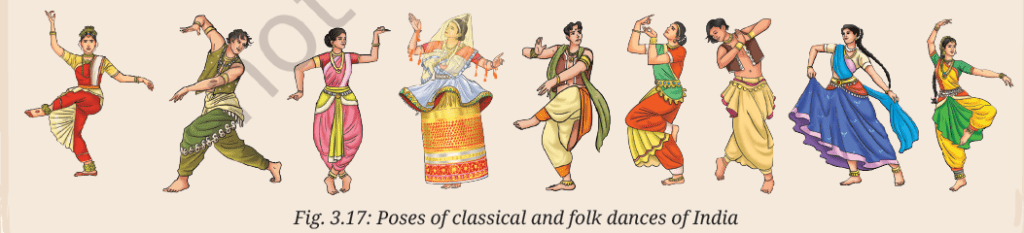
Answer: * Shoulder Joint: Ball and socket joint. It allows free movement in almost all directions—forward, backward, sideways, and circular.
Elbow and Knee Joints: Hinge joints. They allow bending and straightening in one direction only, like a door hinge.
Neck: Pivot joint. Allows the head to rotate side to side.
Question: Can you feel the bones under your chest?
Answer: Yes, these bones are your ribs.
Question: But you may wonder, “How can such a strong cage move? And why does it need to move?”.
Answer: The ribs are attached to the breastbone in the front by flexible cartilage, which acts as a hinge allowing the cage to expand and contract. It needs to move to increase and decrease the space inside the chest cavity, which is the mechanical process that draws air into and pushes air out of the lungs during breathing.
Part 5: Think as a Scientist (Totipotency)
Based upon Table 3.6, think about these questions:
Question: (a) What do you conclude about the characteristics of phloem cells of carrot?
Answer: The mature phloem cells of a carrot retain the remarkable ability to dedifferentiate (regain the ability to divide) and redifferentiate to form a completely new, entire plant. This unique characteristic is known as totipotency.
Question: (b) In which of the three combinations would you obtain the highest and lowest biomass? What could be the possible reason(s) for this observation?
Answer: * Highest Biomass: The combination of “Light + Air + Liquid medium + nutrients” yields the highest biomass (20% increase).
Lowest Biomass: The combinations lacking either air (Solid medium) or lacking light result in reduced biomass.
Reason: Plant cells need light to perform photosynthesis and generate food. They need air (specifically oxygen) for cellular respiration to release energy. A liquid medium is superior to a solid one because it allows the cells to be suspended and easily absorb nutrients from all sides.
Question: (c) Will you get the same results if you culture animal cells instead of carrot cells?
Answer: No. Mature, differentiated animal cells generally do not possess totipotency. You cannot take a single mature skin or muscle cell from an animal and grow an entirely new animal in a culture dish.
Question: (d) Think and mention any two commercial applications of the study above.
Answer:
1. Plant Tissue Culture: Mass-producing identical, disease-free, high-yielding crop plants quickly in laboratory conditions.
2. Genetic Engineering: Using these techniques to introduce new, useful genes into single plant cells, which are then grown into complete plants that have disease resistance or produce valuable phytochemicals.
Part 6: “Revise, Reflect, Refine” (End of Chapter Exercises)
Question: 1. Meristematic tissues divide repeatedly. What property of their cells allows them to do this?
Answer: (iii) They have thin walls, dense cytoplasm and large prominent nucleus.
Question: 2. If a plant is unable to transport food from leaves to roots which tissue is malfunctioning?
Answer: (ii) Phloem.
Question: 3. Why are the epithelial tissues that line an animal’s internal organs usually only one or a few cells thick?
Answer: (iii) To allow quick exchange of materials across them.
Question: 4. You can perform these two jumps (Fig. 3.21): Straight-leg jump – keep knees and ankles stiff. Normal jump-bend knees and ankles naturally. How did your ankle, knee and hip positions differ between the two jumps?
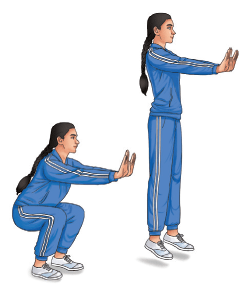
Answer: In a straight-leg jump, the hinge joints of the knees and ankles are locked, reducing power and shock absorption. In a normal jump, the hinge joints (knees and ankles) bend to generate upward force during takeoff and bend again upon landing to act as shock absorbers, protecting the bones from injury.
Question: 5. Which type of joint is involved when you bend your knees and ankles?
Answer: (ii) Hinge.
Question: 6. In each of the following cases (A, B, C and D), choose the correct option as given below:
A. Assertion: Epithelium is well-suited for gas exchange in the lungs. Reason: It consists of multiple layers of tall cells that slow down diffusion.
Answer: (iii) (A) is true, but (R) is false. (The epithelium in lungs is a single layer of thin, flat cells to speed up diffusion, not slow it down).
B. Assertion: Cardiac muscle can contract continuously without fatigue. Reason: Cardiac muscle cells have a high number of mitochondria and an abundant blood supply.
Answer: (i) Both (A) and (R) are true, and (R) is the correct explanation of (A).
C. Assertion: Tendons connect bone to bone and allow joint movement. Reason: Tendons are made of tough connective tissue that transmits force from muscle to bone.
Answer: (iv) (A) is false, but (R) is true. (Tendons connect muscle to bone, ligaments connect bone to bone).
D. Assertion: In a hinge joint, movement occurs primarily in one plane. Reason: The bone ends are shaped to allow sliding in all directions.
Answer: (iii) (A) is true, but (R) is false. (A hinge joint only allows movement in one direction, like a door; a ball and socket joint allows sliding in all directions).
Question: 7. Plot a graph between the age of a tree (in years) on the x-axis and the diameter of the tree (in cm) along with the number of annual rings formed over time on the y-axis, using the data given in the Table 3.7. (i) Analyse the graph in terms of the diameter of the stem over time and share the interpretation.
Answer: The graph would show a steady, direct increase. As the tree ages, its diameter increases correspondingly due to secondary growth.
(ii) What is the relation between the diameter of the teak tree to the annual rings formed?
Answer: It is a direct proportional relationship. The number of annual rings matches the age of the tree, and as the rings are added each year, the overall diameter of the tree increases.
(iii) Which specialised tissue is responsible for the girth of the stem and where is it located?
Answer: The lateral meristem is responsible for the increase in girth, and it is located in a ring arrangement along the circumference of the stem.
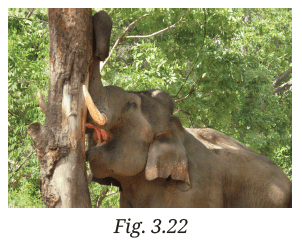
Question: 8. In a forest, it was observed that one of the trees was severely debarked by an elephant to meet its food requirements, as the bark is a rich source of nutrients (Fig. 3.22). Based on your learning, answer the following:
(i) Which function(s) of the tree is/are hampered by debarking?
Answer: The protective function is severely hampered. The bark (cork cells) protects against water loss, mechanical injury, and infection by pathogens.
(ii) Which plant tissue would be affected by further damage to the tree trunk even after debarking?
Answer: The phloem, which is located just beneath the bark, would be affected next.
(iii) Which function of the tree would be hampered if the tissues beneath the bark were severely damaged?
Answer: If the phloem is damaged, the tree will lose its ability to transport food (sugars) synthesised in the leaves down to the roots, ultimately starving the root system.
(iv) What assumptions are you making to answer the questions above? How would the answer change if your assumptions are also changed?
Answer: We assume the debarking was deep enough to expose or damage the phloem. If the elephant only scraped the very superficial, dead outer epidermal layer without reaching the cork cambium or phloem, the transport of food would not be hampered immediately.
Question: 9. Aamrapali observed that a young mango sapling’s stem bends flexibly during monsoon winds and does not break. Which tissue is responsible for this flexibility? Predict and provide your explanation of the impact if the existing tissue was replaced by sclerenchyma.
Answer: The tissue responsible is collenchyma, which provides support alongside flexibility due to pectin deposition. If replaced entirely by sclerenchyma, the stem would become extremely hard, rigid, and brittle (due to lignin). During strong monsoon winds, instead of bending flexibly, the rigid stem would likely snap and break.
Question: 10. Sohan designed an experiment for the regeneration of sugarcane… After a few weeks, type ‘B’ cuttings sprouted and developed into sugarcane plants, whereas the type ‘A’ cuttings did not sprout.
(i) Why were the type ‘B’ cuttings able to grow as sugarcane but type ‘A’ could not?
Answer: Type B cuttings contained a node, whereas Type A cuttings were just internodes.
(ii) What difference was present in type ‘B’ compared to type ‘A’?
Answer: Type B had an intercalary meristem (located at the nodes), which contains actively dividing cells necessary for new branches and leaves to sprout. Type A lacked this tissue.
(iii) What observation or measurement was made to determine whether this change had an effect?
Answer: The observation made was whether the cuttings physically sprouted new leaves/shoots or failed to do so after a few weeks.
(iv) What parameters should be kept the same for both types of cuttings to ensure a fair comparison?
Answer: The soil type, amount of water provided, amount of sunlight, temperature, and the age of the parent sugarcane plant should all be kept identical.
Question: 11. During the discussion in class, Rohan gives a statement that, “A tissue is a group of similar cells performing similar functions”. But Rajiv counter argues that, “this is true in case of simple tissues but little different in case of complex tissues”. Provide your explanation in view of the discussion in class.
Answer: Rajiv is correct. Simple permanent tissues (like parenchyma) are indeed made up of only one type of structurally similar cell. However, complex permanent tissues (like xylem and phloem) are made up of different types of cells (e.g., xylem has vessels, tracheids, fibres, and parenchyma) that work together as a unit to perform a common function (like conducting water).
Question: 12. Coconut husk fibres are used for mats which are tough and fibrous. Which tissue has structural features suitable for providing this strength? Explain why living parenchyma couldn’t serve the same purpose.
Answer: Sclerenchyma tissue provides this strength because it consists of dead cells with highly thickened, lignified walls. Living parenchyma consists of thin-walled, loosely packed cells designed for food storage; they are soft and would easily tear or crush under the pressure applied to a mat.
Question: 13. Vibha claims to her friend Neha that, “Meristematic cells are located only at the root and shoot apices”. What do you think about this statement? What question can Neha ask Vibha to help her understand further if the statement is incorrect?
Answer: The statement is incorrect. While apical meristems are at the apices, meristematic tissue is also found laterally (lateral meristem for girth) and at the nodes (intercalary meristem). Neha could ask: “If meristems are only at the tips, how does a tree trunk grow wider over the years, and how does grass grow back after the top is cut off?”
Question: 14. A plant cell and an animal cell are of the same size.
(i) Which cell will have a larger vacuole? Give reasons.
Answer: The plant cell will have a much larger central vacuole. Plant cells use this large vacuole to store water and maintain internal pressure (turgidity) to keep the cell firm, whereas animal cells only have small, temporary vacuoles for basic storage.
(ii) What assumptions are you making to answer the question above?
Answer: We are assuming that we are comparing a mature plant cell (where the vacuole has fully expanded) to a standard animal cell.
Question: 15. A textbook states, “Each plant tissue performs only one specific function”. What questions would you ask to critically examine the correctness of this statement? What examples of tissues would you take to find out the answers to these questions?
Answer: * Questions: “Are there tissues that play a role in both support and transport?” “Can a tissue store food while also providing structural flexibility?”
Examples: We can look at the Xylem, which is primarily a conducting tissue for water, but its lignified fibres and vessels also play a major role in providing mechanical strength and support to the plant. We can also look at Parenchyma, which mainly stores food, but in green parts of the plant, it also performs photosynthesis. Thus, the statement is incorrect.
Part 7: The Journey Beyond & The Quest Continues…
Question: Visit a doctor and find out what happens in ligament rupture, cartilage rupture and fracture of bones. How can we reduce the risk by changing our lifestyle and nutritional balance?
Answer: A ligament rupture causes joint instability (as bone disconnects from bone). A cartilage rupture removes the soft cushion between bones, causing painful friction. A fracture is a break in the hard calcium matrix of the bone. We can reduce these risks by consuming a diet rich in Calcium and Vitamin D (for bone matrix), adequate protein (for muscle and connective tissue repair), and by doing regular weight-bearing exercises or yoga to maintain flexibility and strength.
Question: Will it be possible to obtain a complete animal from an animal cell like plants? If yes, what would be the advantages and challenges of this development?
Answer: Currently, mature differentiated animal cells are not naturally totipotent like plant cells. However, through advanced biotechnology (like cloning or inducing stem cells), scientists can manipulate animal cells.
Advantages: It could allow for the regeneration of lost limbs, curing degenerative diseases, growing compatible organs for transplant without rejection, or saving endangered species.
Challenges: The biological process is incredibly complex and prone to errors (tumors/cancer). Additionally, there are massive ethical issues regarding the cloning of animals and humans, including the morality of creating life in a lab and defining “identity.”
Read More:Cell The Building Block of Life NCERT Exercise Class 9 Exploration