Here is the complete Carrier of Words Class 9 NCERT Solution. We Hope that you will find it useful.
Reflect and Respond
Q. I. Look at the pictures given below of persons engaged in the same profession. Discuss in pairs and share your answers with your classmates and teacher.
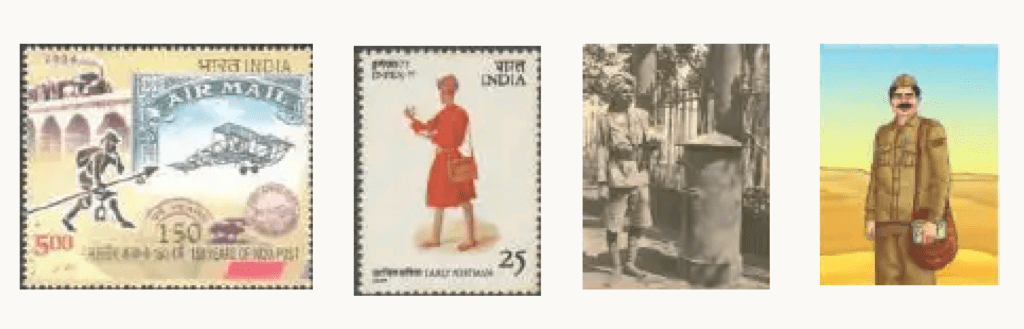
1. Which profession do they belong to?
2. Do they face any difficulties while doing their duty?
3. How does their profession affect the people they meet?
Answer:
They belong to the Postal Service profession. They are postmen or Gramin Dak Sewaks.
Yes, they face numerous difficulties such as travelling long distances on foot or bicycles, carrying heavy mailbags, and working in extreme weather conditions (scorching heat, sandstorms, or heavy rains) to reach remote areas.
Their profession deeply affects the people they meet. They act as a vital link connecting remote villagers to their faraway families, delivering money orders for their survival, and bringing both joyful and sad news. They are highly respected and trusted by the community.
Q. II. Discuss in groups.
1. How can ‘words’ be ‘carried’?
2. Who could be a carrier of words?
3. What are the means for people to stay connected?
Answer:
‘Words’ can be carried physically written on paper (letters, postcards, telegrams) or transmitted digitally through electronic signals (emails, SMS, phone calls).
A carrier of words could be a postman, a messenger, a courier delivery person, or even digital tools like internet servers and satellites.
People stay connected through letters, telephone calls, mobile phones, social media, emails, and video calls.
Q. III. Read the words given in the box below and place them in their appropriate context in the following passage.
(Words: slumped, dunes, defying, hamlets, signals, devoid)
Answer:
We stepped out of the vehicle at the end of the road. Immediately, our body sent 1. signals that our decision to visit the sand 2. dunes in the afternoon was insane. We had passed a few 3. hamlets on our way to the desert. We could not find even a single soul outdoors, 4. defying the blazing sun. Even the camels were 5. slumped in the little shade offered by the khejri trees. In this remote place people relied on Bharat Sanchar Nigam Limited (BSNL) to connect to the world as the area was 6. devoid of any other network service.
Check Your Understanding – I (Page 5)
Q. I. Khetaram needs to submit information about himself for getting an identity card. While reading the text, fill up the following information sheet for Khetaram.
Answer:
| Category | Details |
| Name | Khetaram |
| Position | Gramin Dak Sewak (Sole postman) |
| Employer | India Post (Postal Department) |
| Official address | Somarad Branch Post Office (near Barmer, Rajasthan) |
| Mode of transport used | On foot (walking) / occasionally gets a lift from the BSF |
| Key responsibilities | Delivering mail and money orders across remote desert hamlets near the Indo-Pak border, carrying loads up to 28 kilos across 20 km. |
Q. II. Discuss with your teacher.
1. Why do you think Khetaram has taken up this challenging job?
2. How do you think Khetaram would feel about taking up this challenging task every day?
Answer:
Khetaram has taken up this job for survival. In his arid village, famine is common, and the single crop of bajra he grows is not enough to feed his family of five. This job provides him with a steady and assured income.
Despite the physical exhaustion, Khetaram likely feels a deep sense of pride, gratitude, and responsibility. He knows the villagers rely on him completely, and he says he is grateful to serve the people even after the age of 60.
Check Your Understanding – II
Q. I. Complete the table given below with the situations given in Column 1 and the reasons in Column 2.
Answer:
| Column 1 (Situation) | Column 2 (Reason) |
| When the temperature is recorded as 50 degrees celsius and above, a state holiday has to be declared. | Because the heat becomes extremely severe and highly dangerous for anyone to work or travel outdoors. |
| Khetaram can dwell on any threshold. | Because he is deeply trusted by the villagers. They rely on him not just to deliver mail, but to read their letters and write replies for them. |
| BSF always gave Khetaram a lift. | Because people are kind to him and appreciate the hard work he does to deliver their letters (dak) to remote camps. |
Q. II. Why was a piece of jaggery offered in the village when he brought news of a birth or weddings?
Answer: In Indian rural traditions, offering something sweet like a piece of jaggery is a customary way to celebrate and share the joy of auspicious occasions like a birth or a wedding.
Q. III. How would phone lines help Khetaram in his job?
Answer: With phone lines, Khetaram could become a Gramin Sanchar Sewak. His job would involve carrying a cell phone from home to home along with the post, allowing villagers to speak directly to their loved ones, thereby modernizing and easing the communication process.
Critical Reflection (Pages 8-10)
Q. I. 1. Read Extract 1 (“Akaal or famine is a way of life here…”)
(i) Complete the sentence given below with an appropriate reason. One crop of bajra makes a little difference for people like Khetaram because…
Answer: …it is not sufficient to feed his family of five for the entire year.
(ii) Why did Khetaram term famine as ‘a way of life’?
Answer: Because his village is located in an arid desert region where droughts happen so frequently that the people have accepted food and water scarcity as a normal, ongoing part of their existence.
(iii) Give one reason why Khetaram had to take up a job to help his family to survive.
Answer: Farming was highly unreliable due to frequent famines, so he needed the assured monthly income from the postal job to prevent his family from starving.
(iv) Complete the analogy given below with a word from the extract.
Other families : Money orders :: Khetaram : Job (or Salary)
(v) What would ‘a good year’ signify?
Answer: A ‘good year’ signifies a year with enough rainfall to successfully grow and harvest one crop of bajra.
Q. I. 2. Read Extract 2 (“There is one letter delivery he dreads…”)
(i) Choose the correct option. Who could have torn the right corner of the envelope?
A. Khetaram | B. Sender of the letter | C. Receiver of the letter | D. The postmaster
Answer: B. Sender of the letter (It is a traditional way for the sender to visually signal that the letter contains bad news).
(ii) Complete the sentence with an appropriate reason. The most likely reason for Khetaram reading the letter twice is because…
Answer: …he wants to memorize the exact message perfectly before destroying the physical letter, so he can convey the news accurately to the family.
(iii) What was Khetaram’s philosophy regarding bad news, and how did he act upon it?
Answer: His philosophy was that “Bad news must be destroyed” and an Ashubh Samachar (bad omen) should not physically enter a home. He acted upon it by reading the letter outside the house, memorizing it, and then tearing the paper to bits.
(iv) State whether the following sentence is true or false. Khetaram’s action of tearing the letter differed from his beliefs.
Answer: False. (His action perfectly matched his belief that physical carriers of bad news should be destroyed).
(v) Mention any one aspect of Khetaram’s temperament which is revealed through this extract.
Answer: This reveals his highly empathetic, sensitive, and respectful temperament toward the villagers’ emotions and traditions.
Q. II. Answer the following questions.
1. Justify the statement made by Postmaster-General stating that the role of GDS is ‘invaluable’.
Answer: The role of a GDS is invaluable because they physically walk to the most remote, interior, and inaccessible corners of the country—like frozen deserts and deep sand dunes—where no trains, buses, or mobile networks reach, ensuring every citizen stays connected.
2. How was the purpose of India Post different from that of the British postal system?
Answer: The British postal system was set up solely to relay administrative information and company mail between government centers. In contrast, independent India Post’s purpose was to bring the entire population, including remote villagers, within the mailing and communication network.
3. People trusted Gramin Dak Sewaks. Support this statement with any two instances from the text.
Answer: 1. Villagers comfortably invited Khetaram into their homes to read their private letters and draft replies for them.
2. Rural depositors entrusted their hard-earned monthly financial savings to the post office through the GDS.
4. Infer the most likely reason that Khetaram was grateful to continue as GDS, even after the age of 60.
Answer: At 60, physical labor like farming becomes difficult. Continuing as a GDS allowed him to retain a guaranteed income to feed his family in a famine-struck land where alternate livelihoods are practically non-existent.
5. Explain why the author pays tribute to people like Khetaram.
Answer: The author pays tribute to them because they are the unsung heroes of the nation. Braving terrible weather and physical hardship, they act as the crucial emotional and financial lifelines for marginalized people, keeping the social fabric of rural India intact.
Vocabulary and Structures in Context
Q. I. Study the phrases given in Column 1 and match them with their meanings in Column 2.
Answer:
- crumbles into sand -> (iii) disappears in the desert
- give a new lease of life -> (i) get a chance to continue living
- turn into a trickle before drying out -> (iv) lessen gradually and then finally stop
- bearing words across this desolate geography -> (ii) carrying letters to less populated areas
Sample Sentences using Column 1 phrases:
- After driving for miles, the paved highway slowly crumbles into sand.
- The successful heart surgery gave my grandfather a new lease of life.
- Due to the lack of rain, the mighty river began to turn into a trickle before drying out.
- The brave messenger spent days bearing words across this desolate geography to reach the king’s army.
Q. II. Identify examples of alliteration and metaphor in the extract given below.
Answer:
Alliteration: “scorching summer”, “swirling sandstorms”. (Repetition of the ‘s’ sound).
Metaphor: “desert’s furies” (comparing harsh weather to an angry entity), “walking sandman” (comparing Khetaram covered in sand to a creature made of sand).
Q. III. Match the words in Column 1 to what they suggest in Column 2.
Answer:
arid -> (iii) farmland without much yield
concessional -> (i) interest rate for the farmers
gaunt -> (v) farmer waiting for the rains
remote -> (ii) corner of the world
desolate -> (iv) desert stretching far and wide
Sample Sentences using Column 1 words:
Cacti grow easily in the arid climate of Rajasthan.
The government provided seeds to the farmers at concessional rates.
The stray dog looked incredibly gaunt after weeks without food.
He lives in a remote mountain village with no internet access.
The abandoned ghost town looked incredibly empty and desolate.
Q. IV. Fill in the blanks by using the present perfect form of the verbs given in the brackets.
Answer:
- I have just got a collection of postage stamps from my grandfather.He 2. has collected these stamps over a period of 20 years.I 3. have studied most of the stamps in his collection and loved all of them.I 4. have begun my own collection of postage stamps.Grandfather 5. has truly inspired me.
Q. V. Complete the following paragraph about the advice given by Khetaram (Active to Passive Voice).
Answer:
To begin with, a lot of stamina will be needed for this job. Next, reading clearly A. will be expected as you B. will be asked to read out the letters by some of C. the villagers. Words D. must be written neatly as you E. will be asked to draft replies by some villagers. Full sleeved-shirts and trousers F. must be worn to protect yourself from the heat.
Listen and Respond (Pages 13-14)
(Note: Based on typical context for Daakroom/Postal events, here are the most logical answers)
Q. I. Fill in the blank with the suitable word from the brackets.
Answer: The speaker concluded her talk with a request (suggestion/request/advice). (Generally, speakers request the audience to start writing letters again).
Q. II. Choose the correct option.
What was the occasion that the speaker was talking about? -> (i) Letter writing carnival
India Post is famous for having the most extensive network -> (ii) in the world
Letter writing is being revived as this art form has been -> (iii) forgotten
Which of the following will be a part of the letter writing carnival? -> (iii) letter posting and philately (Origami and calligraphy are sometimes included, but philately is directly related to the postal theme).
What will the postal department add to the event? -> (i) interactive demonstrations
Speaking Activity (Pages 14-15)
Q. I. The postcard, inland letter, envelope, and money order form were engaged in a discussion on who the most important one was. In groups of four, select one each and reason with each other logically.
Answer: (Sample Group Discussion)
Postcard: “It seems to me that I am the most important because I am the most cost-effective. Anyone can afford me to send a quick, short message.”
Inland Letter: “That’s one way to look at it, but I would like to point out that I provide much more space to write a longer message, and I offer more privacy than a postcard since I am folded and sealed.”
Envelope: “I totally agree that privacy is key. However, some people say that having the possibility of enclosures is the most important. With me, people can send photographs, documents, or multiple pages safely!”
Money Order Form: “You all carry words, but I carry survival! I would like to point out that without my utility in transferring money, families in remote areas like Khetaram’s village would starve.”
Writing Task (Pages 15-16)
Q. I. Now, on behalf of your parents draft an imaginary condolence message for your aunt on the recent passing away of her father.
Answer:
20th May 2026
Dear Aunt Radha,
We were deeply saddened to hear the heartbreaking news of the passing of your beloved father. Please accept our most heartfelt condolences during this incredibly difficult time.
We know how close you were to him, and what a kind and guiding light he was for the entire family. We extend our deepest sympathies to you and everyone at home in this hour of grief.
May God grant eternal peace to his departed soul and give you the strength and courage to bear this irreparable loss. Please know that we are always here for you.
Yours affectionately,
Ravi and Sunita
Learning Beyond the Text
Q. II. 1. Study the postage stamps given below and discuss who or what they depict.
Answer: (General observation for standard Indian stamps) Indian postage stamps often depict a rich variety of subjects to celebrate national heritage. They feature famous personalities (like Mahatma Gandhi or leaders of the independence movement), historical architecture and monuments, important cultural festivals, and the diverse flora and fauna (nature) found across the country.
2. Work in groups of five. Find information about stamps on the following categories…
Answer: (Here is sample data you can use for your class board project)
Personalities: Dr. A.P.J. Abdul Kalam (Field: Science and Technology/Former President of India).
Celebrations: Deepavali stamp (Significance: Celebrating the festival of lights and India’s cultural joy).
Centenaries: 150th Birth Anniversary of Mahatma Gandhi (Significance: Celebrating the Father of the Nation and his principles of non-violence).
Nature: Project Tiger stamps (Significance: Raising awareness about wildlife conservation).
Our Heritage: Taj Mahal or Bharatanatyam dance stamps (Significance: Showcasing India’s architectural marvels and ancient classical arts to the world).
Read More: Twin Melodies (NCERT SOLUTION)