Here is Nine Gold Medals Class 9 NCERT Solutions for the poem.
Reflect and Respond
I Work in pairs. Discuss the difference between Olympics, Special Olympics, and Paralympics.
Answer: * Olympics: The world’s foremost international sporting event featuring summer and winter sports competitions for athletes from around the globe.
- Special Olympics: A global movement providing year-round sports training and athletic competition in a variety of Olympic-type sports for children and adults with intellectual disabilities.
- Paralympics: A major international multi-sport event for athletes with physical disabilities, mobility disabilities, amputations, blindness, and cerebral palsy.
II Work in pairs to match the words ’empathy’, ‘sympathy’, and ‘compassion’ to the sentences given in the table below.
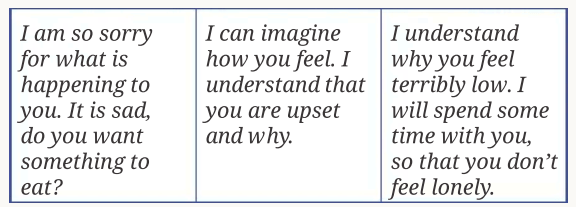
Answer:
- “I am so sorry for what is happening to you. It is sad, do you want something to eat?” — Sympathy
- “I can imagine how you feel. I understand that you are upset and why.” — Empathy
- “I understand why you feel terribly low. I will spend some time with you, so that you don’t feel lonely.” — Compassion
III Work in pairs. List the words you associate with ’empathy’. Share your responses with your classmates and teacher.
Answer: Understanding, shared feelings, connection, perspective-taking, sensitivity, and putting oneself in another’s shoes.
Check Your Understanding
I Work in pairs. Match the words and phrases in Column 1 with their meanings in Column 2. You may read the poem again and infer the contextual meaning. Check your answers with the teacher.
Answer:
- dashed in the dirt — (ii) destroyed
- stumbled — (iv) step awkwardly, lose balance and almost fall
- staggered — (i) walk or move with difficulty
- anguish — (v) extreme pain or suffering
- asphalt — (iii) a hard black substance used to make roads and paths
II Identify the gist of each stanza. Write the number of the stanza in the boxes given.
Answer:
Spectators cheered participants of different events and waited enthusiastically for the final event to start. — Stanza 2
All runners dashed ahead as soon as they heard the gun shot; suddenly, one of the athletes tripped and fell on the ground. — Stanza 4
The race finished with nine athletes holding hands and winning the well-deserved gold medals; their smiles, and spectators standing up to applaud, conveyed everything. — Stanza 8
Participants got ready at the starting line and nine determined athletes waited for the sound of the gun. — Stanza 3
Athletes from various parts of the country had gone through months of training; had big dreams of winning a medal. — Stanza 1
The eight athletes stopped to help the young fallen athlete stand up, forgetting that they were competing. — Stanza 6
Nine athletes held the banner and walked hand in hand; this gesture represented the ethos of Special Olympics. — Stanza 7
The young athlete felt his dreams were shattered and cried in pain and disappointment, but something unique happened. — Stanza 5
III Let us appreciate the poem. 1. Two examples of alliteration from the poem are (i) ______ and (ii) ______
Answer: (i) stumbled and staggered (ii) dashed in the dirt
2. Give three examples of visual imagery from the poem. (i) ______ (ii) ______ (iii) ______
Answer: (i) “The spectators gathered around the old field” (ii) “The blocks were all lined up” (iii) “They came to the finish line holding hands still”
3. Give an example of auditory imagery from the poem. (i) ______
Answer: (i) “The signal was given, the pistol exploded”
4. How does the use of imagery make the poem more appealing?
Answer: The imagery creates vivid mental pictures and sounds, allowing the reader to experience the anticipation of the race, the shock of the fall, and the visual beauty of the athletes crossing the finish line together.
5. How does the poet’s tone change from the beginning to the end of the poem?
Answer: The tone starts with competitive excitement and anticipation, shifts to sudden shock and despair when the athlete falls, and ultimately transforms into a heartwarming, triumphant, and compassionate tone at the end.
6. What is the overall mood created by the poem?
Answer: The overall mood is inspirational, deeply moving, and uplifting.
7. What is the message being conveyed by the poem?
Answer: The poem conveys the message that human compassion, empathy, and solidarity are far more valuable and rewarding than individual athletic achievement or winning a competition.
Critical Reflection
I Read the extracts given below and answer the questions that follow. 1. The eight other runners pulled up on their heels The ones who had trained for so long to compete One by one they all turned round and went back to help him And brought the young boy to his feet.
(i) Select the correct option to complete the sentence. The phrase ‘pulled up on their heels’ means that the runners
A. moved aside
B. stopped running
C. tried to run faster
D. jumped ahead
Answer: B. stopped running
(ii) Mention one character trait common to all the eight other runners.
Answer: Empathy (or selflessness/compassion).
(iii) What is the tone of the poet in these lines?
Answer: The tone is appreciative and full of admiration for the athletes’ selfless act.
(iv) How might the young athlete have felt on being helped by the others?
Answer: He would have felt immensely surprised, comforted, and grateful that his fellow competitors chose to help him rather than leave him behind.
(v) Would you consider this incident as a turning point in the poem? If yes, why? If no, why not?
Answer: Yes, this is the turning point. It shifts the entire narrative from a standard competitive physical race into a profound display of human spirit and unity.
2. That’s how the race ended, with nine gold medals
They came to the finish line holding hands still
And a standing ovation and nine beaming faces
Said more than these words ever will.
(i) How did the nine contestants feel when they reached the finishing line together?
Answer: They felt incredibly proud, joyful, and united, as indicated by their “beaming faces”.
(ii) Why do you think all the nine contestants were given gold medals?
Answer: They were all given gold medals because they displayed the highest form of sportsmanship. Their collective act of empathy made them all equal winners in the eyes of the organizers and spectators.
(iii) Complete the sentence appropriately.
The holding of hands signifies a feeling of ______
Answer: solidarity and brotherhood.
(iv) Choose the correct option to complete the sentence.
The spectators giving a ‘standing ovation’ indicates that they were
A. amazed
B. speechless
C. distracted
D. thoughtful
Answer: A. amazed
(v) Explain the last line of the extract.
Answer: The final line means that the profound visual of the nine athletes holding hands and smiling, combined with the crowd’s reaction, was so powerful that mere words are inadequate to fully describe the beauty of that moment.
II Answer the following questions.
1. Describe how the setting established in the first two stanzas of the poem create a vivid atmosphere for the events that follow.
Answer: The first two stanzas build immense anticipation by detailing the weeks of hard training the athletes endured, the gathering of the spectators, and the high excitement for the final event. This sets the stage for a highly competitive race, making the subsequent act of selflessness even more unexpected and impactful.
2. How do you think the youngest athlete might have felt when he fell?
Answer: He felt shattered, frustrated, and deeply anguished. All his dreams and months of hard work were instantly destroyed in the dirt.
3. Why were the athletes eager to begin the race?
Answer: They were eager because this was the final event of the day, and they had spent weeks and months training hard for this exact moment to win a medal.
4. What does the transformation of the hundred-yard dash to a walk symbolise?
Answer: It symbolizes the shift from individual competition to collective cooperation. Speed and winning were replaced by care and ensuring everyone finished together.
5. How might the poem be different if the focus was solely on individual achievement rather than collective support?
Answer: If the focus was solely on individual achievement, the poem would just be a standard recounting of a sports victory. The eight runners would have ignored the fallen boy, and the poem would lack its emotional depth, moral lesson, and inspirational quality.
6. How does the poet’s use of language and tone enhance the reader’s engagement with the poem?
Answer: The poet uses simple, narrative-driven language that makes the story accessible and relatable. The shifting tone—from tense anticipation to heartbreaking disappointment, and finally to joyful triumph—takes the reader on an emotional journey, keeping them deeply engaged.
7. What might be the poet’s purpose of writing this poem?
Answer: The poet’s purpose is to highlight the true spirit of the Special Olympics and to teach readers that human values like empathy, compassion, and teamwork are far greater achievements than winning a gold medal.
Vocabulary in Context
I The phrase ‘standing ovation’ is an example of an adjective-noun collocation. Identify two other similar examples from the poem. Collocation is a pair or group of words that habitually appear together.
Answer: 1. “old field” 2. “beaming faces”
II Complete the table given below by writing four nouns in Column 2 that collocate with the adjectives in Column 1. One example has been done for you. You may take the help of a dictionary.
Answer:
| Column 1 | Column 2 |
| 1. big | disappointment, failure, surprise, decision |
| 2. heavy | rain, traffic, load, fine |
| 3. strong | coffee, wind, opinion, evidence |
| 4. large | number, amount, scale, family |
| 5. great | success, detail, deal, pleasure |
III Choose the correct adjectives from those given in the box for the underlined words given in the sentences below. Ensure you do not use the same adjective twice.
[Box words: positive, significant, youngest, noisy, loud]
1. The littlest athlete was moving at a steady pace.
Answer: The youngest athlete was moving at a steady pace.
2. The eight athletes had a smiling attitude.
Answer: The eight athletes had a positive attitude.
3. When the athlete fell, he gave a huge cry of pain.
Answer: When the athlete fell, he gave a loud cry of pain.
4. The spectators saw a terrible difference in the athletes who had only come to compete.
Answer: The spectators saw a significant difference in the athletes who had only come to compete.
5. The gaudy crowd cheered the runners enthusiastically.
Answer: The noisy crowd cheered the runners enthusiastically.
Listen and Respond
I You will listen to a radio-talk about Patrick Gomes, a coach of special athletes. As you listen, write true or false for the statements given. (Transcript for teacher on page 268) (Note: As the transcript audio is unavailable, these answers are based on the standard context of the Special Olympics and Patrick Gomes).
1. Patrick Gomes began his career in sports with track events. -> True
2. Patrick Gomes has been coaching special athletes for 10 years. -> True
3. Patrick Gomes does all the household work himself. -> False
II You will listen to the radio-talk once again. As you listen, choose the correct option for each question.
1. When the speaker uses the phrase ‘push your boundaries’, he wants listeners to (i) challenge themselves (ii) meet new people (iii) be open-minded
Answer: (i) challenge themselves
2. Patrick Gomes is a ______ at present. (i) special athlete (ii) coach of special athletes (iii) value education teacher
Answer: (ii) coach of special athletes
3. Special Olympic Games held at Connecticut was a ______ for Patrick Gomes. (i) motivational year (ii) turning point (iii) gradual change
Answer: (ii) turning point
4. As a special athlete, Patrick Gomes mostly participated in (i) track events (ii) jogging (iii) football
Answer: (i) track events
5. Patrick Gomes believes that sports is essential because it encourages ______ along with fitness. (i) a positive outlook (ii) a peaceful mind (iii) an active life
Answer: (i) a positive outlook
Speaking Activity
I Work in pairs. Take turns to express your points of view regarding Special Olympics. Use the key points given below to develop the conversation. Key points: Importance of Special Olympics (promotes inclusion), Impact of Special Olympics on sportspersons with special abilities, How to create awareness regarding Special Olympics.
Sample Conversation:
Student A: What is your opinion on the importance of the Special Olympics?
Student B: Personally, I believe that it is a highly essential platform. It promotes inclusion and gives athletes with intellectual disabilities a place to showcase their incredible talents. How do you feel about its impact on the athletes themselves?
Student A: From my perspective, the impact is massive. It builds their confidence, physical fitness, and gives them a wonderful sense of belonging and community. Do you think that enough people know about it?
Student B: It’s my belief that we still need to do more. We can create awareness by sharing their stories on social media, organizing local support events, and displaying posters in our schools.
Writing Task
I Work in pairs to write three creative slogans on Special Olympics. (Example given: Special Olympics: Igniting a Universe of Potential)
Answer (Three Creative Slogans):
Special Olympics: Beyond Limits, Beyond Labels!
Special Olympics: Champions of Heart, Masters of Spirit!
Special Olympics: Unstoppable Courage, Infinite Capabilities!
Read More: I Cannot Remember My Mother Class 9 NCERT Solution