Here is complete Canvas of Soil Class 9 NCERT Solution
Reflect and Respond
I. Work in pairs. Discuss what all you see in a garden. Think of the colours you see and where you see them. Share your responses with your teacher.
Sights: In a garden, you can see various types of plants, blooming flowers, green grass, fluttering butterflies, and buzzing bees.
Colours:
Green: In the leaves of trees and the blades of grass.
Red, Pink, Yellow, and Purple: In the petals of different flowers like roses, marigolds, and dahlias.
Brown: In the soil and the trunks of trees.
Blue: Occasionally in flowers like bluebells or in the sky above the garden.
II. Look at the picture of a garden and a painting given below. Speak about any similarities between the garden and the painting.
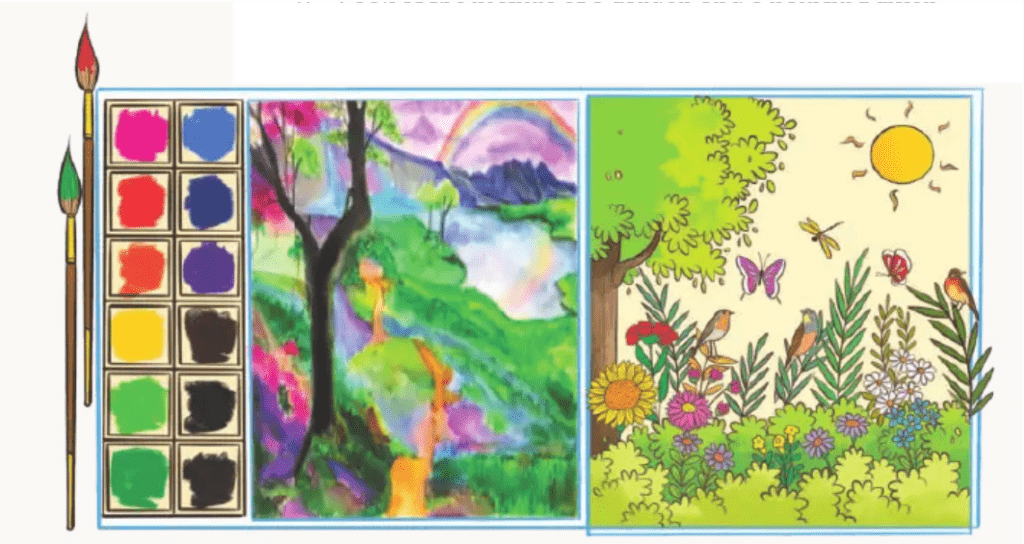
Speak using the following:
Just as a garden is filled with diverse life and vibrant growth, a painting is filled with diverse strokes and vibrant colours.
A garden and a painting, both require a foundation—soil for the garden and a canvas for the painting—to bring a vision to life.
Similarly, a gardener carefully places seeds just as a painter carefully places brushstrokes.
Beauty and creativity are common to both a garden and a painting.
Like a garden, a painting too evolves through different stages before it reaches its full, blooming potential.
III. Let us acquaint ourselves with the meanings of palette, hue, and canvas.
Palette: a thin oval or rectangular board or tablet that a painter holds and mixes colours on.
Hue: shade of a colour.
Canvas: (here) painting.
Now, look at the painting given above and identify palette, canvas, and select a hue.
Palette: The rectangular board on the left side of the image holding various circles of paint.
Canvas: The rectangular surface on the right where the landscape (mountains, trees, and rainbow) is being painted.
Hue: One might select the “vibrant violet” seen in the rainbow or the “deep indigo” on the palette.
Check Your Understanding
I. Read the poem again and complete the summary of each stanza by filling in the blanks.
The earth is portrayed as a rich palette where gardeners’ dreams flourish in the form of brushstrokes of seeds, awaiting spring’s vibrant hue.
The garden flowers bloom, a painted sight, displaying different shades/blossoms, resembling artwork by Mother Nature, in the light of morning.
Each garden plot is likened to a wide canvas, integrating art and life. Through the efforts of gardeners, gardens transform into still-life paintings.
II. Select the appropriate title for each stanza from those given below. There are two extra titles.
- Nature’s Work of Art
- Sweet-smelling Blossoms
- Gardens as Living Canvases
- Earth and Possibilities
- The Painter’s Canvas
- Stanza 1: 4. Earth and Possibilities
- Stanza 2: 1. Nature’s Work of Art
- Stanza 3: 3. Gardens as Living Canvases
III. Match the poetic devices in Column 1 to the examples in Column 2.
| Column 1 (Poetic Device) | Column 2 (Example) |
| 1. Imagery | (iv) colours, brushstrokes, blossoms, shades of green |
| 2. Metaphor | (vi) garden as a painting, plot as canvas, seeds as brushstrokes |
| 3. Rhyme Scheme | (ii) AABB |
| 4. Tone | (i) appreciative |
| 5. Mood | (vii) joyful |
| 6. Speaker | (v) a gardener |
| 7. Alliteration | (iii) ‘Blossoms bloom’ |
Canvas of Soil Class 9 NCERT Solution
Critical Reflection
I. Read the given extracts from the poem and answer the questions that follow.
1. Brushstrokes of seeds, planted true,
Awaiting spring’s vibrant hue.
(i) The poet has used a metaphor in ‘Brushstrokes of seeds’. Which option from those given below uses a metaphor?
Answer: B. She has a heart of gold.
(ii) Complete the sentence appropriately. The phrase ‘planted true’ is significant because it implies the precision, care, and honesty with which the gardener sows the seeds to ensure they grow properly.
(iii) Why has the poet used the word ‘hue’ instead of ‘colours’ in the extract?
Answer: The poet uses ‘hue’ to maintain the artistic metaphor of the garden as a painting, as ‘hue’ is a technical term used in art.
(iv) Complete the following analogy correctly with a word from the extract.
Summer: hot :: Spring: vibrant
(v) Read the Assertion (A) and the Reason (R) and select the option that is correctly suited.
(A): Gardeners wait for Spring.
(R): Gardens are worth painting in Spring.
Answer: B. Both (A) and (R) are true but (R) is not the correct explanation of (A). (Gardeners wait for Spring because it is the season of growth and blooming, which then makes the garden look like a painting).
2. Each plot, a canvas wide,
Where art and life coincide.
(i) What does ‘Each plot’ refer to in this extract?
Answer: It refers to the individual patches of earth or sections of land within a garden.
(ii) Select which option imitates the rhyme scheme of the extract.
Answer: A. beautiful and clear / laughter and cheer
(iii) Select the line from the extract that conveys that gardening blends aesthetic beauty with natural growth.
Answer: “Where art and life coincide.”
(iv) Complete the following sentence appropriately. The plot is likened to a canvas suggesting that the gardener has the freedom to create a masterpiece of nature on the bare soil, much like an artist on a blank canvas.
(v) Why has the poet most likely used the word ‘wide’ instead of ‘long’ in ‘canvas wide’?
Answer: ‘Wide’ suggests a vast expanse of possibilities and an open space for creative expression, whereas ‘long’ feels more restrictive.
II. Give reasons for the comparisons made by the poet in the poem.
A painter is compared to a gardener because both use their vision and tools to create something beautiful and harmonious out of raw materials.
A palette is like earth as it holds all the essential elements (colours/nutrients) required to bring the final art piece to life.
The brushstrokes are like seeds because each seed placed in the soil is a deliberate action that determines the final “picture” of the garden.
A canvas is similar to a garden plot as both provide the foundational space where the creative process occurs.
III. Answer the following questions.
How does the metaphor ‘Brushstrokes of seeds’, enhance the understanding of gardening as an art form?
Answer: It elevates the physical act of planting to a creative act of painting, suggesting that every plant is a chosen stroke of colour and texture.
What can you infer about the poet’s perspective on the relationship between nature and creativity from the following lines? ‘Each plot, a canvas wide,/Where art and life coincide.’
Answer: The poet believes that nature is the ultimate form of art and that human creativity works in harmony with natural life to create beauty.
Do you think the imagery in the poem successfully paints a vivid picture in the reader’s mind? If yes, why? If no, why not?
Answer: Yes, the imagery of “vibrant hues,” “blossoms blooming,” and “morning light” creates a colorful, sensory experience that allows the reader to visualize the garden as a living painting.
Support the view that the poet’s mention of the colour yellow, besides red, blue and green, would have lent effectively to the imagery.
Answer: Yellow would represent sunlight, marigolds, or sunflowers, adding a sense of brightness, warmth, and cheerfulness to the “artwork” of the garden.
Considering the line ‘Gardens become paintings still’, what can you interpret about the poet’s view on the timelessness of nature’s beauty?
Answer: It suggests that a well-tended garden captures a moment of perfect beauty that, like a “still life” painting, remains timeless in the viewer’s memory.
Justify the title of the poem, ‘Canvas of Soil’.
Answer: The title perfectly summarizes the central metaphor: that the soil is the surface (canvas) upon which nature and the gardener together create a masterpiece of life.
Vocabulary in Context
I. Now, Discuss in pairs, any two things that you can associate with these colours.
Rusty red: Dried leaves in autumn, old iron gates.
Apple green: Granny Smith apples, fresh grass.
Navy blue: School uniforms, the deep ocean.
Crimson: Hibiscus flowers, a deep red sunset.
II. Read the following paragraph and discuss in pairs what the underlined painting-related words might mean.
Easels: Stands used to hold a canvas upright while painting.
Tonal range: The variety of light and dark shades used in an artwork.
Portrait: A painting or drawing specifically of a person’s face or head and shoulders.
Underpainting: An initial layer of paint applied to a canvas to establish the basic shapes and tones.
Mural: A large-scale painting created directly on a wall or ceiling.
Speaking Activity
I. Think and note some advantages of both these types [Flower and Vegetable], as gardens for homes.
Flower Garden: Provides aesthetic beauty, pleasant fragrances, and attracts pollinators like butterflies.
Vegetable Garden: Provides fresh, organic, and nutritious food, saves money on groceries, and gives a sense of self-sufficiency.
Writing Task
I. Write a descriptive piece of two to three paragraphs describing the details and colours in the garden you have visited.
The Secret Sanctuary
Entering the community garden felt like stepping into a vibrant painting. The emerald green of the manicured lawn contrasted sharply with the crimson petals of the roses that climbed the wooden fences. Every flower seemed like a deliberate brushstroke. The sky blue forget-me-nots huddled together at the base of a large oak tree, whose olive green leaves shimmered as they caught the mid-afternoon sun.
The texture of the garden was just as varied as its hues. The velvety softness of the lily petals was a stark contrast to the rough, burnt sienna bark of the old trees. As the light shifted toward the golden hour, the marigold yellow flowers seemed to glow, highlighting the intricate “canvas” Mother Nature had laid out in this quiet corner of the city. It was a place where art and life truly coincided.
Read More: Winds of Change Class 9 English NCERT Solution l Kaveri