
Welcome, students! This comprehensive guide provides detailed, text-backed solutions for all the In-Text Activities (Let’s Explore, Think About It) and the End-of-Chapter Exercises for NCERT Solutions Class 9 Social Science Chapter 8 Building Blocks in Economics: The Problem of Choice NCERT textbook. These answers are designed to help you understand core economic concepts like scarcity, opportunity cost, and resource allocation to score maximum marks in your examinations.
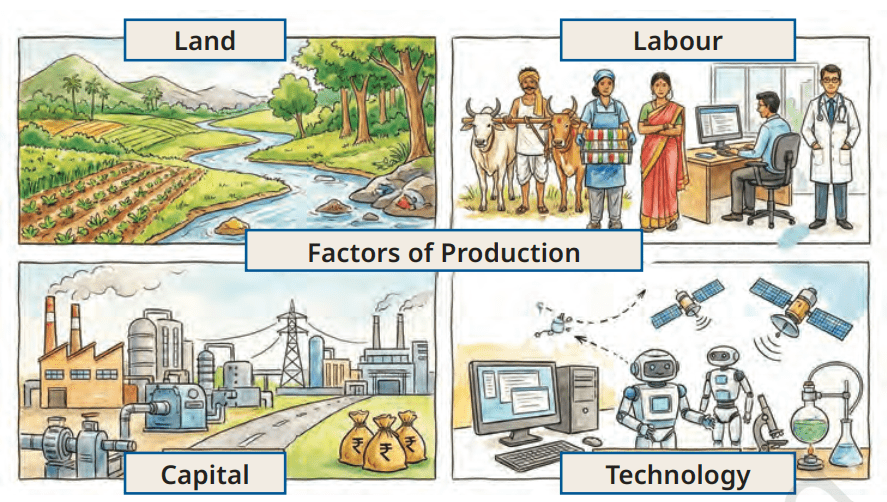
Part 1: In-Text Activities & Questions
LET’S EXPLORE (Page 2)
1. List three things your parents bought this month. Can you classify them into needs or wants?
Answer:
(Sample Response based on student observation)
1. Groceries/Food: Need (Essential for survival).
2. A new smartphone/video game: Want (Desire that improves quality of life but is not strictly necessary).
3. Medicines: Need (Essential for health and survival).
2. Do you think having too many wants may create problems? Why or why not?
Answer:
Yes, having too many wants creates problems because resources (like money, materials, and time) are limited. Trying to fulfill unlimited wants with limited resources leads to scarcity, financial stress for families, and the over-extraction of natural resources, which ultimately results in environmental degradation.
LET’S EXPLORE (Page 4)
1. Ask your parents about how they make choices for everyday purchase. What is the opportunity cost of making a particular decision?
Answer:
Parents make choices based on their limited income by prioritizing essential needs (food, rent, education) over luxuries. The opportunity cost of making a particular decision is the value of the next best alternative that is given up. For example, if they choose to spend money on a family vacation, the opportunity cost is the new furniture they could have bought with that same money.
2. How do you decide to spend your time? Is time a scarce resource?
Answer:
I decide to spend my time by balancing important activities like studying, playing, and resting. Yes, time is a scarce resource because everyone has exactly 24 hours in a day. Choosing to spend time on one activity (like watching TV) means giving up the opportunity to do something else (like studying), which is the opportunity cost of time.
THINK ABOUT IT (Page 8)
1. Should the government allocate more funds to healthcare and education or to defence and space exploration? Why or why not?
Answer:
A balanced allocation is necessary because all these sectors are important, but for a developing economy, healthcare and education should generally be prioritized. Education and healthcare build human capital, ensure a healthy and skilled workforce, drive economic growth, and reduce poverty. While defence ensures national security and space exploration drives technological innovation, they must be balanced against the fundamental well-being and basic needs of citizens.
LET’S EXPLORE (Page 9)
1. In your opinion, should the government completely stay out of enterprise decisions?
Answer:
No, the government should not completely stay out of enterprise decisions. While private enterprises should have the freedom to innovate and operate efficiently, government intervention is necessary to prevent monopolies, protect workers’ rights, enforce environmental regulations, and provide public goods that the private sector may ignore.
2. Can you think of an example where government action helped or harmed an industry or sector?
Answer:
Helped: The government providing subsidies and tax benefits to the renewable energy sector (like solar panels) has helped it grow rapidly, promoting sustainable development.
Harmed: Over-regulation, high tariffs, and excessive taxation in certain manufacturing sectors can sometimes slow down production, stifle innovation, and harm the industry’s growth.
Part 2: End-of-Chapter Questions and Activities
1. Why do you think people’s wants keep changing over time? How does this affect production in an economy? Why cannot all our wants be satisfied?
Answer:
People’s wants change over time due to changes in age, income, technology, fashion, and social trends. This constant change affects production because producers must continuously adapt, innovate, and decide “what to produce” based on shifting consumer demand. All our wants cannot be satisfied because human wants are unlimited, while the resources (land, labour, capital) required to fulfill them are limited (a condition known as scarcity).
2. ‘Human wants are unlimited and keep changing’. How do you think this constant desire for more creates pressure on the environment? Can the fulfilment of wants and the extraction of resources be balanced?
Answer:
The constant desire for more creates immense pressure on the environment because satisfying these unlimited wants requires extracting more natural resources, leading to deforestation, pollution, and resource depletion. Yes, it can be balanced through sustainable development—using resources efficiently, adopting green technologies, recycling, and prioritizing essential needs over excessive material wants.
3. Can you think of a resource in your region that is scarce but used wastefully? How could it be managed better?
Answer:
Water is a scarce resource in many regions but is often used wastefully (e.g., leaving taps running, inefficient agricultural irrigation, or washing cars with a hose). It could be managed better by implementing rainwater harvesting, using drip irrigation in agriculture, fixing leaks, and raising community awareness about water conservation.
4. Which economic system—market, planned, or mixed—do you think gives people the most freedom? Which economic system is best suited for promoting innovation? Why?
Answer:
The market economy gives people the most freedom as individuals and private enterprises have the liberty to decide what to produce, how to produce, and for whom to produce without government interference. The market economy is also best suited for promoting innovation because the drive to maximize profit and compete with other businesses encourages producers to develop new technologies and improve efficiency.
5. Critically examine why pure economic systems rarely exist in reality. Assess the limitations of such systems and justify why a mixed economy is often considered a more practical and effective approach in real-world contexts.
Answer:
Pure economic systems rarely exist because they have extreme limitations. A pure market economy can lead to high wealth inequality, the formation of monopolies, and the neglect of public goods (like healthcare and roads). A pure planned economy often suffers from inefficiency, lack of innovation, and restricted individual freedom. A mixed economy is the most practical approach because it combines the best of both: it allows the private sector to innovate and generate wealth, while the government steps in to provide public goods, ensure social welfare, and regulate markets to prevent exploitation.
6. A student has ₹100 and must choose between buying a notebook or saving the money for buying a tennis racket later. Which economic concept best explains this situation?
a. Demand
b. Opportunity cost
c. Production
d. Inflation
Answer:
b. Opportunity cost
7. How does understanding opportunity cost improve the quality of economic decision-making?
Answer:
Understanding opportunity cost helps individuals, businesses, and governments realize that every choice has a hidden cost—the value of the next best alternative given up. By evaluating what is being sacrificed, decision-makers can weigh alternatives more carefully and allocate their limited resources to the option that provides the highest benefit or satisfaction.
8. Can effective economic decisions be made without reliable data? Support your answer with an example.
Answer:
No, effective economic decisions cannot be made without reliable data; they would just be guesswork. For example, if a government decides to build new schools without data on population demographics, it might build them in areas with an aging population and no children, thereby wasting valuable resources. Data helps identify actual needs, risks, and economic trends.
9. Analyse how a country’s present economic choices can shape its long-term future. Why is it important to consider future consequences while making economic decisions today?
Answer:
A country’s present economic choices determine its future development path. For instance, if a country chooses to invest heavily in education and infrastructure today, it builds human capital and economic capacity for the future. If it chooses to consume all its resources without saving or investing, it will face stagnation. Considering future consequences is crucial to ensure sustainable growth and to avoid exhausting resources that future generations will need.
10. Identify a news article from any newspaper of your choice about a product or commodity (such as vegetables, fruits, fuel, or electronics) where producers or companies are deciding how much to produce or supply. Write 2–3 sentences explaining the example you found and why the production decision was made.
Answer:
(Sample Response)
Recently, a news article reported that automobile manufacturers are cutting down the production of diesel cars and increasing the production of Electric Vehicles (EVs). This production decision (“what to produce”) was made due to changing consumer preferences, rising fuel costs, and strict government regulations aimed at reducing carbon emissions.
NCERT Solutions Class 9 Social Science Related Chapters
- NCERT Solutions Class 9 Social Science Chapter 1: Understanding Social Science
- NCERT Solutions Class 9 Social Science Chapter 2: Shaping of the Earth’s Surface
- NCERT Solutions Class 9 Social Science Chapter 3: Atmosphere and Climate
- NCERT Solutions Class 9 Social Science Chapter 4: Early Humans and Beginning of Civilisation
- NCERT Solutions Class 9 Social Science Chapter 5: State and Society up to 1000 CE
- NCERT Solutions Class 9 Social Science Chapter 6: Democracy
- NCERT Solutions Class 9 Social Science Chapter 7: Elections