
Here are the complete, NCERT Solutions Class 9 Social Science Chapter 1 Understanding Social Science chapter-wise questions and answers. Since the newly launched NCERT textbook does not contain any back-of-the-chapter exercises, these questions and answers have been carefully curated from the official textbook content to help students prepare for their exams and understand the fundamental concepts of social science.
Section A: Multiple Choice Questions (MCQs) [1 Mark Each]
Q1: According to Chapter 1 of the Grade 9 textbook, what is the systematic study of human society called?
(a) Natural Science
(b) Social Science
(c) Earth Science
(d) Physical Science
Answer: (b) Social Science
Explanation: The text explicitly defines Social Science as the systematic study of human society, focusing on cultures, institutions, and human interactions.
Q2: Which Indian knowledge tradition explains the natural world as an interconnected system composed of five fundamental elements?
(a) Pañchamahābhūtas
(b) Vasudhaiva Kuṭumbakam
(c) Arthaśhāstra
(d) Itihāsa-Purāṇa
Answer: (a) Pañchamahābhūtas
Explanation: The concept of the Pañchamahābhūtas describes the natural world as composed of five elements—earth (Pṛithvī), water (Āpaḥ), fire (Agni), air (Vāyu), and space (Ākāśha)—forming an interconnected system.
Q3: What is the literal meaning of the Sanskrit phrase ‘Vasudhaiva Kuṭumbakam’?
(a) Society does not function by chance
(b) The world is one family
(c) Rulers must serve their people
(d) Knowledge is acquired through observation
Answer: (b) The world is one family
Explanation: The textbook notes that “vasudhaiva kuṭumbakam, meaning ‘the world is one family’, expresses the interconnectedness of human societies.”
Q4: Approximately how many years ago was the Arthaśhāstra, attributed to Kauṭilya, composed?
(a) 1,500 years ago
(b) 2,300 years ago
(c) 3,000 years ago
(d) 5,000 years ago
Answer: (b) 2,300 years ago
Explanation: The Arthaśhāstra, which examined administration and economic management in ancient India, was composed about 2,300 years ago.
Q5: Which digital portal, developed by NCERT, allows students to explore spatial data and map their own village or city?
(a) E-Pathshala
(b) School Bhuvan
(c) Digital India
(d) SWAYAM
Answer: (b) School Bhuvan
Explanation: The textbook highlights that students can access NCERT’s School Bhuvan portal to map their own village or city using geospatial data.
Q6: The Tirukkuṟal, which is preserved on a traditional palm-leaf manuscript (as shown in Fig 1.3), is an ancient text of ethical wisdom from which language tradition?
(a) Sanskrit
(b) Tamil
(c) Kannada
(d) Telugu
Answer: (b) Tamil
Explanation: Figure 1.3 shows a traditional palm-leaf manuscript of the Tirukkuṟal, which is described as an ancient Tamil text of ethical wisdom.
Q7: What is a historical source comprising coins, currency, or medals called?
(a) Epigraphic source
(b) Literary source
(c) Numismatic source
(d) Genealogical source
Answer: (c) Numismatic source
Explanation: The textbook defines a numismatic source as a historical source comprising coins, currency, or medals used to study the economy, chronology, and rulers.
Q8: The Kannada inscription at the underground Shiva temple in Hampi (Fig 1.7) belongs to which historical ruler?
(a) Samudragupta
(b) Jahangir
(c) Emperor Krishnadeva Raya
(d) Ashoka
Answer: (c) Emperor Krishnadeva Raya
Explanation: The inscription in Fig 1.7 is a Kannada inscription of Emperor Krishnadeva Raya at Hampi.
Q9: Information collected by actual observation or experimentation is known as:
(a) Traditional evidence
(b) Epigraphic evidence
(c) Empirical evidence
(d) Numismatic evidence
Answer: (c) Empirical evidence
Explanation: The glossary sidebar on Page 6 defines empirical evidence as “Information collected by actual observation or experimentation.”
Q10: The Sāmaveda manuscript shown in Figure 1.2 is preserved in which institution?
(a) Indian Museum, Kolkata
(b) National Museum, New Delhi
(c) British Museum, London
(d) Asiatic Society, Mumbai
Answer: (b) National Museum, New Delhi
Explanation: As per the caption of Fig 1.2, the Sāmaveda manuscript is housed in the National Museum, New Delhi.
Q11: Which system in India’s villages embodies grassroots democracy by giving citizens a voice in local development planning?
(a) Legislative Assembly
(b) Panchayati Raj
(c) Rajya Sabha
(d) Municipal Corporation
Answer: (b) Panchayati Raj
Explanation: The textbook states that the Panchayati Raj system in India’s villages embodies grassroots democracy and promotes local self-governance.
Q12: The study of the location and distribution of places, physical features, and human-environment relationships is called:
(a) Sociology
(b) Political Science
(c) Economics
(d) Geography
Answer: (d) Geography
Explanation: Geography is defined as the study of the location and distribution of places and the relationships between societies and surroundings.
Q13: A coin issued by King Samudragupta (shown in Fig 1.8) belongs to which century CE?
(a) 2nd century CE
(b) 4th century CE
(c) 6th century CE
(d) 12th century CE
Answer: (b) 4th century CE
Explanation: The caption of Fig 1.8 indicates that the coin issued by King Samudragupta is from the 4th century CE.
Q14: Which Mughal emperor issued a coin showing the zodiac sign ‘Sagittarius’?
(a) Akbar
(b) Jahangir
(c) Shah Jahan
(d) Aurangzeb
Answer: (b) Jahangir
Explanation: As shown in Fig 1.9, the Mughal coin showing the zodiac sign ‘Sagittarius’ was issued during the reign of Jahangir.
Q15: According to the text, which of the following is NOT one of the four core disciplines of Social Science in Grades 9–10?
(a) Geography
(b) Economics
(c) Sociology
(d) History
Answer: (c) Sociology
Explanation: The textbook outlines four core disciplines that provide a comprehensive understanding of society at the secondary stage: Geography, History, Political Science, and Economics. Sociology is listed as a broader family member that is developed in higher grades.
Section B: Very Short Answer Questions (VSA) [1 Mark Each]
Q16: Define ‘Social Science’ in simple words.
Answer: Social Science is the systematic study of human society, focusing on institutions, cultures, and human interactions.
Q17: What are the five great elements of the Pañchamahābhūtas?
Answer: The five great elements are earth (Pṛithvī), water (Āpaḥ), fire (Agni), air (Vāyu), and space (Ākāśha).
Q18: Mention two scientific tools or methods used in modern historiography to establish timelines.
Answer: Modern historiography uses carbon-14 dating and human genetics to establish timelines.
Q19: What is an epigraphic source?
Answer: An epigraphic source is a historical record, text, or decree inscribed on durable materials such as stone, metal plates, or rock surfaces.
Q20: What is a genealogical record?
Answer: A genealogical record is a document or source that traces family lineage and ancestry by recording relationships and events between generations.
Q21: How did colonial rule impact traditional industries in India?
Answer: Colonial rule disrupted India’s economic progress, resulting in widespread poverty, recurrent famines, and the decline of traditional industries.
Q22: What does the term ‘Rājadharma’ mean in early Indian political thought?
Answer: Rājadharma refers to the moral duty and ethical responsibilities of a ruler toward their citizens and administration.
Q23: Give one example of an archaeological source mentioned in Chapter 1.
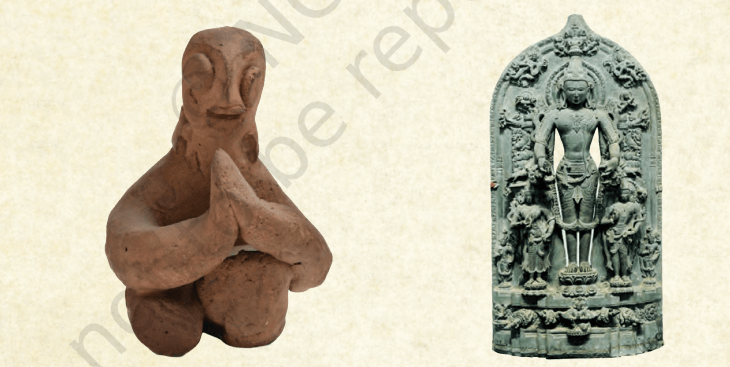
Answer: The terracotta figurine from the Sindhu-Sarasvatī Civilisation (as shown in Fig. 1.4) is an archaeological source.
Q24: What is the primary purpose of NCERT’s School Bhuvan portal?
Answer: The portal’s primary purpose is to allow students to access geospatial data and map their own villages or cities.
Q25: What was Kautilya’s main view on political power in the Arthaśhāstra?
Answer: Kautilya viewed political power as an ethical responsibility for public welfare rather than merely a privilege.
Section C: Short Answer Questions (SA) [3 Marks Each]
Q26: Distinguish between the focus of Natural Sciences and Social Science.
Answer:
1. Focus of Study: Natural Sciences (such as Physics, Chemistry, and Biology) study the physical and natural world. In contrast, Social Science focuses on society, cultures, human interactions, and institutions.
2. Objective: Natural Sciences seek to understand natural laws and phenomena through controlled experiments, whereas Social Science explains why societal events occur and how environments, governance, and economies are interconnected.
3. Methods: Natural sciences rely on laboratory testing and physical proofs, while social science relies on surveys, observation, historical documents, and empirical evidence from human activities.
Q27: How does the concept of Pañchamahābhūtas describe the natural world as an interconnected system?
Answer:
1. Five Elements: The concept of Pañchamahābhūtas, arising from Indian philosophical traditions, views the world as composed of five fundamental elements—earth, water, fire, air, and space.
2. Human Embedding: It explains that human life is deeply embedded within this natural system rather than being separate from it.
3. Societal Influence: This interconnected view helps explain how environmental factors shape human settlement patterns, occupations, architecture, food habits, and health practices, which remains relevant for addressing modern environmental challenges.
Q28: Explain how Geography adopts a holistic approach by integrating spatial and temporal perspectives.
Answer:
1. Spatial Perspective: Geography studies the location and distribution of physical features, environments, and human communities, looking at where things are and why they are located there.
2. Temporal Perspective: It examines how these locations and human-environment relationships change over time.
3. Integration: By combining these two perspectives, Geography views the world as a system of interdependencies. It draws on both the natural sciences (physics, biology) and social sciences (history, economics) to explain complex global interactions, such as how India’s long coastline facilitated sea contact with other continents.
Q29: What is the itihāsa-purāṇa tradition of Bharat, and how does it differ from modern historiography?
Answer:
1. Itihāsa-Purāṇa Tradition: This is one of the oldest methods of preserving cultural memory in India. It utilizes stories to transmit historical information and give cultural meaning to events, reinforcing enduring ideals, values, and identity.
2. Modern Historiography: In contrast, modern history writing relies strictly on empirical evidence, analyzing documents, travelogues, and revenue records to verify events.
3. Scientific Methods: While the itihāsa-purāṇa tradition focuses on moral and philosophical insights, modern history uses scientific instruments and laboratory testing, such as carbon-14 dating and archaeology, to establish timelines.
Q30: How do numismatic sources help historians reconstruct the past?
Answer:
1. Chronology and Kings: Inscriptions and symbols on coins help historians identify rulers, their reigns, and establish accurate historical timelines.
2. Economic History: The metal content (gold, silver, copper) of coins reveals the economic condition, prosperity, and technological capabilities of a civilization.
3. Trade and Boundaries: The location where coins are found helps trace ancient trade routes, commercial activities, and political boundaries (e.g., King Samudragupta’s coin in Fig 1.8 and Jahangir’s zodiac coin in Fig 1.9).
Q31: Explain the importance of India’s coastline in facilitating historical trade and interactions, as mentioned in the geography section.
Answer:
1. Strategic Geography: India is historically a hub of global interaction due to its strategic position in the Indian Ocean.
2. Sea Connections: The long coastline of the Indian peninsula facilitated easy contact and navigation across the sea.
3. Global Outreach: This allowed Indian merchants and scholars to establish contacts and exchange goods, ideas, and culture with Africa, Europe, and Southeast Asia from ancient times.
Q32: Outline the challenges faced by India’s economy after gaining independence from colonial rule, and highlight its key achievements in recent decades.
Answer:
1. Colonial Disruption: Colonial rule disrupted India’s economic history, leaving the nation at independence with widespread poverty, recurrent famines, and the decline of traditional industries.
2. Achievements: In recent decades, India has made significant progress by improving infrastructure, expanding education, adopting new technologies, reducing poverty, and rising life expectancy.
3. Ongoing Goal: The central goal remains achieving sustainable economic development while ensuring that the benefits of growth reach all sections of society to reduce inequality.
Q33: How does Political Science connect formal institutions of governance with social relationships and customs?
Answer:
1. Formal Study: Political Science studies constitutions, governments, power distribution, and the rights and responsibilities of citizens.
2. Grassroots Governance: Power does not exist only in formal capitals; it is also present in daily social relationships and customs. For example, the Panchayati Raj system in India’s villages embodies grassroots democracy by involving local citizens in development planning.
3. Holistic Context: Thus, studying politics is about examining society itself—its hierarchies, struggles, and the constant search for effective and accountable governance.
Section D: Long Answer Questions (LA) [5 Marks Each]
Q34: Discuss why the study of Social Science is essential for becoming a responsible and active citizen in a democratic society.
Answer:
1. Understanding Societal Systems: Social Science helps us understand how daily systems (schools, transportation, markets, and laws) developed and how they affect different groups of people.
2. Appreciating Diversity and Unity: It explains why communities speak different languages and follow different traditions as outcomes of historical and geographical factors. This builds respect while fostering national unity through an underlying cultural bond.
3. Responsible Civic Participation: By teaching how governments function and how laws are made, it prepares students to actively and responsibly participate in civic life.
4. Analyzing Shared Challenges: It strengthens the ability to think critically about national and global issues like environmental protection, employment, and public health, encouraging students to ask informed questions about solutions.
5. Connecting Past, Present, and Future: By showing how past choices shaped the present, Social Science equips citizens to make wiser decisions for a better future.
Q35: Explain how the four core disciplines of Social Science (Geography, History, Political Science, and Economics) are interconnected, using the example of a drought.
Answer:
1. The Geography Aspect: Geography analyzes the physical aspects of the drought, such as climate patterns, rainfall distribution, affected areas, and the direct impact on local environments, soil, and water resources.
2. The Economics Aspect: Economics studies how the drought affects crop yields, reduces farmers’ incomes, influences market prices of food, and shifts the supply and demand of resources.
3. The Political Science Aspect: Political Science examines the government’s response, looking at relief measures, distribution policies, and how public resources are allocated to help the affected population.
4. The History Aspect: History looks at past occurrences of droughts in the region, examining how past communities coped with water scarcity, traditional water conservation practices, and how historical policies influenced migrations.
5. Conclusion: Human society is complex. No single field of study can fully explain a crisis like a drought. These four disciplines are interconnected and together provide a comprehensive, holistic understanding of societal challenges.
Q36: Trace the evolution of political and governance thought in ancient India as described in the textbook.
Answer:
1. Early Roots: Systematic thinking about governance and economic management in India began long before modern academic disciplines developed, with early reflections recorded in the Vedas, Upaniṣads, and Purāṇas.
2. Moral and Economic Link: Ancient political thought was closely linked with the ideas of dharma (moral duty), artha (economic well-being), and rājadharma (the duties of the ruler).
3. Ethical Leadership: Epics like the Mahābhārata and texts like the Śhukranīti addressed governance, law, and ethical leadership, emphasizing that power was a responsibility to serve the public rather than a privilege.
4. Kautilya’s Arthaśhāstra: Composed about 2,300 years ago, Kautilya’s Arthaśhāstra stands out as a foundational text detailing administration, tax collection, defense, and the ruler’s responsibility toward the welfare of the people.
5. Continuity in Democratic Practices: These ancient ideas continue to shape modern democratic structures. For example, the Panchayati Raj system reflects the traditional idea of local self-governance and public participation in decision-making at the village level.
Q37: Detail the various types of historical sources used in modern history writing, citing specific examples and figures from Chapter 1.
Answer:
1. Literary Sources: These include written texts, travelogues, and memoirs. Examples from the text include the Sāmaveda manuscript (Fig. 1.2) and the palm-leaf manuscript of the Tirukkuṟal (Fig. 1.3), which offer ethical wisdom and records of past thoughts.
2. Archaeological Sources: Material remains like monuments, art, and excavated artefacts. Examples include the terracotta figurine from the Sindhu-Sarasvatī Civilisation (Fig. 1.4) and the 12th-century CE sculpture of Viṣhṇu (Fig. 1.5), which are analyzed using laboratory tests and instruments.
3. Epigraphic Sources: Inscriptions on durable materials like stone or metal. Examples include the Brahmi inscription on a Gupta-period pillar (Fig. 1.6) and the Kannada inscription of Emperor Krishnadeva Raya at Hampi (Fig. 1.7), providing direct administrative and historical evidence.
4. Numismatic Sources: The study of coins and medals. Examples include a 4th-century CE coin issued by King Samudragupta (Fig. 1.8) and a Mughal coin issued by Jahangir showing the Sagittarius zodiac sign (Fig. 1.9), which help study chronology, rulers, and trade activity.
5. Integration of Evidence: Historians compile data from all these sources and analyze them using scientific methods (like carbon-14 dating and genetics) to build evidence-supported accounts of history.
Q38: Explain how Social Science helps students understand and respect diversity while fostering a sense of national unity in India.
Answer:
1. Explaining Differences: Social Science explains that variations in languages, occupations, and customs across India are outcomes of geographical, historical, cultural, and economic factors.
2. Building Respect: By understanding the reasons behind these differences, students learn to appreciate diverse cultural practices and build mutual respect and cooperation among different communities.
3. Fostering National Unity: It highlights how Indian culture binds this diversity together through an underlying unity, helping students recognize a shared heritage and a sense of belonging.
4. Promoting Dialogue: Reflecting India’s long knowledge tradition of questioning, dialogue, and observation, it encourages students to discuss issues openly and look for logical reasoning.
5. Shaping Thoughtful Citizens: It prepares students to act as informed citizens who respect community diversity while actively participating in strengthening national unity and democracy.