
Chapter 3: Questions and Activities
1. Choose the most appropriate answer: Resistance and resilience are closely connected because:
Answer: b. Resilience enables communities to endure difficulties and sustain resistance.
Explanation: While resistance represents the active opposition to external threats or authority, resilience serves as its underlying foundation. Without the capacity to absorb shocks, adapt culturally and economically, and endure hardships over extended periods, sustained political or military resistance cannot survive.
2. Why and how did groups such as the Sikhs, Marathas, and Rajputs assert their political power and identity during periods of changing political authority?
The Sikhs
Why: The increasing political interference and religious persecution by the Mughal state—marked by the executions of Guru Arjan Dev and Guru Tegh Bahadur—forced the community to protect its religious freedom and community survival.
How:
Guru Hargobind introduced the concept of Miri-Piri, balancing worldly/temporal governance (miri) with spiritual authority (piri), and established the Akal Takht.
In 1699, Guru Gobind Singh created the Khalsa, instituting a dedicated martial discipline.
Following continuous Mughal hostility, the Sikhs organized themselves into armed peasant-soldier confederacies called misals to defend and administer their territories.
The Marathas
Why: Driven by the ideal of Swarajya (self-rule and sovereignty free from external domination), the Marathas sought to establish an independent political order in western India.
How:
Led by Chhatrapati Shivaji, they utilized the rugged Sahyadri terrain and practiced guerrilla tactics against larger imperial armies.
They constructed and maintained an extensive network of fortified hill forts (such as Raigad and Sinhagad) that functioned as defensive bases and administrative centers.
They formed strategic tributary alliances, draining Mughal military and financial resources during prolonged campaigns.
The Rajputs
Why: They aimed to preserve their dynastic lineage, territorial sovereignty, and local cultural autonomy in the face of Sultanate and Mughal centralizing expansion.
How:
Rulers formed broad confederacies, such as the one led by Rana Sanga at Khanua.
Under Maharana Udai Singh and Maharana Pratap, Mewar shifted its operational base to the Aravalli hills, deploying guerrilla warfare and localized surprise attacks.
They built strategic alliances with indigenous forest-dwelling groups, notably the Bhils, whose archery and terrain mastery proved vital.
Other clans negotiated diplomatic settlements, securing imperial titles (mansabs) while retaining domestic control over their ancestral homelands.
3. Why did some Rajput rulers decide to negotiate alliances with the Mughal power?
Preservation of Internal Autonomy: Rulers such as the Kachhwahas of Amber recognized that direct armed confrontation against the vast resources of the Mughal Empire caused sustained destruction; negotiation allowed them to govern their ancestral territories without day-to-day imperial interference.
Integration into Imperial Governance: By accepting Mughal suzerainty, Rajput rulers were granted high military and administrative ranks (mansabs), giving them significant influence in imperial court politics and campaigns across the subcontinent.
Security and Economic Stability: Alliances protected their kingdoms from recurrent military invasions and plundering, ensuring stable agricultural revenue and access to wider imperial trade routes.
Mutual Strategic Benefit: The Mughals actively incentivized these understandings because they needed the recognized military prowess, loyalty, and regional administrative networks of the Rajputs to stabilize imperial boundaries.
4. Foreign Trader Scenario: Securing Cotton Textiles in a Port Town (Surat, Masulipatnam, or Puducherry)
How to Secure the Product in the Local Market
Commercial deals could not be struck directly with scattered village artisans; transactions required placing forward contracts and cash advances through established local mercantile networks.
Production was distributed among specialized rural and urban groups—peasants cultivating raw cotton, weavers, dyers, and bleachers—coordinated by merchant syndicates.
Whose Help to Seek
Local Brokers and Gumasthas: Specialized agents who possessed established links with local weaving communities and supervised weaving schedules.
Interpreters (Dubhashis): Multilingual local intermediaries who bridged linguistic and cultural gaps between European merchants and Indian traders.
Money-Changers and Bankers (Sarrafs): Financial specialists needed to convert foreign bullion, evaluate currency standards, and issue or discount bills of exchange (hundis) for secure payments without physically moving cash.
Challenges Faced
Linguistic Barriers: Inability to communicate directly in regional dialects, Persian, or commercial vernaculars without a dubhashi.
Quality and Standardization: Ensuring uniform yarn quality, cloth dimensions, dye durability, and timely delivery across independent artisan workshops.
Price Volatility and Monopolies: Competing against established Indian merchant cartels (like Gujarati, Coromandel, or Chettiar traders) who maintained substantial leverage over regional supplies and shipping routes.
Transit Taxes and Regulations: Complying with diverse regional tolls, coastal customs duties, and local administrative permits.
5. Strategic Importance and Functions of Forts and Fortresses
Strategic Functions
Defensive Nuclei for Asymmetric Warfare: Forts placed across mountainous ridges or river bends served as secure hubs from which forces launched surprise raids and safely retreated.
Self-Contained Resistance Centers: Equipped with perennial water cisterns, deep stepwells, fortified armories, and subterranean granaries, allowing garrisons to endure prolonged sieges.
Fallback Capitals: In the event of open territorial overrun, impregnable strongholds (like Gingee/Senji Fort or Raigad) functioned as emergency royal seats, preventing total political collapse.
Administrative and Fiscal Hubs: Fortresses housed provincial treasuries, judicial courts, and grain storehouses, anchoring state authority over nearby agrarian regions.
Strategic Perception by Rulers
Rulers viewed forts as the physical embodiment of state sovereignty. Maharana Kumbha prioritized a protective fort network across Mewar, and the Marathas treated forts like Raigad and Sinhagad as the essential backbone of their defense against Mughal armies.
6. Architectural Changes in Temple Construction and How They Reflect Civilizational Resilience
Architectural Changes (16th Century Onward)
Rise of ‘Haveli Temples’: Shrines were increasingly constructed in the architectural style of ordinary residential townhouses (havelis) rather than traditional monumental stone complexes.
Concealed Entrances: Temples were built within narrow urban lanes, featuring inconspicuous entryways that did not open onto main avenues.
Omission of Traditional Superstructures: Tall decorative spires (shikharas) and elaborate exterior stone carvings were avoided to keep the shrines visually indistinct from surrounding residences.
Reflection on Civilizational Resilience
These adaptations illustrate how Indian society preserved sacred rites, idols, and community worship during periods of political vulnerability.
Instead of abandoning devotional life when traditional monuments were vulnerable to destruction, communities adapted their architectural forms—camouflaging their sacred spaces to ensure spiritual continuity.
7. Two Ways a Kingdom with Limited Military Resources Uses Terrain, Fertile Land, and Local Support to Build Resilience
Exploiting Geography for Asymmetric Defense: A kingdom can leverage its detailed knowledge of natural terrain—such as dense forests, deep river gorges, or mountain passes—to negate an invader’s numerical and cavalry advantage. As demonstrated by the Ahoms using Assam’s monsoons and river channels, or the Marathas utilizing the Sahyadris, terrain mastery enables devastating ambushes and prolonged, wearing attrition without facing open-field pitched battles.
Sustaining Extended Defense Through Agrarian Wealth and Local Alliances: Fertile agricultural land ensures that internal food supply chains, water storage, and emergency grain reserves remain uninterrupted during prolonged blockades. Simultaneously, widespread support from local inhabitants (such as the Bhils supporting Mewar) provides crucial scouting networks, guerrilla fighters, and logistical supply lines, preventing invaders from consolidating control.
8. “A tradition becomes more resilient when people can carry it with them.” (Evaluation with Bhakti Examples)
Agreement
- This statement accurately captures how the Bhakti movement sustained cultural and spiritual traditions across the subcontinent.
Bhakti Examples
Internalizing Faith Beyond Stone Structures: When temple construction was restricted or existing shrines were vulnerable, the Bhakti tradition transferred sacred expression into interior devotion, congregational singing (kirtan), and community assemblies (satsangs) that required no formal building.
Use of Spoken Vernaculars: Saints rejected difficult, exclusive liturgical barriers and composed verses in everyday regional languages—such as Tulsidas writing the Ramcharitmanas in Awadhi, Sankardev authoring the Kirtana Ghosha in Assamese, Eknath composing in Marathi, and Atukuri Molla composing the Ramayana in Telugu.
Democratic Mobility: Hymns and verses could be memorized, recited, and sung while farming, weaving, traveling, or carrying out daily chores, embedding spiritual knowledge across generations regardless of social status or physical displacement.
9. Voices from the Past: Short First-Person Accounts of Resilience
Perspective 1: An Ahom Commander
“To us, resilience is not defined by matching the enemy cannon for cannon on an open plain. The Mughals arrive with massive armadas and heavy horsemen, assuming power lies in sheer numbers. But our land belongs to the monsoons and the Brahmaputra. We know every shifting sandbar, forest track, and river eddy. We draw them deep into our wet swamps, cut off their supply lines, maneuver our swift, light bachari boats past their heavy galleys, and strike under the cover of rain. Resilience means letting the river fight beside us, enduring until the invaders exhaust themselves, and keeping Assam unbowed.”
Perspective 2: A Maratha Administrator
“Resilience is built upon high mountain ridges and disciplined foresight. When the imperial forces march into our valleys, we do not despair; our granaries on Raigad and Sinhagad are sealed with grain, our stepwells hold pure water, and our scouts watch every pass from their crags. Our fighters strike like lightning through guerrilla raids (ganimi kava) and retreat into the mist before the enemy can deploy. An empire cannot buy the loyalty of our hills. Resilience means wearing down the wealth and will of an imperial army month after month until its treasury bleeds dry, while our ideal of Swarajya endures intact.”
10. Design a Fort: Plan and Siege-Resistance Explanation
Labelled Fort Layout Plan
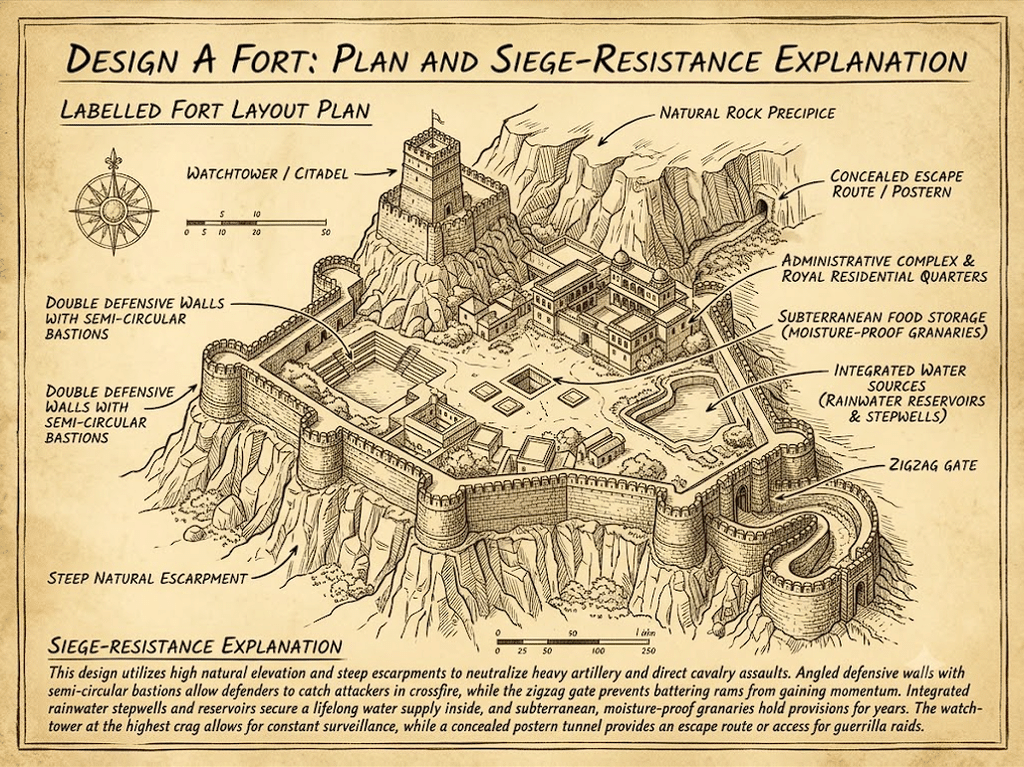
How This Design Withstands a Long Siege
- Natural Elevation and Bastioned Walls: Constructing the fortress along a sheer natural escarpment prevents the enemy from deploying heavy siege engines or launching direct cavalry charges. The angled walls and high watchtower ensure unbroken line-of-sight surveillance over approach roads.
- Secured Water Supply: Natural rainwater catchment basins and deep rock-cut cisterns ensure that the garrison retains independent, clean drinking water even if external streams are poisoned or diverted.
- Subterranean Granaries: Below-ground storage protects harvested grain from rot, pests, and incendiary flaming arrows, sustaining civilian and military inhabitants through extended encirclements.
- Concealed Escape Route: A disguised postern tunnel on the cliff face allows scouts to exit unnoticed for reconnaissance, coordinate external guerrilla relief attacks, and provide a secure evacuation path if outer ramparts are breached.
______________________________________________________________________________________________________