Teaching coordinate grids early helps kids bridge the gap between mathematics, geometry, and computer science and excel at STEM. Our free printable Free Unplugged Grid Coding Worksheets for Kindergarten provide screen-free coordination games, animal map pathways, and directional coordinates logic. If you are looking for premium **grid coding worksheets for kindergarten** or need **introduction to coordinates for kids** classroom lessons, this A4 PDF collection is the perfect fit.
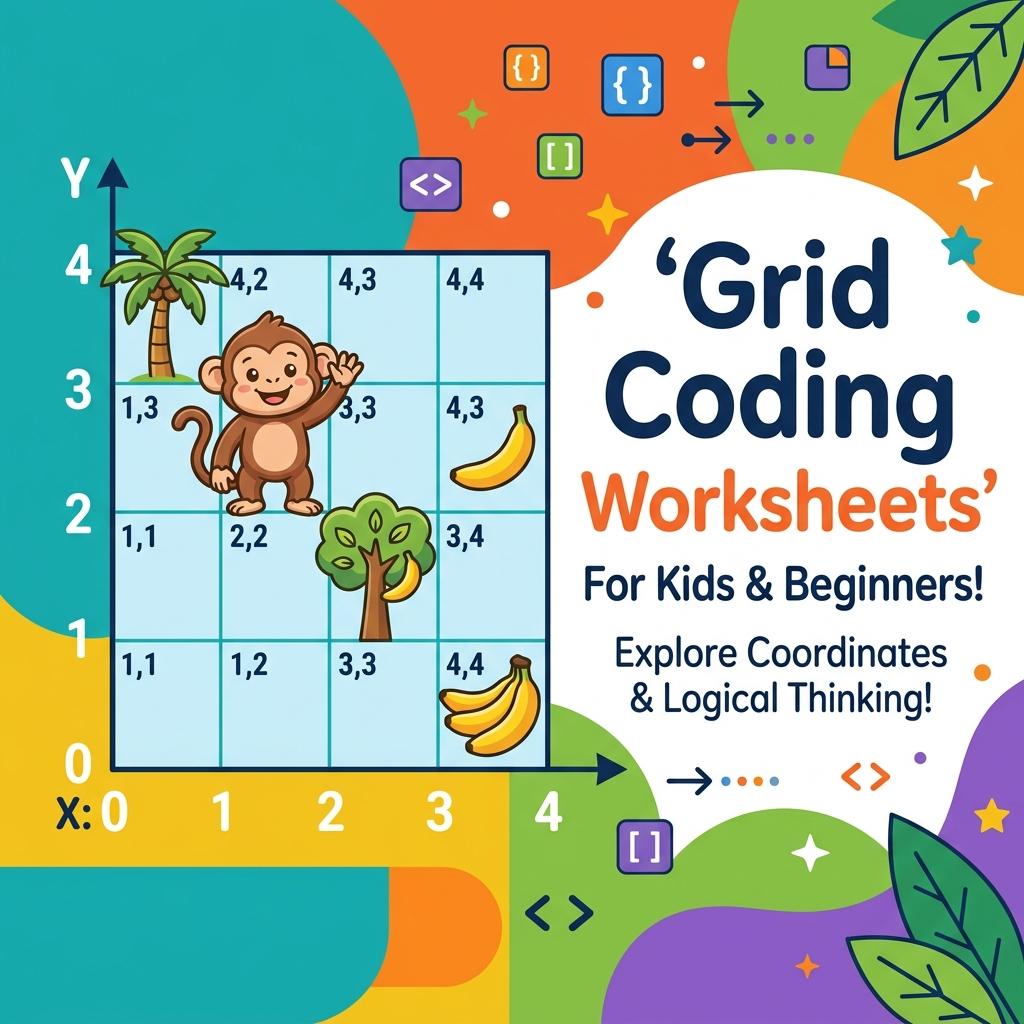
Why Map Logic and Grid Navigation Matter
In computer programming, visual positions are represented by a coordinate system (X and Y axes). In Scratch, kids move characters using grids, and in Code.org, they solve maze puzzles by counting squares. By teaching coordinate grids early, we prepare children for these environments. Our **screen free grid coding activities** use letters A, B, C for columns and numbers 1, 2, 3 for rows. This helps 5-year-olds easily locate symbols (like stars and fruits) on a map and navigate grid shifts using simple directions.
Additionally, working with **coordinate grid worksheets for elementary** students builds spatial awareness, left-to-right reading habits, and fine motor skills. It also reinforces early math concepts, including column and row headers. This makes it an ideal cross-curricular activity for both STEM blocks and early math centers in the United States.
What’s Included in This Free PDF Pack?
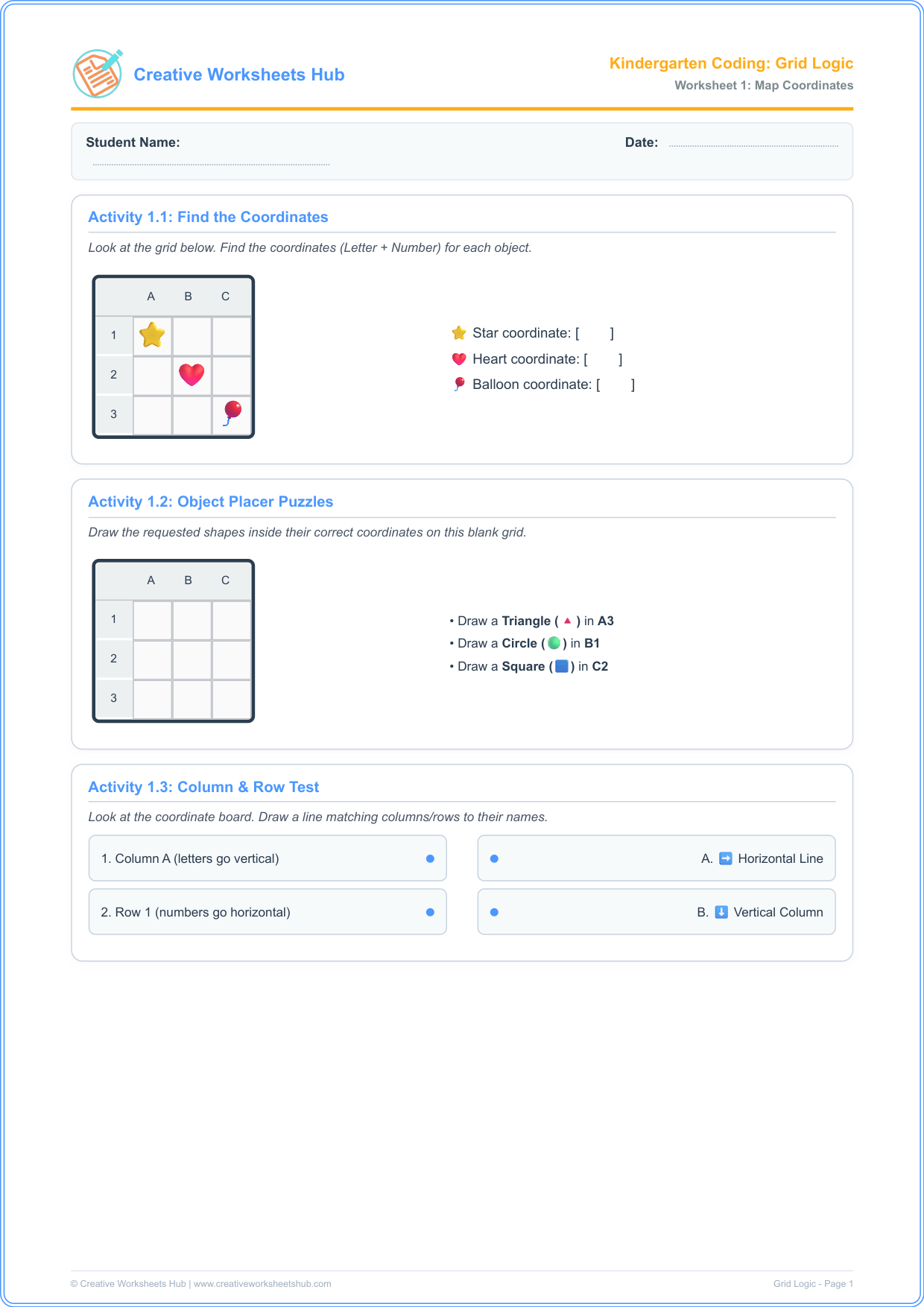
This package contains two classroom-ready **unplugged coding maps printable** pages with 3 activities each, designed to cover the page densely with engaging visual cards:
Worksheet 1: Map Coordinates & Layouts
- Activity 1.1: Find the Coordinates — Read a 3×3 grid (Rows 1-3, Columns A-C) to identify coordinates for a Star, Heart, and Balloon. This teaches students how to combine column letters and row numbers.
- Activity 1.2: Object Placer Puzzles — Draw a Triangle, Circle, and Square at designated coordinate blocks, developing shape placement skills.
- Activity 1.3: Column & Row Test — Connect columns and rows with their vertical and horizontal directional definitions, building grid vocabulary.
Worksheet 2: Animal Map Coordinates & Paths
- Activity 2.1: Monkey’s Forest Grid — Identify map coordinates for a Monkey (🐒), Bananas (🍌), and a Tree (🌳) on a 4×4 coordinate forest grid.
- Activity 2.2: Coordinate Puppy Path — Track a puppy moving along: A1 ➔ A2 ➔ B2 ➔ B3, and write down the landing destination.
- Activity 2.3: Coordinate Shift Logic — Predict where a cat ends up when starting at B2 and shifting 1 block Right and 1 block Up.
How to Teach Coordinate Grids in the Classroom
To run this **preschool grid mapping games** activity successfully with students:
- Understand the Axis: Explain that we read the letter at the bottom first, then climb up to the number. We call this “walk then climb”.
- Interactive Warm-up: Draw a 3×3 grid on the board. Put a magnet in A1. Ask a student: “Which letter is under the magnet? What number is to the left?”. Let them shout out “A1!”.
- Independent Practice: Hand out Worksheet 1. Let kids draw the triangle, circle, and square independently in Activity 1.2. Guide kids who struggle to align the rows and columns.
- Path Tracing: In Activity 2.2, have them trace the puppy’s path using a crayon to visually understand path tracking on a coordinate system.
Teacher & Parent Answer Key
Worksheet 1 Solutions:
- Activity 1.1: Star is at A1; Heart is at B2; Balloon is at C3.
- Activity 1.2: Triangle in cell A3; Circle in B1; Square in C2.
- Activity 1.3: Column A matches “Vertical Column”; Row 1 matches “Horizontal Line”.
Worksheet 2 Solutions:
- Activity 2.1: Monkey is at A1; Bananas are at C2; Tree is at D1.
- Activity 2.2: The puppy lands on cell B3.
- Activity 2.3: The cat lands on cell C1.
Frequently Asked Questions (FAQs)
Why are grids important for early coders?
Grids represent computer screen coordinate matrices, visual pixels, and array indexes. Understanding coordinates prepares children for coordinate movement blocks in Scratch and coordinate mapping in Python.
Can preschoolers do coordinate grids?
Yes! With simple labels (like letters A-C and numbers 1-3) and familiar symbols (like monkeys and bananas), young children easily grasp this spatial layout game.
What are the CSTA standards for coordinate coding?
These worksheets align with CSTA Standard 1A-AP-10: “Model daily processes by creating and following algorithms (sets of step-by-step instructions) to complete tasks.” This is standard for US Kindergarten and Pre-K classrooms.
How do columns and rows help with logical reasoning?
Working with grid coordinates requires children to process two variables at once (letters and numbers). This double-entry tracking is a foundational math and data sorting skill.
Are the worksheets print-ready for school letter size?
Yes! The worksheets are compiled in a high-resolution, standard A4 PDF format that scales perfectly to standard US Letter size for easy printing in schools.
Can I use this for a screen-free pixel art lesson?
Definitely! You can have children color specific coordinate cells to draw simple shapes, which introduces them to pixel coding and digital image creation.